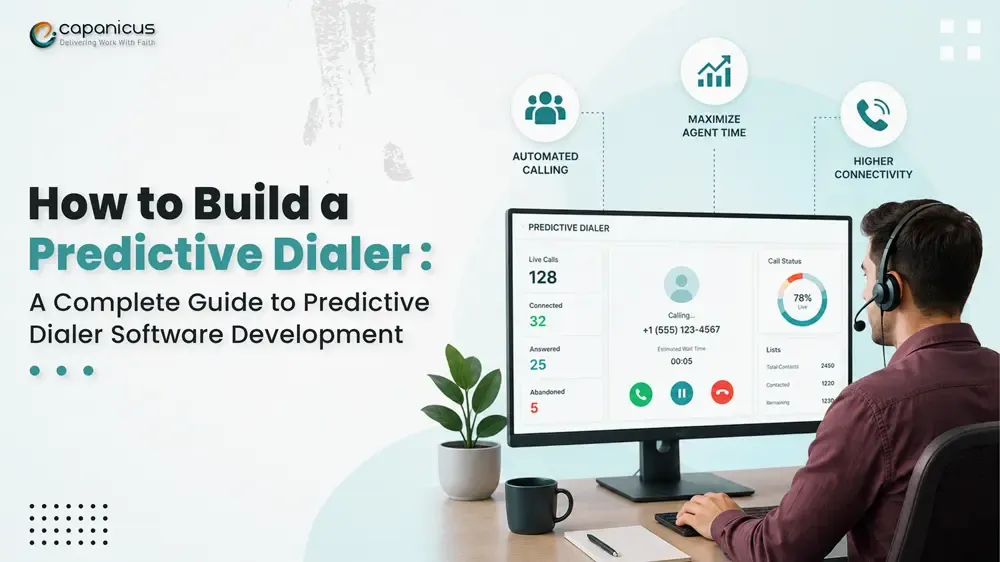
Predictive dialer software is one of the essential tools for contact centers, BPOs, and sales teams who aim to maximize the time agents spend speaking while at the same time reducing the time spent on dialing without any conversation. Using dialer software, agents no longer need to dial numbers manually. Their only job is to engage customers while intelligent predictive algorithms are responsible for pacing calls, filtering, and routing. This guide will provide insights into what a predictive dialer is, reasons why businesses choose to build their own predictive dialer solutions, the most important features, possible technology stack choices, a breakdown of compliance issues, and practical steps taken from idea to implementation. Predictive dialer development: are you thinking of having a custom predictive dialer platform? If you are thinking of building a predictive dialer yourself or you want to have a custom predictive dialer platform, this guide is for you.
What does “predictive dialer” mean?
A predictive dialer is nothing but an automation system that can dial multiple lines at a time. The system has a feature of calling multiple telephone numbers at the same time and connecting the agents to the phone call only when the person is the one who answers it and not voicemail or an automated response. It also uses mathematical techniques to estimate what proportion of agents are occupied and how many calls are likely to get answered by people. It will eliminate calls with no person answering. The result will be agents spending much of their work time on actual conversations with prospects and customers and a very small portion on waiting for calls only to disconnect or drop dead.
Auto Dialer vs. Predictive Dialer: The Key Differences
The auto dialer will call only one number for each agent. Although the technology is very simple, the call will be put through, but the call could go to voicemail, a dead call, or just a busy signal. Hence, agents will still be on the line without any customer call. A predictive dialer dials more than one number at the same time and makes a guess about which calls will get connected. Then, it only directs live calls to agents who are available to talk. If all is done right, your agents will be 2–3 times more productive if you use a predictive dialer than in the case of manual dialing!
Why Develop the Custom Predictive Dialer Solution?
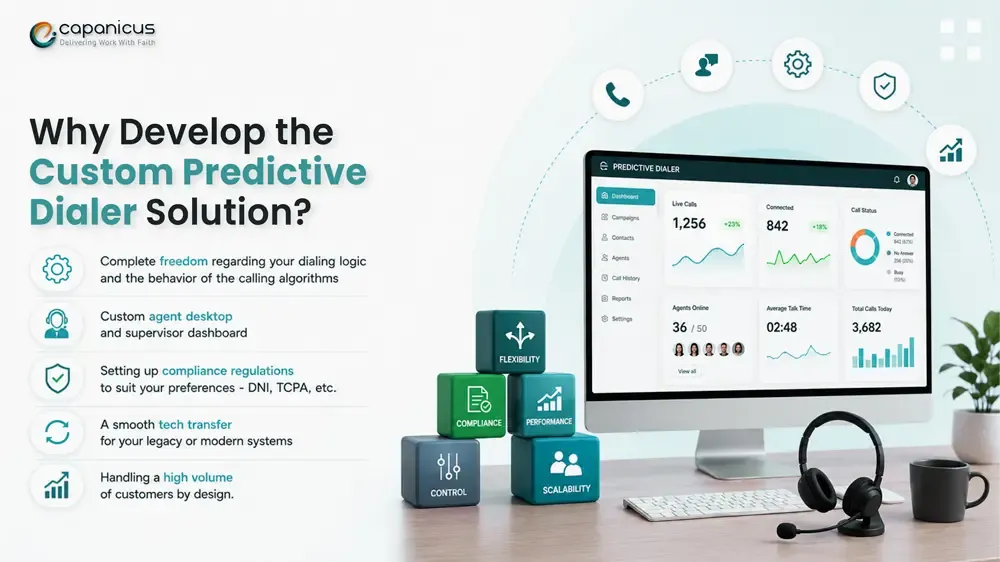
Commercial off-the-shelf dialers are suitable for relatively simple operations. Yet, it is a fact that companies operating complex sales campaigns with stricter compliance policies, or those who would like CRM and business process deep integration, a custom predictive dialer solution, these would provide the following benefits:
- complete freedom regarding your dialing logic and the behavior of the calling algorithms;
- custom agent desktop and supervisor dashboard;
- setting up compliance regulations to suit your preferences—DNI, TCPA, etc.;
- a smooth tech transfer for your legacy or modern systems;
- handling a high volume of customers by design.
If you, for example, have a large customer service department and want to make it more efficient, a dialer development company like Capanicus can create a platform that fits your workflow directly without forcing you to adapt to a one-size-fits-all solution.
Main Components of a Predictive Dialer System

A powerful predictive dialing software is one of the tools of the trade for every telemarketing team. It must have these features:
1. Intelligent Predictive Dialer Algorithms
Straight away, the engine that powers any predictive dialer is its pacing algorithm. It constantly does calculations:
- The number of calls to be made based on the availability of agents
- How to set the pacing if there is no answer and how to speed-dial when there is an answer (for example, using historical connect rates according to day, campaign, list segment, etc.)
- Make real-time changes so that it avoids over-dialing and the number of abandoned calls stays low
2. Supervisor-Level Call Pacing Adjustments
The user who will be responsible for the campaign must be able to fine-tune the dialing speed per campaign, team, or slot of time.
This not only helps in keeping the number of abandonments within the limits specified but also gives maximum live connection opportunities.
3. Real-Time Tracking of Availability of Agents
The system has to identify and monitor the status of each agent, such as free, on call, wrapping, or on break, and then route all the live calls accordingly.
4. Abandonment Rate Monitoring
In case of laws such as TCPActing, one has to limit the number of calls that get disconnected and are thus considered abandoned calls. In order to stay compliant, one needs the capability of monitoring abandonment rates in real time in good automatic dialer systems. Such dialers will adjust the level of dialing so as to stay compliant.
5. Lead List Organization
Lead lists are different depending on whether the lead belongs to the customer with higher value, segmentation on basis of geographical region or behavior of the leads, etc. Moreover, the leads must be retried based on different factors and in different intelligent ways (e.g., for a particular lead only once; for a group of leads several times). Prioritize the lead contacts of higher value, segment them according to geographical area or behavior, etc., and then assign different retry rules accordingly (e.g., for one lead once, for a group of leads several times).
6. Managing Several Campaigns Together
One can run many telemarketing campaigns side by side if one has a single console that allows one to create and manage all such campaigns. All one needs to do is define the dialing rule, script, and KPI for each campaign. One also gets the advantage of centralizing control and reducing clutter.
7. CRM Connectivity
Integrate the solution with sales tools like Salesforce, HubSpot, Zoho, or Microsoft Dynamics so that you get:
- The call can be directly logged
- Creativity of agents is enhanced with features like calling with just a click on contact information.
- Able to update lead status and call disposition in real time through the CRM interface
8. Reporting and Real-Time Analytics
Reports to be generated include:
- Present call connection rates
- Agent efficiency metrics
- Analysis of campaign lead-generation performance
- Tracking of disconnection rates and abandoned calls
- Results from the SLA and compliance reports
9. The use of AI (artificial intelligence) features to make predictive dialer software the most powerful tool. The latest dialing solutions (e.g., predictive dialer services) may use artificial intelligence (AI) for several areas:
- Lead scoring and prioritization—Deciding which contacts are most likely to convert.
- Sentiment recognition—Detecting caller mood during calls.
- Vocal recording, call transcriptions, and note-taking—these were done at the end of the call.
- A customer call scheduler—The best time to schedule a call for the customer is to tell them when to call and then retry the call automatically.
- Live Voice Trainer—By receiving real-time feedback on how customer support representatives are handling customer calls, they can improve customer support.
Stack for Predictive Dialer Tech Development
Creating a predictive dialer involves telephone infrastructure, back-end processing, and a user interface. The usual stack is:
Telephony
- To be a great solution, a predictive dialer system must first be a great communication solution. This may mean having your system connected via the following:
- VoIP Trunk: Twilio, Plivo, Vonage, etc.
- Media Servers
Backend & Logic
- Languages: Node.js, Python, Go, or Java to power the logic of the dialer and the various APIs
· Databases
- Contact data is usually kept in PostgreSQL or MySQL
- For the session, an in-memory database like Redis is used
· Message Queues:
- RabbitMQ, Kafka, etc. for event-driven call routing
Frontend & Agent Desktop
- Agent Interface Technologies: React, Vue. Angular for web agent desktop applications.
- Live updates: Webhooks or Server-Sent Events for call updates
Optional AI & Analytics
- Speech-to-Text: for call transcription, Google Speech, AWS Transcribe, and Deepgram, for example.
- NLP: call summarization and agent assistant using LLMs.
- Data Visualization: e.g., using Elasticsearch + Kibana or even custom dashboards with charts. js/Plot
Compliance predictive dialer
Compliance isn’t just a regulation; it’s the essence of your system. A custom predictive dialer has to support the following areas of law:
- TCPA (USA): rules on abandonment rate of calls, obtaining consent from customers, and regular checking of DNC lists
- GDPR (Europe): data protection, handling consent, providing the right of erasure or being forgotten
- Regional Telemarketing Laws: such as time-of-day restrictions, local do-not-call (DNC) lists, call recording disclosure, etc.
Some basic features for compliance:
- Scrubbing & managing DNC lists
- Courtesy & Record-Keeping Consent
- Limitation of the recording & keeping the same only within a certain period of time
- Role-Based Access Management (RBAC)
- Encrypted end-to-end data
Steps in Building a Predictive Dialer: The Planning Process

Stage 1: Requirements Discovery
- Specify the objectives. For example, is the dialer supposed to generate leads or recover payments.
- Set a roadmap. Think of customer acquisition as just the beginning and identify the various stages a contact would go through before becoming a customer.
- Research the applicable regulations for different countries and regions.
- Closer look: decide whether it’s an opportunity to develop a new telephony system or to build upon the functionalities of the existing one
Stage 2: MVP Development
To develop this, one can start with the essential features:
- It will work as a basic version without any additional capabilities, such as dialer features, and so on.
- It allows agents to make calls simply by clicking on the screen.
- An example CRM integration can be done with one CRM tool, let’s say, Salesforce.
- Call logging and disposition tracking
- Data mining of statistical data through Connect,
Connect Rates and Agent Activity Dashboard, a tool that one might use to begin the analysis
Stage 3: Feature-Rich Product
Having a solid MVP already in place, you can then progressively enrich it:
- Single multi-campaign management
- Adapt the call pacing to the campaign needs dynamically
- Serve a supervisor toolset that will monitor agents’ calls, intrude, and coach
- Provide AI-led scoring or summarizing calls, to begin with
Stage 4: Compliance and Scaling
- Drafting a proper DNC policy is just the beginning, but managing consent is a long-term task
- Compliance is ensured by generating audit trails and reports
- Carrying out load testing and horizontal scaling – the two main preparation tools when it is about handling much higher call volumes
- The dialer should be equipped with monitoring and early warning systems to detect any problems beforehand, in particular in compliance and scaling issues.
Stage 5: ongoing improvement.
- Refining dialing logic based on analytical reporting
- Carry out A/B testing with scripts, duration of calls, lead-prioritized calling, etc.
- Get feedback from the Agents for agent user experience upgrade
- Updating/reprogramming machine learning/artificial intelligence models is part of the dialer enhancement process to improve the predictions.
Major pitfalls (and how to avoid them)
1. Dial speed is a mistake.
One issue is that dial speed is often too fast when a campaign starts. The solution is to dial slower initially by applying a pacing algorithm. In addition, to keep the dial rate in check based on the number of calls that get answered with the number of agents, it is possible to monitor the system in real time and make adjustments as you wish.
2. Data is not good quality.
Cleaning up the data is the solution before starting with the list. Removing duplicates, if necessary, excluding invalid numbers and making sure that the list is clean. Besides, preparing for applying DNC filters at the very beginning is the main point.
3. There is no CRM integration
You should be thinking about the CRM integration right in the initial phase and also be ready in planning which features of a CRM you can use. Also, besides CRM updates, you might need to synchronize by webhooks, or the system is event-driven, so it is updated only after events occur.
4. Compliance Only Considered at the End
Fix: Make your application comply with the different standards right from the architectural stage. Don’t think of regulations on DNC, consent, or recording as extra add-ons only. The features have to comply at the core.
5. Resistance of Sales Representatives to the Technology
Fix: Have them take part right from the design phase of the user interface! Give them training, provide a manual, and encourage them to give feedback as to how to continuously improve the application.
Business Applications for Predictive Dialers

1. Sales Teams that Have a Huge Volume
Industries like insurance, the real estate industry, and SaaS companies that get a lot of new potential customers in one single day have implemented predictive dialers to be able to get in touch with several hundred. By applying AI to analyze and rank prospects according to their likelihood to buy, we can focus our efforts on the most suitable ones (i.e., “warm” leads).
2. Collection Centers for Debt
A predictive dialer system automatically triggers the next step in collecting a debt that the computer system is already handling, sets the parameters for the system to determine a number of times before it calls you back automatically, and also ensures that the regulations on calling frequency and time are properly followed.
3. Outreach & Customer Service
To reach out, contact, or check up with the customer, and the customer, banks, mobile and telecommunication companies, hospitals, and medical centers have been using automated dialing.
4. Telemarketing and Surveying
Telemarketing teams or those who perform opinion polls have a multi-channel option and live dashboards to monitor performance instantly.
The Need to Partner a Predictive Dialer Development Company
You should have an expert telephony team, be familiar enough with compliance standards, and understand real-time systems to create an in-house predictive dialer platform. Predictive dialer development companies like Capanicus could:
- Decrease the development & implementation periods with a time-proven approach.
- Guarantee that your predictive dialer complies with the rules and guidelines.
- Develop tailor-made functionalities that would match your workflows.
- Be always there for you if you want their expertise and scale their resources as your business expands.
A predictive dialer development vendor can also help you to develop the platform on your own if you want, or combine the dialer with any other solution you may need, such as a big call center, to give birth to a fully functional system right after the software has been completed.
Thoughts in Conclusion
A predictive dialing solution is not only a tool for making calls; it is a time-saving machine that changes how sales teams handle customer calls. You can get a well-programmed predictive dialer to do the following things:
- Keep your agents free from work for about 70% less time on average
- Boost the number of live calls that agents can make per hour with the predictive dialer
- Help you make money by selling better and converting more, at least; if not, the campaign results will be just fine
- Help you comply legally with telemarketing regulations without having to worry about them.
It’s time now to decide whether you would like to go further with your dial system based on prediction software development.
You should make sure to have clear plans for the project, start off by dealing with the problem of compliance in a very serious and thoughtful way, and think about working with an organization that has developed and delivered solutions at the level of your industry before.