WebRTC has become the default technology behind browser-based video calling, but there is a significant architectural gap between a two-person video call and a platform that needs to reliably support thousands of concurrent participants across webinars, telehealth consultations, live classrooms, or customer support queues. Peer-to-peer connections, which work fine for one-on-one calls, break down almost immediately once you introduce more than a handful of participants, and understanding why that happens is the starting point for anyone building a genuinely scalable platform. This is precisely the kind of engineering problem addressed through WebRTC development, where the difference between a demo and a production system usually comes down to architectural decisions made early in the build.
According to Fortune Business Insights, the global WebRTC market is projected to grow from USD 13.07 billion in 2026 to USD 122.08 billion by 2034, expanding at a compound annual growth rate of 32.21 percent, a forecast detailed in the firm’s WebRTC Market research report. That kind of growth curve means far more organizations are going to attempt building on WebRTC over the next several years, and a large share of them are going to run into the same scaling wall: an architecture that worked perfectly in a five-person demo but collapses the moment real users show up in meaningful numbers.
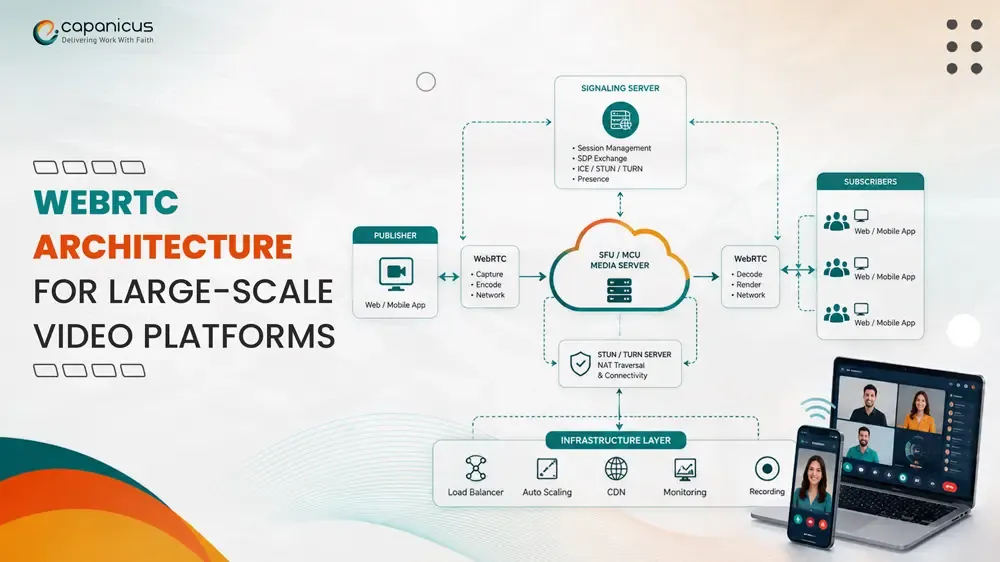
This article breaks down what scalable WebRTC architecture actually requires, from the media routing model all the way through to the infrastructure decisions that determine whether a platform holds up under load.
Why Peer-to-Peer WebRTC Doesn’t Scale Past a Handful of Users
WebRTC was originally designed around a peer-to-peer mesh model, where every participant in a call establishes a direct connection to every other participant. For a two-person call, this works cleanly and efficiently, since there’s exactly one connection to manage.
The problem is mathematical rather than incidental. In a mesh topology, the number of connections grows according to n(n-1)/2, where n is the number of participants. A five-person call requires ten simultaneous peer connections. A ten-person call requires forty-five. Each participant’s device has to encode and transmit a separate video stream to every other participant individually, which means bandwidth and CPU load scale in a way that quickly overwhelms consumer hardware and home internet connections.
This is why virtually every large-scale WebRTC video platform, from telehealth systems to enterprise webinar tools, abandons the pure peer-to-peer model somewhere between three and six participants and shifts to a server-mediated architecture instead.
The Three Media Routing Models Behind Every WebRTC Video Platform

Once mesh topology stops being viable, there are three established architectural patterns for routing media between participants, and the choice between them shapes nearly every other decision in the system.
Mesh Architecture and Its Narrow Use Case
As described above, mesh architecture connects every participant directly to every other participant with no intermediary server handling the media. It remains genuinely useful for small, low-participant calls where minimizing latency matters more than scalability, since there’s no server hop adding delay to the media path. Beyond a handful of participants, though, it becomes impractical for the bandwidth and processing reasons already covered.
MCU Architecture: Centralized Mixing at the Cost of Server Load
A Multipoint Control Unit, or MCU, takes a fundamentally different approach. Every participant sends a single stream to a central server, and that server decodes every incoming stream, mixes them into a single composite video and audio stream, and sends one combined stream back to each participant. This dramatically reduces the bandwidth and processing burden on each participant’s device, since they’re only ever sending and receiving one stream regardless of how many people are in the call.
The tradeoff is that all of that mixing work moves onto the server, and video mixing is computationally expensive. Decoding, compositing, and re-encoding video streams in real time requires substantial CPU or GPU resources, which makes MCU infrastructure costly to scale and introduces additional latency at the server hop. MCU architecture tends to show up in legacy conferencing systems and specific use cases like recorded broadcast production, where a single composited output is actually the desired result.
SFU Architecture: The Standard Approach for Modern Scalable Platforms
A Selective Forwarding Unit, or SFU, has become the dominant architecture behind large-scale WebRTC deployments, and for good reason. Rather than decoding and re-encoding streams like an MCU, an SFU receives each participant’s stream and forwards it, unmodified, to whichever other participants need it. No mixing, no transcoding, no compositing.
This matters enormously for server efficiency. Forwarding a stream is a fraction of the computational cost of decoding and re-encoding one, which means a single SFU server instance can support far more concurrent participants than an equivalent MCU deployment. It also means each participant’s device can choose to receive only the streams it currently needs, rather than a single fixed composite, enabling features like selective layout, active speaker detection, and bandwidth-aware stream selection on the client side.
Simulcast and Scalable Video Coding: How SFUs Handle Mixed Network Conditions
A well-designed WebRTC media server has to account for the reality that not every participant in a large call has the same bandwidth, device capability, or network stability. This is where simulcast and scalable video coding come into play.
How Simulcast Solves the Bandwidth Mismatch Problem
With simulcast, each sending client encodes and transmits multiple versions of its video stream simultaneously, typically at different resolutions such as high, medium, and low quality. The SFU then selects which version to forward to each receiving participant based on that participant’s available bandwidth and device constraints. A participant on a fast connection might receive the high-resolution stream, while a participant on a congested mobile network receives the low-resolution version of that same feed, without the sender needing any awareness of who’s receiving what.
Why Scalable Video Coding Is Gaining Ground as an Alternative
Scalable Video Coding, or SVC, achieves a similar outcome through a different mechanism. Rather than encoding multiple separate streams, SVC encodes a single stream containing layered information, where a base layer provides basic quality and additional enhancement layers can be added or dropped to adjust resolution and frame rate dynamically. This reduces the encoding overhead on the sending client compared to simulcast, though it requires SFU and codec support that isn’t universally available across every WebRTC implementation yet.
Why NAT Traversal Infrastructure Is Non-Negotiable at Scale
Even with the right media routing model in place, WebRTC connections still need to actually establish a network path between clients and servers, and this is where NAT traversal infrastructure becomes essential rather than optional.
The Role of STUN Servers in Discovering Public Network Addresses
STUN, or Session Traversal Utilities for NAT, allows a client sitting behind a router or firewall to discover its own public-facing IP address and port. This is the first step in establishing a connection, since most consumer and enterprise networks use NAT, meaning devices don’t have a direct public IP address they can share with other peers or servers.
Why TURN Relay Servers Are Required for a Meaningful Percentage of Users
STUN alone isn’t sufficient for every network configuration. Some firewalls and symmetric NAT setups block direct connections entirely, even after address discovery. TURN, or Traversal Using Relays around NAT, provides a fallback by relaying media traffic through an intermediary server when a direct connection can’t be established. Industry data consistently shows that somewhere between fifteen and twenty percent of real-world connections require a TURN relay to function at all, which means any production-grade WebRTC infrastructure has to provision TURN capacity as a core part of the deployment, not an edge case handled as an afterthought.
ICE as the Negotiation Framework Tying STUN and TURN Together
Interactive Connectivity Establishment, or ICE, is the framework that actually negotiates the connection, gathering candidate addresses from STUN and TURN and testing them in priority order to find the most efficient viable path between two endpoints. A properly implemented ICE negotiation process is what allows a WebRTC session to fail over gracefully from a direct peer connection to a relayed one without the user noticing anything beyond a brief connection delay.
Designing WebRTC Infrastructure for Geographic and Load-Based Scale

A single SFU server, however well-optimized, has a practical ceiling on how many concurrent participants it can support before CPU, memory, and network throughput become limiting factors. Scaling a WebRTC video streaming platform beyond that ceiling requires infrastructure decisions that go well beyond the media server itself.
- Horizontal SFU clustering distributes participants across multiple SFU instances, with cascading or forwarding logic between instances so participants connected to different servers can still see and hear each other in the same session
- Geographic distribution places SFU infrastructure in multiple regions, routing each participant to the nearest available server to minimize latency, which matters significantly for platforms with a global user base
- Load balancing and dynamic provisioning automatically route new sessions to servers with available capacity and can spin up additional infrastructure in response to demand spikes, which is particularly relevant for platforms with predictable peak usage patterns like scheduled webinars or classroom sessions
- Recording and stream egress services are typically handled by separate infrastructure from the live media path, since recording, transcoding for storage, and pushing streams to CDNs for broader distribution have very different resource profiles than real-time forwarding
Signaling, Session Management, and the Layer WebRTC Doesn’t Define
It’s worth being explicit about something that surprises a lot of teams new to WebRTC: the protocol itself does not define a signaling mechanism. WebRTC handles media transport and NAT traversal, but the process of discovering peers, exchanging session descriptions, and coordinating who’s joining or leaving a call is left entirely to the application layer.
This means every WebRTC video platform has to build or adopt its own signaling infrastructure, commonly implemented over WebSocket connections, to handle session negotiation, participant presence, and room or call state management. For large-scale deployments, this signaling layer has to be just as carefully architected for reliability and scale as the media layer itself, since a signaling failure during a large session can disconnect participants even when the underlying media infrastructure is functioning correctly.
Security Considerations Specific to Large-Scale WebRTC Deployments
WebRTC includes mandatory encryption as part of the specification, but that baseline protection doesn’t cover every security consideration relevant to a production platform at scale.
DTLS-SRTP handles encryption of the media stream itself by default, which is a meaningful advantage over legacy VoIP protocols where encryption is often optional. Beyond that baseline, though, large-scale platforms need to think about authentication and authorization for who can join a given session, protection against denial-of-service attacks targeting SFU or TURN infrastructure, and secure token-based access to prevent session hijacking, particularly for platforms handling regulated data such as telehealth consultations or financial services calls.
Scalable WebRTC Development: Why Capanicus Is Built for This Kind of Work

Building a genuinely scalable WebRTC video platform involves far more than integrating an SDK and calling it done. It requires deliberate decisions about SFU deployment, TURN capacity planning, signaling architecture, geographic distribution, and security posture, each of which needs to be sized correctly for the platform’s actual expected load rather than a best guess made during initial development. This is the category of infrastructure work we focus on directly at Capanicus, and it’s worth walking through what that actually looks like in practice.
Real-Time Communication Infrastructure Built From the Media Layer Up
Our engineering team designs and deploys the full WebRTC media stack directly, including SFU architecture, TURN and STUN infrastructure, and signaling systems, rather than wrapping a third-party platform and calling it custom development. That matters because scaling issues around simulcast configuration, NAT traversal failure rates, or SFU clustering usually need to be diagnosed and adjusted at the infrastructure level, not through a vendor’s dashboard settings.
Experience Across Video Conferencing, Telemedicine, and Live Streaming Platforms
We’ve built WebRTC-based video conferencing applications, telemedicine platforms supporting virtual consultations, live streaming and broadcasting solutions, and real-time collaboration tools, giving us direct experience with the different load patterns each use case demands, from small consultation rooms to large one-to-many broadcast sessions.
Infrastructure Sized to Actual Concurrent Load, Not Guesswork
Rather than deploying a generic media server configuration and hoping it holds up, we size SFU clustering, geographic distribution, and TURN capacity around a platform’s actual expected concurrent user counts and usage patterns, whether that’s a scheduled webinar with predictable peak load or a customer support tool with steady, distributed traffic throughout the day.
End-to-End Ownership From Media Server to Application Layer
Because our work spans both the real-time communication infrastructure and the application layer built on top of it, we can build signaling, session management, recording, and CDN integration as one coherent system, rather than leaving teams to stitch together infrastructure and application logic built by separate vendors with no shared context.
Conclusion: Scalable WebRTC Architecture Is a Design Decision, Not an Afterthought
The gap between a WebRTC demo and a production-ready video platform comes down almost entirely to architectural choices made early: whether the system relies on mesh, MCU, or SFU media routing, how simulcast or scalable video coding handles mixed network conditions, whether TURN infrastructure is provisioned to handle the real-world percentage of users who need it, and whether the signaling and scaling layers are built to hold up under genuine concurrent load rather than a handful of test users.
None of these decisions are exotic or unsolvable, but they do require getting the architecture right from the outset rather than retrofitting scalability onto a system that was never designed for it. As WebRTC adoption continues expanding across telehealth, e-learning, live streaming, and enterprise collaboration, the platforms that hold up under real usage will be the ones built on infrastructure designed for scale from day one. If your organization is building or scaling a WebRTC video platform and needs infrastructure that can actually support that growth, our team’s work in WebRTC development covers this end to end, from SFU and media server architecture through the signaling and application layers your users actually interact with.