




It all started with a simple but urgent problem.
A patient needed medical advice but couldn’t visit the hospital. Maybe the nearest clinic was hours away, the appointment slot was already full, or the technology gap was the reason. What once felt like a small inconvenience quickly became a reality for millions of people during the pandemic.
And suddenly, global healthcare began facing the same pressing question: “How can doctors care for patients when patients cannot easily reach them?”
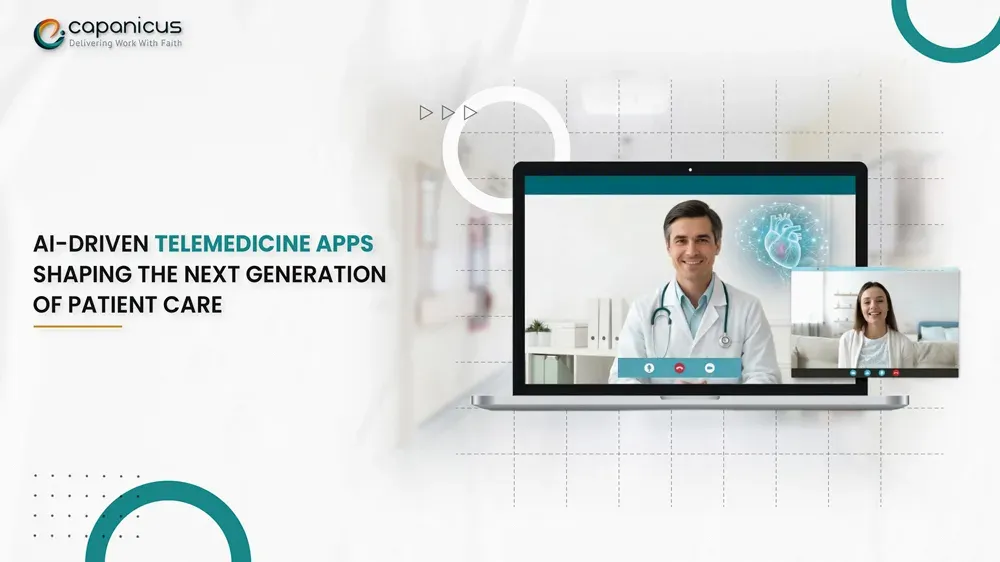
This challenge not only exposed the vulnerabilities in healthcare systems but also accelerated the adoption of innovative solutions that had previously been slow to gain traction. One such solution is AI-powered telemedicine app development, which many healthcare organisations are building in collaboration with a telemedicine app development company.
We at Capanicus strongly believe AI’s health convenience has made it an increasingly popular option among today’s patients. Here are some ways AI is beginning to rewrite the rules of patient care.
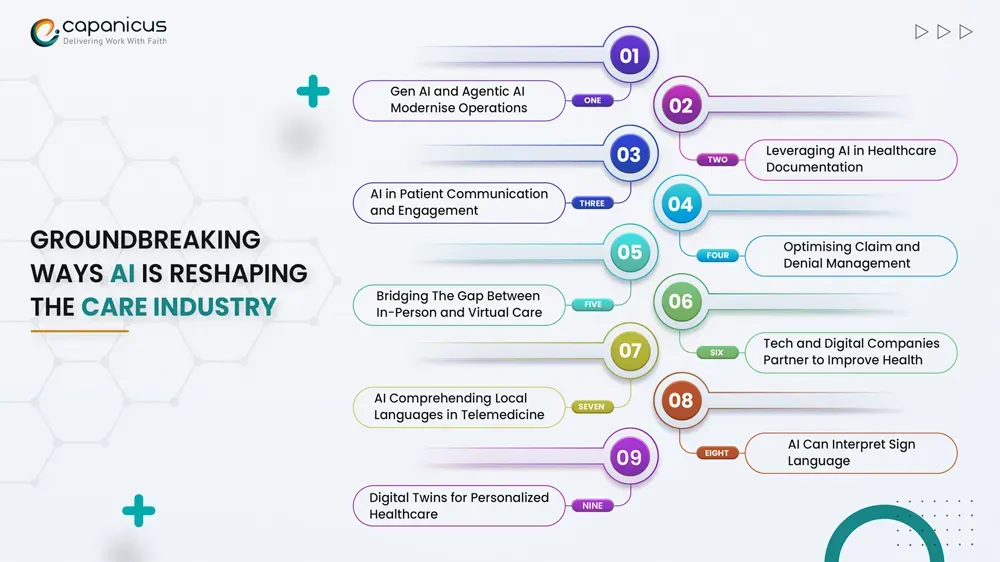
9. Groundbreaking Ways AI is Reshaping the Care Industry
As we move through 2026, AI potential in custom telehealth software development is rewriting how we understand, prevent, and treat diseases.
-
Gen AI and Agentic AI Modernise Operations
AI has the potential to improve health outcomes, strengthen consumer engagement, and streamline operations for health care organisations. Achieving scalability with AI means establishing the technology enterprise-wide and realising measurable financial impact.
Healthcare organisations that integrate AI across multiple functions can widely minimise administrative burdens, improve outcomes and accelerate decision-making. Sutter Health is leveraging AI agents to offer patients a faster and more unified experience, resulting in 85% reduction in interaction abandonment rates.
-
Leveraging AI in Healthcare Documentation
Many medical facilities use AI to summarise their clinical encounter notes, which results in minimising the administrative load on healthcare providers. This often works as effectively in a telehealth climate as it does in an office.
From automating documentation tasks to addressing concerns like clinician burnout, healthcare practitioners can spend more time on patient care. For example, some revolutionary AI tools being developed at a leading healthcare app development company can scan and extract data from handwritten prescriptions, allowing providers to maintain control over documentation.
-
AI in Patient Communication and Engagement
For older adults, navigating the healthcare system often feels like a maze of unanswered questions and confusing processes. Because of these long and confusing processes, experts have stated that more patients need assistance in using the healthcare system.
Today, AI is solving this by acting as a virtual assistant that provides patients with quick and reliable answers, whether related to their diagnosis, medications or suggesting the next course of treatment.
-
Optimising Claim and Denial Management
AI-powered telemedicine app development is not just confined to clinical documentation. Today, it’s assisting in claim management and denial resolution as well. By automating repetitive tasks like claim submissions and detecting potential errors in insurance claims, AI is saving the voluminous time it takes to process claims. Healthcare organisations are partnering with a trusted telemedicine app development company to reduce the administrative onus and maintain cash flow, allowing more time to focus on patient care.
Also, AI systems can analyse patterns in denials and recommend actionable advancements to skip any potential claim rejections.
-
Bridging The Gap Between In-Person and Virtual Care
Conventionally, telehealth has faced numerous obstacles in creating detailed insights from physical appointments. However, AI is minimising this by analysing patient data from different sources that include wearable health devices or medical records. This provides practitioners with a more in-depth view of a patient’s health, whether they are physically present or not.
For example, AI-assisted tools can track patients’ vital signs and lifestyle data remotely through devices. Industry giants like Amazon are leveraging these types of multimodal AI models that can process text, images, and data more accurately in real time.
-
Tech and Digital Companies Partner to Improve Health
Nearly 70% of surveyed health care executives plan to pursue collaborations with technology or digital companies in 2026. To address the industry’s challenges with access and outcomes, ride-sharing companies are partnering with a globally reclaimed telemedicine app development company to provide transportation for nonemergency doctor visits and treatment appointments.
Best Buy’s collaboration with Atrium Health is an example of efforts to address access and results. This joint initiative scales hospital-at-home operations by using the tech partner’s resources to set up connected care monitoring for patients.
-
AI Comprehending Local Languages in Telemedicine
Language barriers are considered among the biggest challenges in telemedicine, especially in rural and suburban areas. Presently, through AI-assisted natural language processing systems, patients can talk about their symptoms more easily as local dialects and languages are understood by the AI system.
In essence, telemedicine solutions can train AI models using region-specific datasets to accomplish translation and summarising abilities, consisting of translation not only for precision but also for real-time delivery of medical advice. AI models integrated with a voice recognition feature can capture and evaluate consultations varying in all languages according to specific regional accents as well as idiomatic expressions.
For healthcare organisations, this marks an innovative way of widening the net, reducing miscommunications, and welcoming AI-powered telemedicine app development beyond geographies.
-
AI Can Interpret Sign Language
AI technologies in healthcare are also developed to help patients with hearing impairments by translating signs into text or spoken words in real time. By establishing computer vision and deep learning models, AI systems can precisely recognise hand gestures and facial expressions. Modern machine learning architectures like CNNs process video frames, while LSTM networks also analyse temporal dependencies, achieving more than 90% precision in gesture recognition.
Today’s advanced AI models are capable of translating more than 300 different sign languages found across the globe, ensuring wide access in different regions. AI-powered sign language interpreting solutions can be connected to telemedicine platforms for enhanced patient accessibility. Thus, handholding custom telehealth software development in the care industry is marking the new era of reduced communication barriers between various patient populations.
-
Digital Twins for Personalised Healthcare
Artificial Intelligence enables the creation of digital twins of patients in real time from data collected from personal wearables, medical records, and genetic profiles.
These models predict disease progression, simulate responses to treatment, and assist in personalised care plans. By regularly updating these data sources, telemedicine enhances its potential to offer hyper-personalised solutions with minimal misdiagnosis and maximally better outcomes.
Final Thoughts
AI-driven telemedicine apps are quickly becoming the foundation of modern patient care. And, healthcare providers embracing this transition today will be better prepared to deliver faster, smarter, and more accessible care tomorrow.
Whether you are at square one of building your own telemedicine app or want to leapfrog your competitors, understanding the cost to develop one is a great place to start. Especially having the right experts by your side can make all the difference.
Frequently Asked Questions
- How much does it cost to develop a telemedicine app with AI capabilities?
The cost to develop a telemedicine app depends on factors like AI integrations, platform complexity, security features, and regulatory compliance requirements. For a bracket, the cost can vary from basic telehealth apps to advanced AI-enabled solutions with features like remote monitoring, predictive analytics and intelligent diagnostics.
- What is an AI-driven telemedicine app?
An AI-driven telemedicine app is a digital healthcare platform that uses artificial intelligence to help practitioners and patients during virtual consultations. These AI-assisted apps can analyse symptoms, provide clinical insights, streamline patient data and much more.
- What factors influence the cost to develop telemedicine app solutions?
Numerous factors like features, AI integrations, platforms, security, compliance requirements and third-party integrations like EHR (Electronic Health Record) influence the cost to develop telemedicine apps. Advanced features like agentic AI and AI-assisted diagnostics can also add to the development costs.