





Did you know – the gap between“could happen by 2030” and is “happening just now” just collapsed.
Nearly 57% of today’s work activities could already be automated using current technologies.
Yes, if you look inside most businesses, teams are still investing a surprising amount of time answering repetitive questions, customers expecting faster responses, and manually connecting workflows that should ideally run on their own.
The challenge is not that organizations lack technology. Mostly, companies have the tools, the data and the digital infrastructure in place. What’s actually missing is a layer of intelligence that can analyze sentiments, understand requests, pull the right information from different systems, and take meaningful action on their own.
This is where custom AI agents are rewriting the way organizations think about technology. And, this is exactly where the conversation shifts from using AI tools to building custom AI agents. With OpenAI APIs capabilities, businesses can now build AI agents that are customized to their own environment. But turning this potential into a trusted, production-ready system needs thoughtful architecture, integrations, and deep expertise in building AI platforms.
In this blog, we’ll discuss how OpenAI Agent Builder is helping businesses like you automate smarter, innovate faster and customize deeper, and why now is the time to invest in an AI agent for your business.
When Should You Build an AI Agent?
Developing AI agents requires rethinking how your systems make decisions and manage complexity. Unlike traditional automation, AI agents are best suited to workflows where conventional deterministic and rule-based approaches fall short.
Think of a payment fraud analysis. Here, a traditional rules engine works like a checklist, flagging transactions based on ongoing criteria. Whereas, an LLM agent works more like an experienced investigator, evaluating context, considering subtle patterns and detecting suspicious activity even when rules aren’t breached. This subtly reasoning capability is exactly what allows agents to manage complex and vague situations.
As you evaluate where agents can add value, prioritize workflows that have earlier resisted automation, especially where traditional methods face friction:
- Complex Decision-making: Processes that involve uncertain judgment, exceptions, or context-sensitive decisions, for example refund approval in customer service processes.
- Difficult-to-maintain Rules: Systems that have become disorganised because of extensive and intricate rules, making updates expensive or error-prone, for example vendor security reviews process.
- Heavy Dependency on Unstructured Data: Situations that involve interpreting natural languages, extracting meaning from documents, or engaging with users conversationally, for example, a home insurance claim process.
So, before committing to building an AI agent, make sure your use case can meet these criteria clearly.
Benefits of OpenAI Agent Builder and Why Businesses are Talking About Them
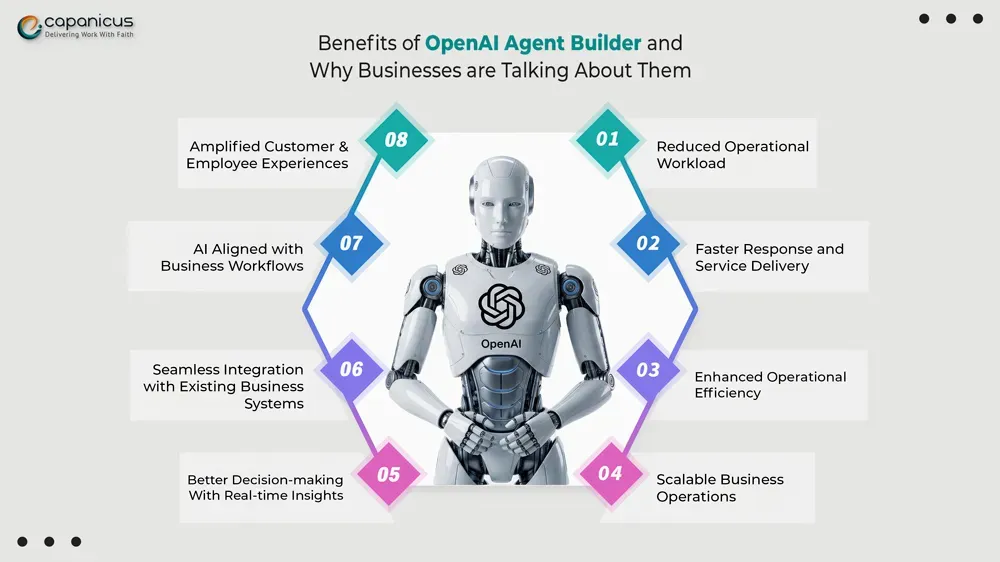
We at Capanicus understand that businesses want AI solutions that do more than just generate responses. This is why OpenAI’s Agent Builder capabilities are gaining strong attention across industries.
Here are a handful of benefits you must know about.
-
Reduced Operational Workload
AI agents can easily manage repetitive tasks like collecting information, processing requests, and addressing routine queries, thus allowing teams to focus on higher-value strategic tasks.
-
Faster Response and Service Delivery
Businesses significantly reduce response times by establishing AI agents that quickly analyze requests, collect relevant information, and offer accurate outputs.
-
Enhanced Operational Efficiency
By automating multi-step workflows and connecting different systems, AI agents remove delays caused by manual coordination and fragmented processes.
-
Scalable Business Operations
AI agents can easily manage thousands of conversations simultaneously without needing additional workforces, allowing organizations to scale their services without proportionally increasing costs.
-
Better Decision-making With Real-time Insights
These agents have the capability to analyze voluminous data and surface relevant insights, helping business leaders make informed decisions faster.
-
Seamless Integration with Existing Business Systems
OpenAI-enabled agents can easily connect with platforms like knowledge bases, CRMs, internal databases, and enterprise tools to retrieve and process information in real-time.
-
AI Aligned with Business Workflows
Organizations can build AI agents specifically designed for their operational needs, making sure that the technology aligns with their processes rather than forcing teams to adapt to generic solutions.
-
Amplified Customer and Employee Experiences
By allowing quicker responses, accurate information retrieval, and flawless workflows, AI agents enhance both customer interactions and internal productivity.
Custom AI Agents Development: Industry Use Cases
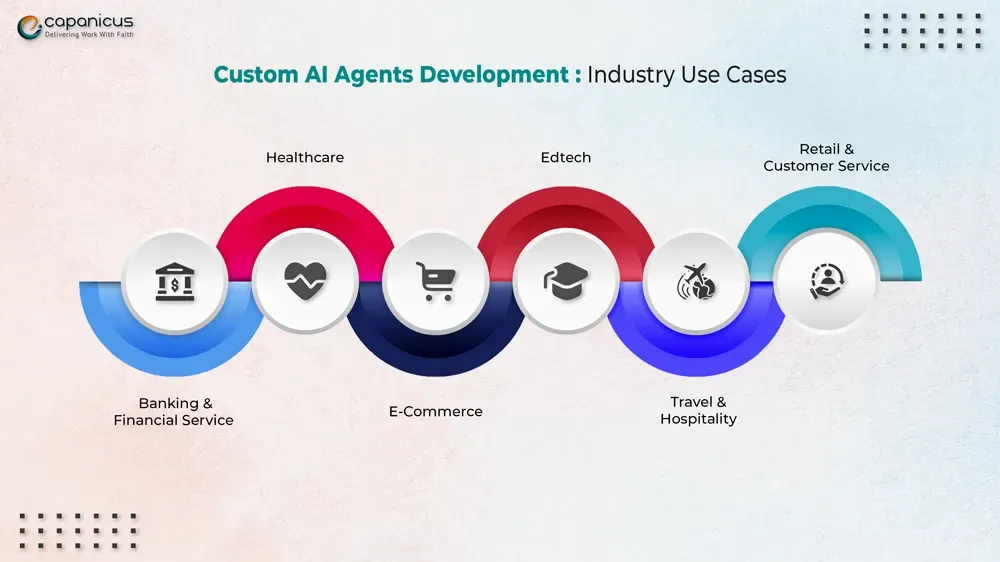
AI agents are rewriting the rules of the business world. These intelligent systems are making big decisions on their own, taking over complicated tasks, and addressing goals proactively. Besides, they boost operational efficiency, uphold the customer experience, and automate workflows.
Partnering with an experienced AI development company can help you integrate these solutions effectively and quickly. Here are some handpicked use cases across different business verticals:
1. Banking & Financial Services
Virtual Agents (24/7 Support): AI agents provide round-the-clock assistance for account management and transaction-related queries.
Fraud Detection: Transactions are continuously monitored. If any suspicious activity is detected, instant alerts are sent, and real-time protection is activated.
Financial Suggestions: Based on customer data, AI agents provide personalized recommendations for budgeting, saving, and investing.
2. Healthcare
Symptom Checking & Diagnosis: AI agents assess patient symptoms, track vitals, and provide guidance for faster recovery.
Appointment Scheduling & Reminders: AI agents can automatically book doctor appointments and send reminders, helping patients avoid missed visits.
Patient Health Tracking: AI agents monitor patient vitals and health conditions and instantly notify healthcare providers during emergencies.
3. E-commerce
Reduced Cart Abandonment: AI agents assist with order status, returns, and queries, helping reduce cart abandonment rates.
Personalized Product Recommendations: AI agents analyze customer behavior and shopping patterns to recommend relevant products and increase sales.
Customer Support Automation: AI agents handle customer queries automatically, saving time and improving service efficiency.
4. EdTech
Personalized Tutoring: AI agents provide one-on-one learning assistance, helping students understand concepts at their own pace.
Automated Grading: Assignments and exams are graded automatically, with instant feedback for students.
95% Accuracy in Paper Evaluation: AI agents can scan handwritten exam papers with up to 95% accuracy and provide detailed feedback on mistakes.
5. Travel & Hospitality
24/7 Customer Support: AI agents assist customers with travel queries, booking issues, and last-minute changes anytime.
Real-time Updates: Automated updates on flight status, hotel check-ins, and weather conditions keep travelers informed.
Booking Assistance: AI agents manage bookings, cancellations, and travel-related queries efficiently.
6. Retail & Customer Service
Sentiment Analysis: AI agents analyze customer feedback and emotions to help businesses improve service quality.
FAQ Automation: Frequently asked questions are handled automatically, allowing human agents to focus on complex tasks.
Loyalty Program Management: AI agents track reward points, manage enrollments, and send personalized discounts and promotional offers.
Why Do Custom AI Agents Work Better Than Generic AI Tools?
Generic tools are beneficial for basic tasks. And, businesses today quickly gauge that they rarely fit into operational environments. Organizations working with complicated processes, multiple systems, and large volumes of internal data find it difficult to comply with basic AI tools. Therefore, custom AI agents address this gap by being developed around how a business actually operates and what the must-know is of custom AI agents.
Also read: How AI Virtual Agents Are Elevating Customer Support Services?
Key advantages consist of:
-
Context-aware Decision Support
By accessing business data and operational logic, custom agents can provide more relevant outputs and support decision-making instead of generating generic responses. As a result, these agents can move beyond generic responses and begin to support practical decision-making within day-to-day operations.
-
Faster Task Execution
Generic AI tools typically provide answers. Custom AI agents can take action, for example updating records, triggering workflows, processing documents, or coordinating tasks across platforms.
This ability to move from response to execution is what makes custom AI agents far more valuable for businesses. By handling operational tasks directly within systems, they help reduce manual intervention, speed up processes, and ensure that workflows continue without unnecessary delays.
-
Higher Operational Value
Because they operate within business systems, custom agents contribute directly to productivity, operational efficiency, and service delivery. For businesses, this translates into measurable productivity gains and smoother service delivery.
Instead of employees switching between multiple tools to gather information or complete a workflow, AI agents can automatically pull the required data, process it, and initiate the next step in the process.
Finally
This is where Capanicus brings a unique advantage. With a strong background in building high-performance communication platforms, real-time applications, and intelligent software systems, the company understands how complex business environments actually operate.
Instead of offering generic AI implementations, Capanicus focuses on developing custom AI agents that fit naturally into existing workflows and help organizations unlock the real value of artificial intelligence.
Frequently Asked Questions
- What is a custom AI agent and how does it work?
A custom AI agent is often termed as an intelligent software system designed to comprehend requests, extract relevant information, and perform tasks across numerous distributed business systems. These AI agents can analyze context, interact with APIs, and execute multi-step workflows to support different operations.
- What are the benefits of developing custom AI agents for businesses?
Custom AI agents help businesses improve operational efficiency, allow faster-decision making and automate mundane repetitive tasks. By establishing AI agents with data sources and internal systems, tasks like handling customer queries, analyzing business information and 24*7 round the clock assistance.
- How do custom AI agents differ from traditional chatbots?
Conventional bots typically follow predefined rules to reply to limited queries. Whereas, custom AI agents are advanced, as they understand context, gather information from multiple systems, and perform actions like triggering workflows, updating records or connecting tasks across platforms without human intervention.