


Is your conventional call center facing the challenge of managing long queues of calls and high volumes of calls that are overburdening your agents and impacting the experience of your customers? Then it is time to adopt a modern call center platform that enables your agents to effectively meet the growing expectations of customers. It does this by enabling them to contact customers, better understand customer demands, and provide them with quick and efficient solutions. As the platform facilitates seamless, efficient, personalized, and satisfactory interactions with customers, it helps you gain the trust and loyalty of your customers and get a competitive edge.
There are so many advanced call center platforms available today. To choose the right platform solution for your business, you ought to have knowledge of the necessary and must-have features of modern and powerful call center software platforms. Therefore, we are sharing useful information about these features with you here. This information will act as a guide when you are making the decision of choosing the ideal call center solution for your business.
Key Features of Modern Call Center Software Platforms
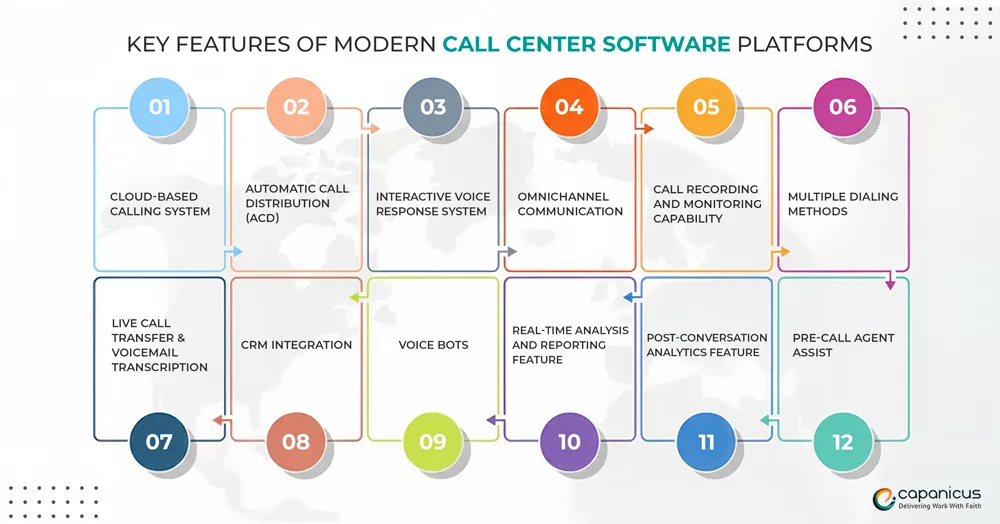
- Cloud-Based Calling System
A cloud-operated calling system enables your call center agents to work from diverse locations in the world. Moreover, it helps you improve security and imparts operational flexibility to your business. With the help of the system, your agents can have smoother interactions with customers. Furthermore, the cloud-based system can scale up or down as per the growth or contraction of your business.
- Automatic Call Distribution (ACD)
One of the most important features in hosted contact center software, Automatic Call Distribution, enables efficient management of thousands of incoming calls. It intelligently routes calls to the most suitable agents on the basis of predefined criteria. This includes availability and skill sets of agents, priority, working hours, caller ID, IVR selection, and support level.
By allowing businesses to balance their agents’ workload, it helps them avoid performance burnout in the agents and maintain their productivity.
- Interactive Voice Response System
An IVR system equips your customers with self-service capabilities. It requires them to navigate through a structured in-call menu that contains a set of options. Depending on the option chosen by them, the menu will either lead customers to quick answers or connect them with the suitable department. This helps to lessen the workload of agents.
- Omnichannel Communication
Calling is just one way through which customers seek support from call centers. They also expect to get support through multiple communication channels. That’s why an omnichannel contact center is a quite useful feature of modern-day call center platforms. An omnichannel contact center enables integration of various communication channels being used by customers. These include email, voice-based calls, chat, and SMS, as well as social media. The integration of communication channels enables businesses to provide unified and integrated experiences to their customers.
Moreover, the integration ensures a seamless and consistent customer journey across different communication channels.
- Call Recording and Monitoring Option
This feature allows businesses to record, monitor, and do analysis of various calls for the sake of quality assurance, provide training to agents, and maintain compliance with stipulated standards. It is helpful in ensuring high service standards and boosting the performance of agents.
Moreover, call monitoring in real-time enables stakeholders to track Key Performance Indicators (KPIs) and device strategies for better customer experience. It also enables them to monitor the overall progress of the department.
Call monitoring also includes features like call whispering and call barging that enable supervisors to jump on live calls and assist in the resolution of queries.
Call whispering enables supervisors to join and help agents in providing a relevant solution to customers without letting them know about their joining the call. Call barging allows supervisors to take control of the call and provide a solution themselves to the customer.
- Multiple Dialing Methods
As sales agents have to spend a major part of their time on performing administrative work, their priority tasks get sidelined. For this reason, they require a solution that can manage routine tasks such as dialing and data management. Utilizing such a solution enables them to focus on having quality conversations.
Advanced call center software platforms offer various dialing methods that match different lead types and campaign goals. Preview dialing is one such method through which agents can see customer-specific details before they make a call to them. It helps agents make better preparations and tailor conversations for each lead.
Preview dialers are suitable for complex or high-value leads that require a more personalized approach. Their use helps decrease the time spent on performing manual admin tasks. Consequently, agents can focus on revenue-generation activities.
Other dialing options include progressive dialers and predictive dialers. Progressive dialers auto-dial phone numbers of customers one by one as call center agents become available. Predictive dialers make use of algorithms to dial multiple phone numbers of customers and connect the answered calls to call center agents who are free.
Multiple dialing methods help call centers boost lead engagement and productivity. Moreover, the methods enable them to run smarter and more targeted campaigns.
- Live Call Transfer
The live call transfer feature is another helpful feature in modern call center software. The feature lets agents shift calls to other agents, supervisors, or an Interactive Voice Response system without requiring them to disconnect the calls.
For successfully transferring an ongoing call, the current agent takes consent from the customer and begins a call transfer request through the portal. The corresponding agent or supervisor receives the request if he is available. The current agent then briefs the agent or supervisor about the case while the customer waits on hold.
After the briefing is complete, the customer is connected to the new agent or supervisor, and the call continues from that point. The live transfer feature saves time for customers as well as agents, as customers don’t need to connect over a new call to talk about their issues. By ensuring agents deliver the most relevant solution to customers, this particular feature acts as a bridging tool in a call center software platform.
- Voicemail Transcription
One of the most important features in a call center software system, voicemail-to-email, offers key benefits to agents. Moreover, it plays a role in the departmental progress. Agents in a call center can receive voicemails directly in their email inbox, which ensures they deliver prompt responses to inquiries from customers.
This feature is useful when agents miss out on the initial call made by the customer. Voicemail transcription imparts convenience and flexibility that help agents stay connected and fulfill customers’ needs from any location.
Voicemail transcription enables organizations to improve documentation efficiency and follow up on customer-associated cases. Agents can archive and review voicemail recordings in a convenient manner for accurate tracking and resolution of customer queries.
Moreover, call center software systems can utilize voicemail data for tracking and assessing the performance of agents. This consequently enhances processes in the department and improves the performance of agents on a consistent basis.
- CRM Integration
Advanced call center platform systems allow integration with Customer Relationship Management (CRM) systems. This integration enables agents to gain access to past information about customers, including their names and preferences, interactions from the past, purchase history, transcripts of chats, ticket types, etc.
This key information about customers empowers agents to work in an organized and efficient manner. Moreover, they are able to provide relevant solutions to customers. Furthermore, they can provide personalized support experiences to them, resulting in enhanced customer satisfaction.
- Voice-Based Bots
Voice-based bots enable businesses to manage a huge number of customer queries in an automated manner. These AI-driven tools utilize natural conversational language to do various tasks.
These tasks can include giving answers to Frequently Asked Questions and scheduling appointments. Moreover, they can include providing account-related information and processing orders.
Voice bots function on a 24 x 7 basis and deliver instant support to customers. This helps lessen the load on human agents. Voice bots are scalable and cost less than human agents. Therefore, they are beneficial for industries with increased customer expectations and where resources are often stretched. These industries include Telecommunications, Banking, Financial Services, Insurance, and retail.
- Real-time Analysis and Reporting Feature
It provides you with a live dashboard through which your business can gain useful insights related to the performance of agents, volume of calls, level of customer satisfaction, and quality of calls. Moreover, you can attain knowledge about metrics such as call waiting time and average handling time. Furthermore, these metrics can include the maximum time customers have to wait and the average number of call center agents who are available. The metrics can help supervisors discover potential issues and bottlenecks.
The metrics and insights can aid businesses in making data-enabled strategic decisions that bring improvements. They can be in terms of increased efficiency, optimization of call center-related operations, and improvement in processes. Furthermore, you can make decisions to make your customer experiences better and achieve your organizational objectives.
The analysis of data also enables your supervisors to observe closely the workload of your team and helps them find any deviations at the same time. This helps you make effective staffing decisions in the long run.
- Post-Conversation Analytics Capability
This particular feature leverages artificial intelligence and natural language processing to assess customer-agent conversations after they have occurred. It processes all the recorded interactions to offer profound and data-enabled insights regarding agents’ performance, the sentiment of customers, and any compliance-related issues. The feature enables businesses to monitor churn signals and service quality and bring improvements in the training of agents. Businesses across diverse industries make use of the post-conversation analytics capability to retain customers in a proactive manner and maintain compliance.
- Pre-Call Agent Assist Feature
Call center agents often struggle with information-related overload or a lack of context during live interactions. The Pre-Call Agent Assist feature in a call center software system helps resolve this problem faced by agents. It uses artificial intelligence and machine learning for the assessment of various data sources and provides the most crucial information to the agents.
These data sources include Customer Relationship Management (CRM) data and the Knowledge Base. The sources also consist of Customer Journey Analysis and Customer Intent. The Customer Relationship Management (CRM) data consists of customers’ purchase history and their past interactions, and account-related details. The knowledge base consists of relevant frequently asked questions and policies, as well as troubleshooting guides. Customer journey analysis assesses the recent web browsing behavior of the customer, and associated support tickets, or automated chatbot conversations. Customer intent predicts the reason for a customer’s call on the basis of their recent activity.
By analyzing data from various sources, pre-call agent assist offers real-time recommendations, contextual data, and next-best actions to agents. This helps them better their first-call resolution and lower the average time spent handling. Moreover, the feature enables call center agents to personalize the conversations that they have with customers. As a result, customers form the impression that the business cares to understand them. This feature is significant for industries requiring precision and speed.
By now, you have gained insightful knowledge about various significant features that modern call center platforms come equipped with. This knowledge will be handy for you while choosing the right option from the many available call center software platform options with different features. The solution you choose should best align with your particular organizational needs and goals. Moreover, it should impact and enhance various facets of your call center department and improve the effectiveness and efficiency of your operations. Furthermore, the solution should facilitate improved customer experiences and help your business get a competitive edge.
Do you want to seek help from knowledgeable and veteran call center software specialists of Capanicus to choose and develop an advanced and feature-rich call center platform tailored to the unique requirements and goals of your business? Then reach out to our experts to discuss your particular needs.