




Over the last ten years, education has had a digital renaissance. The move from face-to-face to online learning is not only about saving time and effort; it is mainly about making learning more intelligent, scalable, and personalized. Technology in teaching, through an E-Learning App and E-Learning Platform, is the main driver of this change, which opens the door of learning to anyone, anywhere, and at any time.
The Digital Shift in Education
Learning is not bound by the old methods of study and classrooms any longer. The teaching staff is integrating modern technology into their teaching, not just as a supporting means but as the main one. Lockdown sped up the change, but the forced model at the time has now transformed into the chosen one.
By using e-learning apps, students are given the opportunity to join live lessons, work with other students, take tests, and monitor their learning in a very easy way. The same goes for the institutions; they can address learners worldwide, plan course delivery in a time-saving manner, and use data for continuous progress.
This is where E-Learning App Development plays a vital role, turning educational ideas into functional, engaging, and adaptive digital platforms.
Why E-Learning Apps Are Transforming Modern Education
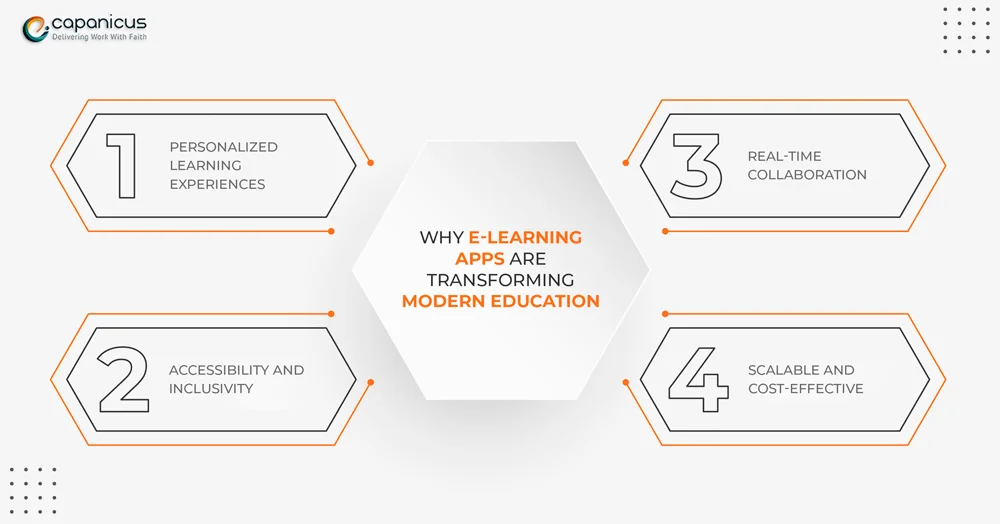
- Personalized Learning Experiences: E-learning tools rank at the top of the list when it comes to the huge benefits they can bring to learners in terms of adapting to their specific needs. Artificial intelligence recommendations allow students to take personalized roadmaps that are based on their abilities, tempo, and areas of interest. Teachers have the opportunity to constantly monitor students’ output and modify their teaching strategies, a feat that is nearly impossible to achieve in traditional classrooms.
- Accessibility and Inclusivity: E-learning solutions break down the barriers that limit education both geographically and physically. A learner located in a remote area or an urban center can take a course, provided there is an internet connection. The use of educational aids such as text-to-speech, subtitles, and language translation promotes the accessibility of education for all learners.
- Real-Time Collaboration: Due to the implementation of technologies like WebRTC, live video streaming, and chat integration, the real-time interaction of teachers and students has become feasible. These options allow the existence of virtual classrooms that are close to real ones, thus making the engagement and participation of students continuous.
- Scalable and Cost-Effective: E-learning platforms are a cost-saving tool for the development of infrastructure by institutions and corporations. A single platform is capable of accommodating a large number of users at the same time; thus, there are no limits to its reach. It is possible to think of e-learning as a scalable model since the introduction of new courses or features requires only a minimal amount of resourcing.
Inside E-Learning Platform Development: What Makes a Great Learning App
The proper plan for the development of an efficiently functioning E-learning Platform must integrate the essential components, which are:
- Interactive User Interface: The attractive design, intuitive navigation, and bright graphics attract the learners again and again.
- Content Management System (CMS): It is done very easily, including updating as well as uploading of lessons, quizzes, and materials.
- Gamification Features: Learning gets simplified, made fun, and the students become self-motivated by means of badges, leaderboards, and reward programs.
- AI-Powered Analytics: The first step is to perform tracking, then prediction of the future, and finally, adaptive recommendations.
- Secure Payment & Enrollment Systems: For courses that are paid, subscriptions, and certifications.
- Multi-Device Compatibility: The design is responsive to desktops, tablets, and smartphones.
- Data Security & Compliance: Student data privacy is ensured through encryption and GDPR compliance.
The mentioned features turn an e-learning app from just a tool into an engaging and future-ready one.
The said components make an e-learning app not only a tool but also an engaging and future-ready one.
How E-Learning Apps Empower Institutions and Enterprises
E-learning is not limited to schools or universities anymore. A cross-section of businesses is investing in E-Learning App Development for employee training, onboarding, and upskilling. The microlearning modules, gamified assessments, and performance tracking dashboards enable organizations to enhance productivity and learning retention.
Custom-built platforms can do a lot of good for educational institutions by increasing administrative efficiency, automating attendance, tracking progress, and delivering content effortlessly.
Emerging Technologies in E-Learning
The learning of the future will be the result of the interaction of several advanced
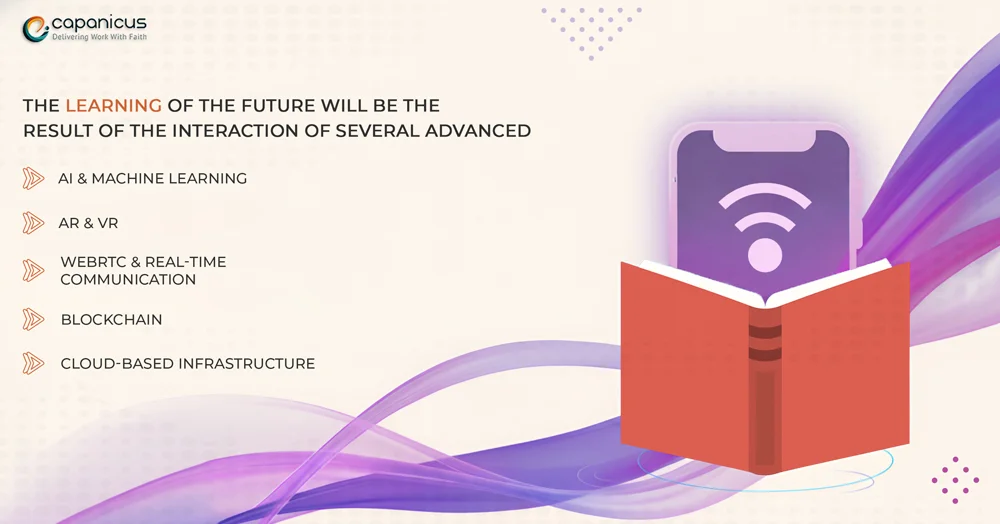
- AI & Machine Learning: These technologies analyze knowledge and interests to provide the best-fitting course recommendations.
- AR & VR: They can offer deep-dive learning experiences, e.g., in the fields of medicine, engineering, and design.
- WebRTC & Real-Time Communication: These technologies open the possibilities for live classes, online seminars, and instant feedback loops.
- Blockchain: A decentralized ledger is used for very secure storage of certificates, credentials, and educational records.
- Cloud-Based Infrastructure: It makes it possible to flexibly scale and extend the reach to different parts of the world.
These are just some of the innovations that are reshaping education.
Capanicus: Driving the Future of E-Learning
At Capanicus, we specialize in creating e-learning apps and platforms that reflect the core values of your organization. Technically, our team stays ahead of the curve while also making the product visually appealing so as to keep the end-users engaged and satisfied with the learning solutions that are not only scalable and secure but also attractive.
We, the E-Learning experts, are ready to serve you if you happen to be an educational institution, an e-learning training company, or a large enterprise. Our tools and techniques would be the perfect match for the way you want to deliver online lessons, as they would be trouble-free and interesting. The result of this process would be a digital ecosystem that would effectively link up teachers, students, and administrators.
We are the people who will walk with you through every mile from the ideation of your platform, its unveiling, up to when it is mature enough to carry on with your users, meet their needs, and make digital learning effective.
Final Thoughts
Teaching and Technology are no longer two distinct things; rather, they cooperate to bring about memorable learning journeys. E-learning apps are the bridge that connects educators’ passion with learners’ curiosity, making knowledge accessible to everyone, everywhere.
Fine-tuning the proper E-Learning Platform Development strategy means that you are doing more than just app creation; instead, you are determining the future of education.