





Artificial Intelligence and WebRTC are cutting-edge technologies that have revolutionized the way individuals and businesses collaborate and communicate worldwide. The integration of AI’s natural language processing and machine learning capabilities with the Real-time WebRTC communication framework enables building of cutting-edge and powerful communication applications. Apart from boosting user experience, these applications also promote innovation across industries.
Artificial Intelligence (AI) Technology
Artificial Intelligence (AI) is an innovative technology used for building machines that can do those tasks that normally require human intelligence. The tasks they perform without human intervention include understanding speech and generating appropriate responses to it, making decisions, and learning from users’ past experiences. AI is already making an enormous impact on various industries through artificial intelligence-powered tools, including smart virtual assistants and chatbots. These tools are useful for users in various ways. They include enabling users to find information swiftly and providing them with assistance in real-time.
WebRTC Communication Framework
Web Real-Time Communication (WebRTC) is a framework of open-source nature that facilitates real-time communication by utilizing browser technology. WebRTC does not require plug-ins, additional extensions, applications, etc. to conduct Real-time communication. That’s why it is preferred for holding peer-to-peer communication in real-time.
As WebRTC supports two-way exchange of voice, video and data, it is used for building diverse communication solutions that make rich communication accessible.
Due to its support for audio, video, and data sharing in real-time, WebRTC facilitates outstanding quality video calls and instant data transfers directly through the apps or web browsers of users. WebRTC has clear communication capabilities and decreased latency. They make WebRTC an essential component of advanced internet-enabled communication.
WebRTC’s adaptive bitrate streaming process automatically adjusts the quality of the audio and video streams as per available bandwidth. This helps maintain a smooth communication experience even when network conditions fluctuate, lowering the risk of reduced communication quality or interruptions in communication.
WebRTC uses bandwidth in an efficient manner, optimizing the use of network-related resources to offer the best possible experience to users. This is especially beneficial in remote work situations where users’ internet connectivity levels differ.
WebRTC has an increasingly scalable nature. This makes it ideal for one-on-one communication as well as collaborations featuring large groups. Because of WebRTC’s peer-to-peer nature, it lets users communicate in a direct way. This resultantly lessens the need for centralized servers, which can result in a bottleneck in deployments of large scale.
WebRTC has echo cancellation features that are necessary for clear communication taking place through audio calls. This technology automatically brings down or eliminates echo, ensuring all participants can hear each other clearly without the distraction from audio feedback.
WebRTC utilizes powerful security protocols like DTLS and SRTP to encrypt communication channels. This makes it highly secure communication technology. WebRTC performs encryption of voice and data packets that are exchanged online. As a result, the real information remains protected from theft and misuse in case communication lines are intercepted.
Apart from Real-time communication, WebRTC also supports cross-platform operations. It does not have any technology-related restrictions. As an example, WebRTC can enable peer-to-peer connection between two users who use macOS and Windows respectively.
Moreover, WebRTC can overcome challenges related to Network Address Translation which provides a high level of compatibility even when users use different web browsers for communication.
In short, WebRTC is a perfect technology that can be used to build reliable and dependency-free peer-to-peer communication tools. A specialist WebRTC development company can build diverse kinds of WebRTC-based communication applications. These include applications voice-based calling, video conferencing, and live streaming.
How AI and WebRTC Enhance Communication?
The combination of AI and WebRTC helps organizations drive powerful and transformative results.
AI and WebRTC integration can be performed in two ways. The first one is about integrating functionality of AI into a WebRTC-based application. The second one involves integrating WebRTC-related communication features into AI solutions.
AI-based algorithms and AI-powered tools and features like voice bots, video bots, and VAs can help make WebRTC-based communication systems more intelligent, adaptable and efficient. The AI-powered WebRTC solutions allow automated interactions that are aware of the context. Moreover, they elevate the reliability and quality of real-time based communication. Furthermore, AI technology maintains security by performing monitoring of communications and recognizing any threats, making communication channels safer.
AI-driven WebRTC applications are revolutionizing digital-based communication across industries by resolving their unique challenges and increasing their operational efficiency. AI’s integration with WebRTC-based technologies allows the building of more intuitive, secure, and accessible communication applications. They are positively impacting various industries and fields. Some of them are remote-based collaboration and customer service.
How AI Algorithms Bring Improvement in Audio and Video?
AI can be integrated into WebRTC-driven communication systems for automatically adjusting audio and video-based settings for achieving optimal performance. As an example, AI algorithms can improve video resolution on the basis of available bandwidth. Moreover, AI algorithms can help suppress background noise. Moreover, they can perform real-time translations. These improvements can drastically increase communication quality, specifically in environments with less-than-ideal network-related conditions.
How WebRTC Adds to the Capabilities of AI-Based Voice Bots?
Voice-based bots function by utilizing various cutting-edge AI technologies. Automatic Speech Recognition constitutes these technologies. It uses deep learning models to change users’ spoken words into text. This enables voice bots to perform transcription in an accurate manner even in instances of background noise and accents.
WebRTC media streams can be routed to AI services in real-time. This enables voice AI applications like voice bots to process user speech and respond to it with least latency as soon as an AI-generated response is ready. This helps support live conversational workflows.
How Artificial Intelligence Supports Video-based Bots Taking Part in WebRTC Sessions?
An AI video bot is a software program that simulates human-like conversations through a combination of advanced technologies. They include machine learning, artificial intelligence, natural language processing, virtual reality, augmented reality, and robotic process automation. AI video bots create a human-like conversational experience by interpreting and generating facial expressions and emotional responses. Thus, they help make interactions more personal and real. AI video bots are available 24/7 and ensure continuous service without the limitation of working hours.
AI supports video bots that take part in WebRTC sessions and interact with the participants. Here, users can talk directly to an LLM model which, in turn, generates direct responses to their requests.
These bots can extract relevant information and perform tasks on users’ behalf. These include updating account-related information or making reservations. Video bots can join a video conference session in a third-party platform by using a separate headless browser or similar device.
Apart from supporting video bots, AI also supports audio bots taking part in WebRTC sessions.
How WebRTC Enhances the Capabilities of Smart AI Virtual Assistants?
AI virtual assistants are software programs that make use of artificial intelligence to perform various tasks without much human oversight. They automate tasks of routine nature like answering questions, scheduling meetings, or doing simple processes, recognizing speech, and performing analysis of data. They also include managing calendars, setting reminders, creating call summaries, and crunching numbers. Their use helps improve response times and resolution rates.
You can use an AI algorithm to develop and integrate virtual assistants within a WebRTC application. The WebRTC virtual assistants’ integration enables virtual assistants to provide more engaging assistance during interactions with users.
Moreover, WebRTC scalability enables these assistants to handle a huge number of tasks concurrently and route only complex issues to human agents. This makes human agents free to focus on tasks of increased importance.
The integration of AI-based Virtual Agents with WebRTC channels allows businesses to offer 24 x 7 live assistance to customers. This resultantly lessens human agents’ workload while keeping customer satisfaction intact.
Thus, integration of WebRTC for AI agents, AI voice bots, and AI video bot applications facilitates natural, efficient, and reliable interactions that benefit businesses as well as their customers.
Let’s now discuss various useful ways through which AI enhances WebRTC.
How AI Improves WebRTC?
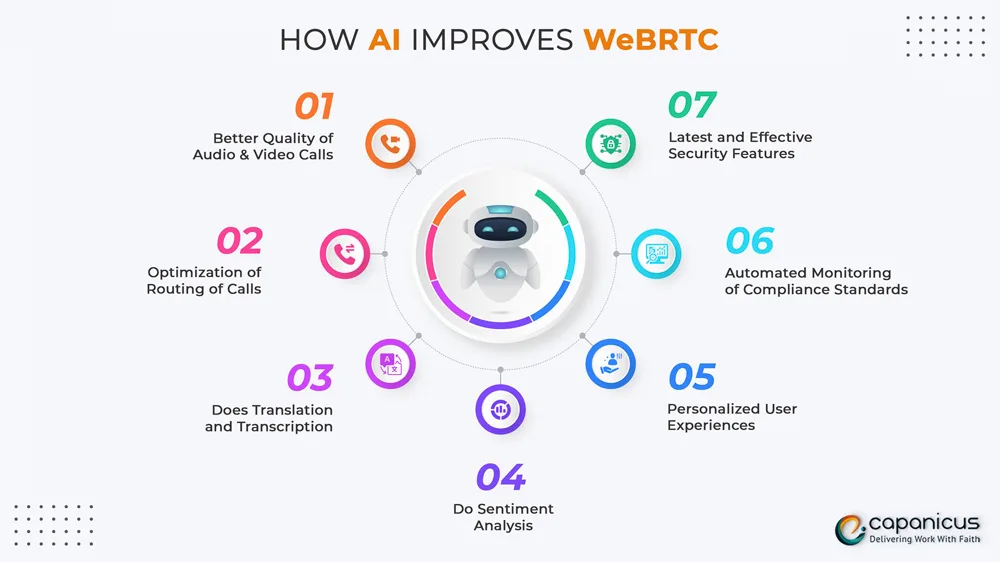
- Better Quality of Audio and Video Calls
AI can increase the quality of WebRTC-related communications to a great extent. It makes use of advanced algorithms for enhancing clarity of audio and video calls. Artificial Intelligence can help lower background-related noise, eliminate echoes, and adjust quality of video as per network conditions. In instances with not so good internet connection, AI helps maintain smoothness and clarity of calls. This leads to effective and smooth remote meetings, irrespective of the internet’s quality or the participants’ location.
- Optimization of Routing of Calls
Artificial Intelligence can help optimize routing of WebRTC-enabled calls, resulting in exceptional connection quality. Moreover, it can make predictions about network-related congestion. Furthermore, it can route calls through least congested paths. Artificial intelligence can perform routing of calls through the servers with maximum efficiency on the basis of participants’ location. AI can optimize routing on the basis of processing power and network capabilities of user devices. Such intelligent routing can enhance the calls’ reliability and quality to a significant extent. These particularly include large-scale calls or international conference-related calls.
- Does Translation and Transcription
Artificial intelligence is equipped with real-time transcription and translation capabilities. This boosts real-time communication among a globally distributed workforce that speaks different languages. AI-powered speech recognition converts users’ spoken words into text during a call. With the help of natural language processing, AI can translate these words of users into preferred languages. AI-enabled real-time transcription and translation let people communicate with ease from different locations in the world.
- Do Sentiment Analysis
AI can perform analysis of the speaker’s sentiments, emotional tone, facial expressions, and other signals to assess his emotional state. This helps identify the particular context for enriching communication and boosting understanding. By recognizing a customer’s frustration or satisfaction, representatives can accordingly provide them with a more tailored and effective response.
With the help of sentiment analysis, sales teams can identify customer interest in a product/service, and they can accordingly change their approach. AI can also deliver insights into satisfaction, engagement or disengagement, or stress in members taking part in a meeting. The gathered insights enable team leaders and managers to intervene quickly to resolve any issues encountered. Thus, they can maintain the effectiveness of communication and keep the team’s morale intact. This helps create a more productive and increasingly supportive environment for remote-based work.
- Personalized User Experiences
WebRTC applications manage a huge number of peer-to-peer calls and conferences. Furthermore, WebRTC apps support multimedia, data, and instant message exchange. A huge amount of data is stored during these WebRTC sessions.
Analytics for WebRTC applications including WebRTC for AI agents, can analyze, interpret, and process huge amounts of video and audio data to identify certain patterns and provide critical insights about users’ past behavior, habits, and preferences. These insights enable businesses to provide personalized recommendations, suggestions, responses, and specific features to users according to their needs. This personalization makes communication experiences more enjoyable, engaging and efficient for customers. This in turn makes customers more satisfied. Moreover, this helps to elevate the organization’s productivity.
- Automated Monitoring of Compliance Standards
Certain industries have to mandatorily maintain compliance with established regulatory standards. Here, AI can be integrated into WebRTC-enabled tools to automate compliance monitoring. By reviewing communications in real time, AI algorithms make sure all your interactions are strictly compliant with industry regulations and your company’s policies. This helps bring down the risks of non-compliance and lets you maintain high standards in communication practices.
- Latest and Effective Security Features
Security is a topmost concern in communication systems and artificial intelligence plays a significant role in boosting the security of different WebRTC applications. These include WebRTC-based virtual assistants and audio and video boots driven by artificial intelligence technology. AI algorithms can perform monitoring of communication-related channels to assess and identify potential threats and activities that are suspicious or not likely. AI-driven algorithms can identify breaches related to security and respond to them in real-time. Thus, they can help keep critical business and customer-centric information protected. Moreover, they can keep communications private and secure.
How is AI-WebRTC Integration Useful for Businesses and Consumers?
The integration of AI technology with the WebRTC framework delivers benefits to businesses and individuals.
Businesses can elevate their customer service by integrating WebRTC with AI. Through AI-powered chatbots, they can deliver immediate responses to customer inquiries. Through automated systems, they can provide customer support and guidance during interactions. With the utilization of these technologies, businesses can make their remote team collaboration better. Moreover, they can enhance their productivity and improve efficiency of their workflows.
Individuals can also make their communication more engaging and interactive. Language translation in real-time and personalized settings help improve accessibility of conversations and make them enjoyable. Moreover, AI-WebRTC integration results in smoother and more effective communication.
Application of AI-WebRTC Integration
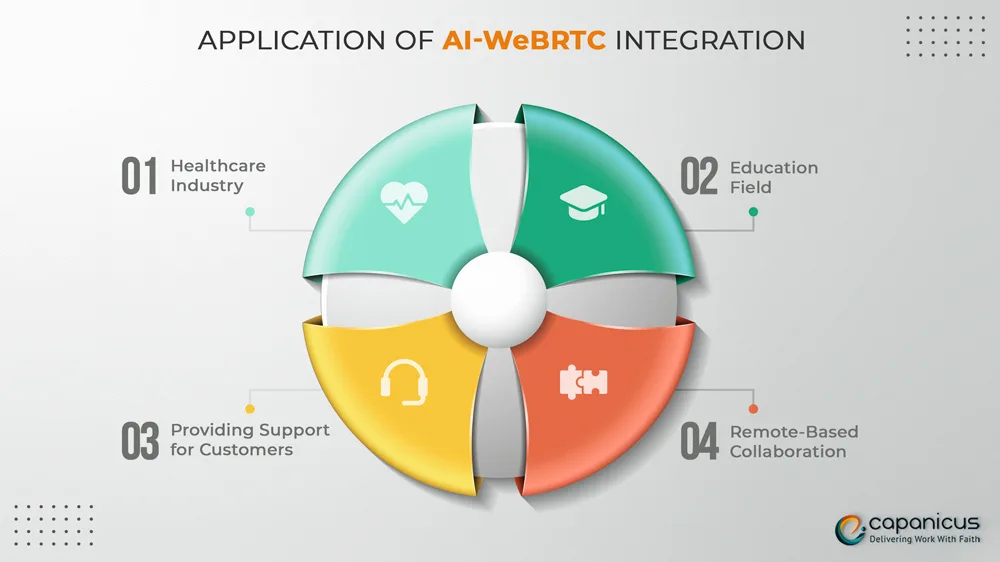
The integration of AI and WebRTC is finding use across various industries.
Healthcare Industry
WebRTC lets patients make video calls to doctors in far away locations from their home while AI enables doctors to make better diagnoses and create personalized plans for patients’ treatment. The AI-WebRTC integration makes remote care increasingly effective and results in smoother operations. Moreover, it fosters better collaboration and learning among medical professionals.
Education Field
WebRTC applications that are enhanced with AI can help create interactive and real-time learning environments for students. Furthermore, they can be adapted according to the individual learning needs of students. Moreover, they allow immediate feedback and support. Thus, the applications help boost students’ learning experience.
Providing Support for Customers
AI-powered WebRTC applications facilitate the management of inquiries from customers and the resolution of issues faced by them in real-time. These applications can include personalized support mechanisms and intelligent chatbots. This leads to more personalized and efficient customer experience. By performing assessment of customer sentiments, the tools help generate and deliver customized responses. This in turn improves customers’ satisfaction and they remain loyal to the business organization concerned.
Remote-Based Collaboration
WebRTC applications enhanced by AI provide smart meeting rooms and advanced project management tools. They make communication and collaboration among remotely based teams seamless and effortless. The applications contain useful features such as automated summary generation, progress tracking, and task assignments. These features help improve organization’s productivity and streamline management of projects.
In view of the AI’s integration with WebRTC enabling businesses to enhance their remote communication and collaboration, customer experience, and other aspects of their organization, it makes perfect sense for businesses to opt for the development of AI-driven WebRTC applications.
If you have decided to build a custom AI-enabled WebRTC application, choose a specialist and veteran WebRTC development company like Capanicus. The company’s experts are skilled in cutting-edge Artificial Intelligence and WebRTC technologies. Moreover, they have extensive experience in building innovative and groundbreaking software development solutions for a wide range of industries.
Discuss your particular business needs with our company’s experts today. After understanding your business requirements, demands, and expectations thoroughly, they will accordingly take the next step to bring your desired application to life.