




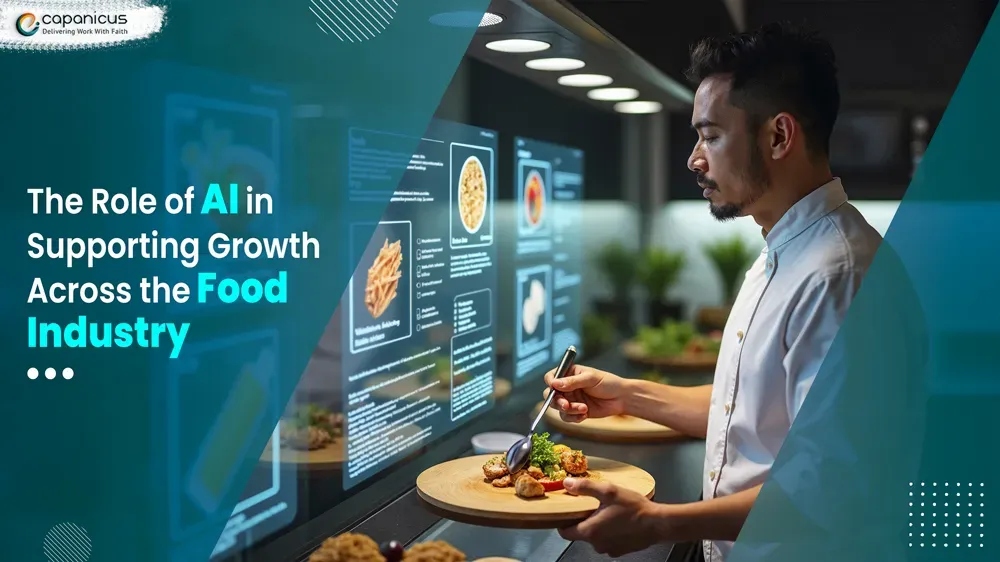
The food industry has been changing alongside consumer behaviour. Technology has determined the shape of each phase of the shift from traditional dine-in restaurants to quick-service chains and now to digital-first kitchens. Today, one of the most influential forces behind this evolution is Artificial Intelligence (AI). In restaurants, cloud kitchens, and food delivery platforms, AI is not merely an add-on feature; it is becoming the very pillar of operations, customer engagement, logistics, and business strategy. Predictive ordering systems, smart route optimisations, the list goes on: through these examples, AI is helping businesses improve their performance, operate more sustainably by reducing waste, and turn customer experience into a unique selling point. At Capanicus, we have seen the food delivery app ecosystems fundamentally change, grow, and compete in an increasingly digital marketplace through the adoption of AI-powered systems.
Let us first look at how AI is driving growth in the food industry from the perspective of industry players and why it is a must-have for businesses if they want to be ahead of the pack in the market.
- AI-Powered Personalisation in Food Delivery Apps
- Help customers to pick dishes that match their tastes
- Suggest restaurants based on the customer’s location and budget
- Offer personalised discounts and promotions
- Predict when a user will place the next order
- Smarter Logistics and Route Optimisation
The word “logistics” refers to the way a food delivery platform functions. If the deliveries are delayed, the customers will leave negative reviews, and that would be a great risk to the business.
AI helps in delivery route optimization by considering:
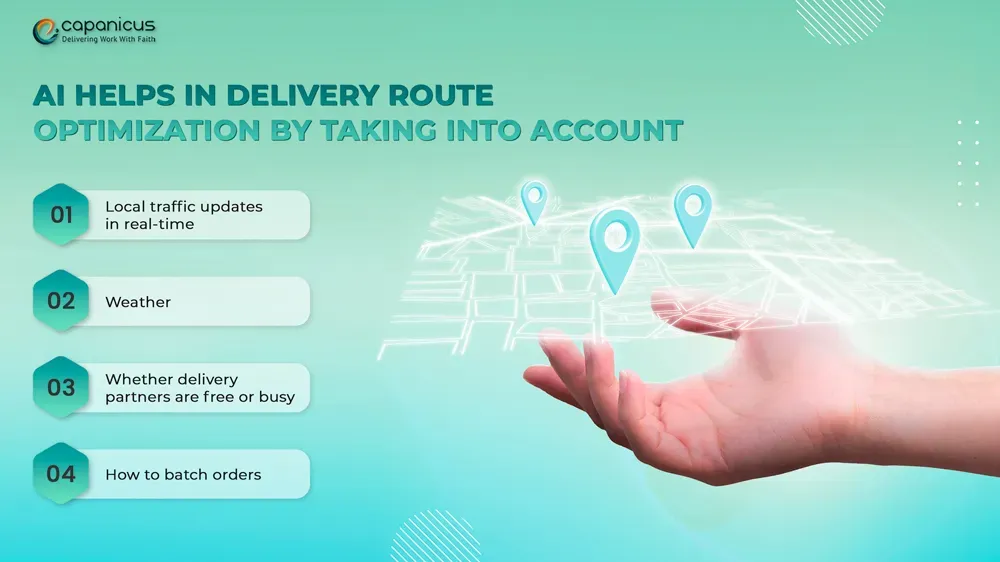
- local traffic updates in real-time
- Weather
- Whether delivery partners are free or busy
- How to batch orders
DoorDash and Grubhub are examples of platforms that are using AI-powered dispatch solutions to detect the nearest delivery associate quickly, and then the order will be given to that person. Hence, the time that the delivery takes is drastically cut down, and at the same time, the fuel costs are also reduced.
The major benefits of the same are:
- Prompt delivery
- Reduction in operational costs
- Increased productivity of delivery associates
- Customer satisfaction
Further, AI algorithms can also predict the peak hours and thus the delivery teams can be ready beforehand. Attending to the customers during the two main meal times, lunch and dinner, with a high level of efficiency can significantly uplift the customer experience, besides being highly advantageous to the business. Any company that wants to be scalable and sustain its growth cannot afford to look at AI-powered logistics as a luxury but rather a necessity.
- Demand Forecasting and Inventory Management
Food wastage is a huge problem in the industry. A big part of the difficulty for restaurants is that they either have too much or too little stock of ingredients.
AI-powered demand forecasting analyzes
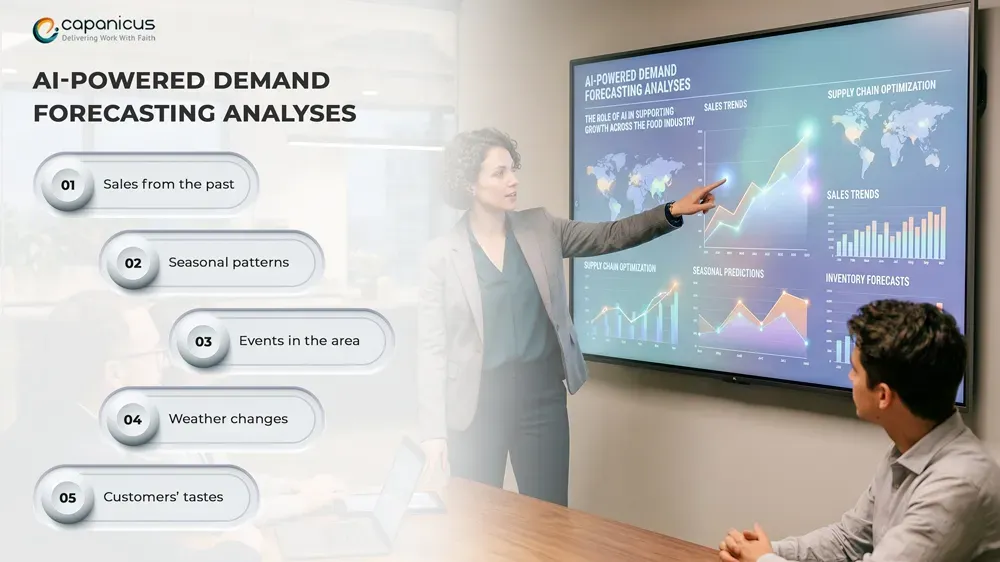
- Sales from the past
- Seasonal patterns
- Events in the area
- Weather changes
- Customers’ tastes
By using predictive analytics, restaurants can:
- Purchase only the quantity of ingredients necessary
- Minimize food waste
- Enhance profit margins
- Prevent running out of stock
Major franchises such as McDonald’s and Domino’s Pizza use AI forecasting tools to efficiently handle their supply chains in many store locations. If a food delivery app business operates multiple cloud kitchens, AI forecasting can help keep operations efficient and maintain consistent quality of services.
- AI Chatbots and Virtual Assistants in Customer Support
In the entire food delivery sector, one of the most crucial aspects is customer service. It does not take long for users to get annoyed if their delivery is delayed, or their orders are cancelled or refunded.
AI chatbots and virtual assistants:
- Supply customers with immediate answers at any time of the day or night
- Automatically respond to FAQs
- Handle refunds and cancellations
- Re-route troubled users to human agents
This not only decreases reliance on huge call center staff but also greatly increases the speed of response.
AI-driven conversational systems may also be utilized for:
- Voice ordering
- Providing support in various languages
- Facilitating complaint handling
At Capanicus, we embed AI Virtual Agents in the food delivery platform, which increases user satisfaction and, at the same time, lowers the platform’s operational costs.
- Dynamic Pricing and Smart Promotions
AI is revolutionising industries such as travel and ride-hailing, where dynamic pricing strategies play a major role. Thus, AI-driven delivery charges can be adjusted or targeted discounts can be offered, simply by allowing the system to have the following information:
- Demand
- Peak
- Restaurant
- Competitor
For instance:
- Apps can offer souvenir coupons during non-peak periods.
- At peak times, there may be a slight increase in delivery charges to ensure the supply and demand are in balance.
By adopting this approach:
- You generate more sales
- Besides that, people are encouraged to order during off-peak hours
- The allocation of delivery partners gets optimized
AI-enabled smart promotions help to ensure that the marketing budget is efficiently spent by precisely targeting those users who most likely convert.
6. AI in Cloud Kitchens and Smart Restaurants
The business model of cloud kitchens depends fully on online orders. AI is really the core of the performance management there.
AI systems help:
- Understand
- Find
- Change
- Improve
- Supervise
Besides that, AI can work with IoT in smart kitchens to:
- Control
- Schedule
- Save
This implementation not only eliminates errors but also helps in achieving higher operational efficiency.
- Fraud Detection and Secure Transactions
Food delivery platforms cannot afford to overlook fraud prevention with millions of daily transactions.
AI algorithms detect:
- Bots
- Stealing
- Refund abuse
- Fake deliveries
ML algorithms can keep updating themselves transaction after transaction to be able to pinpoint out of the ordinary behavior instantaneously.
This makes:
- Payment security
- Losses minimization
- Customer loyalty
Security is the key to the successful growth of an online food delivery app.
8. AI-Powered Marketing Insights
Marketing in the food industry has changed drastically from broadcasting to precision targeting.
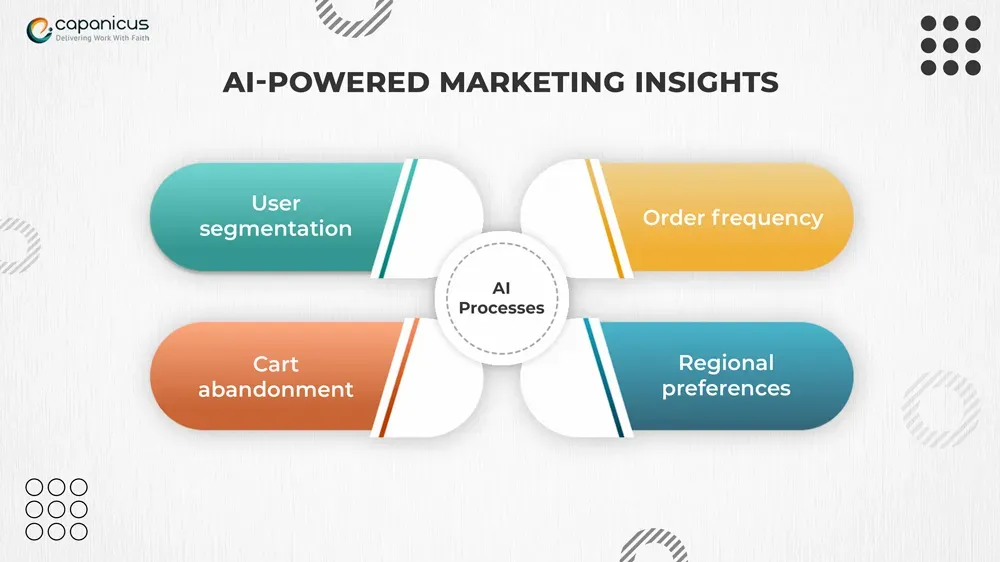
AI processes:
- User segmentation
- Order frequency
- Cart abandonment
- Regional preferences
Predictive analytics allow companies to:
- Start a campaign focused on a specific location
- Send a push notification that feels personal to the user
- Use promotions limited to a certain location
- Enhance advertising return on investment
For instance, AI can track down the habits of nearby users who have ordered this type of cuisine frequently and target them if a new restaurant decides to open in their area. Hence, it leads to the campaign being more successful and the number of users increasing at a faster pace.
- Voice Technology and AI Ordering
Ordering food via speech has become increasingly popular, especially with the help of smart assistants and mobile integrations. Alexa by Amazon and Google Assistant by Google are some of the most common platforms through which users can give commands to place an order.
AI voice technology:
- Improves accessibility
- Speeds up ordering
- Enhances user convenience
- Reduces app navigation friction
Thus, by incorporating these features into their platforms, food delivery businesses may win over customers and succeed in this market of ever-changing voice commerce.
10. Data-Driven Business Expansion
Using AI, food delivery businesses can take a data-driven approach to expansion, thereby making the whole process smart!
Through AI analysis of:
- The most ordered locations
- The number of customers
- The quality of delivery is based on various metrics
- Trends in the popularity of different cuisines
Businesses will be able to:
- Decide on the new cloud kitchen location(s)
- Choose the right new cuisines to offer
- Optimize the usage of the marketing budget
Rather than you having to take a stab in the dark, AI presents a host of measurable-outcomes strategies that are low-risk and high-ROI.
How Capanicus Helps Food Businesses Scale with AI
We at Capanicus mainly concentrate on developing AI-powered digital ecosystems that are customized to the food industry.
Some of the solutions we offer are:
- AI-powered recommendation engines
- Smart logistics and route optimization systems
- AI Virtual Agents for customer support
- Predictive analytics dashboards
- Secure payment and fraud detection systems
- Voice-enabled ordering integrations
We believe that the food delivery platforms that are scalable and respond to market demand are the ones that can really grow with your business. Whichever is your case, an AI-driven approach is a smart decision for sustained growth.
Conclusion
AI in the food industry has moved beyond being a far-off, futuristic idea; it is the very force behind the rise, innovation, and profitability. With AI, the food delivery experience is going through a massive change, with AI being involved in each and every instance, from personalized user experiences to predictive logistics and smart marketing automation. When rivalry becomes tougher, and customer demands keep going up, companies must make use of AI not just to stay in the game but to be the first. Those food delivery platforms that implement AI will be the ones molding digital dining in the future. If you feel that your company is prepared to benefit from AI-driven expansion, then Capanicus is at your disposal for creating the next generation of intelligent food delivery app solutions. The food of the future is clever. And AI is serving it warm.