




Physician burnout is the one problem everyone in healthcare knows exists, but rarely does anyone talk about it.
Long hours with patients are often followed by even longer hours of documentation, updates, and administrative work that pull a physician’s attention away from what truly matters. And, in the middle of this constant pressure, even small interruptions like typing notes or swapping screens can start taking a toll on efficiency, focus, and care.
This is exactly where healthcare software solutions start to make a real difference. Just imagine updating a patient’s healthcare chart with voice, while treating them with utmost focus and care. Such convenience has become a reality in hospitals, home healthcare settings, and clinics.
It’s also why more than 70% of care industry leaders are already adopting healthcare app development, looking for practical ways to reduce workload and support their teams. Another study states that physicians using speech recognition tools have witnessed reduced documentation time by 17% with faster diagnosis.
If you are also among those trying to reduce this constant load without compromising patient care, this is where the shift begins.
This blog explains how voice-driven healthcare software development helps organisations reduce burnout, improve workflows, and bring the focus back to patient care. Let’s start by.
What is Voice Technology in Healthcare Software Solutions?
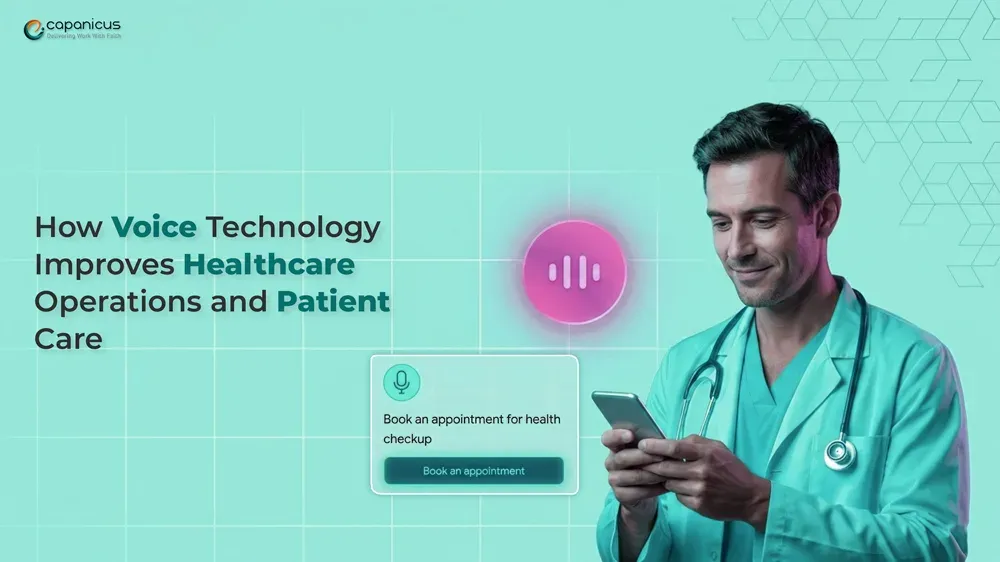
Voice technology in the healthcare industry helps physicians chart patients’ notes, pull up medical histories, or alter a patient’s room settings, all by speaking. From a user’s perspective, the enhancements in voice technology allow for a human-like verbal communication between patient and care provider.
A strong example of voice technology in healthcare is the Healthy Coping voice bot deployed on Google Home. It’s specifically designed for patients with type 2 Diabetes mellitus. This solution was curated as easy and physically convenient, with understandable language and communication.
Whereas, from a practical perspective, voice technology is able to support routine care through automatic at-home monitoring, triaging, screening, providing medical recommendations and guidelines, and enhancing operational workflow. Also, a healthcare software development company helps hospitals reduce their infection risk and exposure of medical staff by automatic paperless and hands-free scripting services like dictating visit notes, charting, and patient onboarding.
Types Of Voice Tools the Healthcare Industry Uses Today
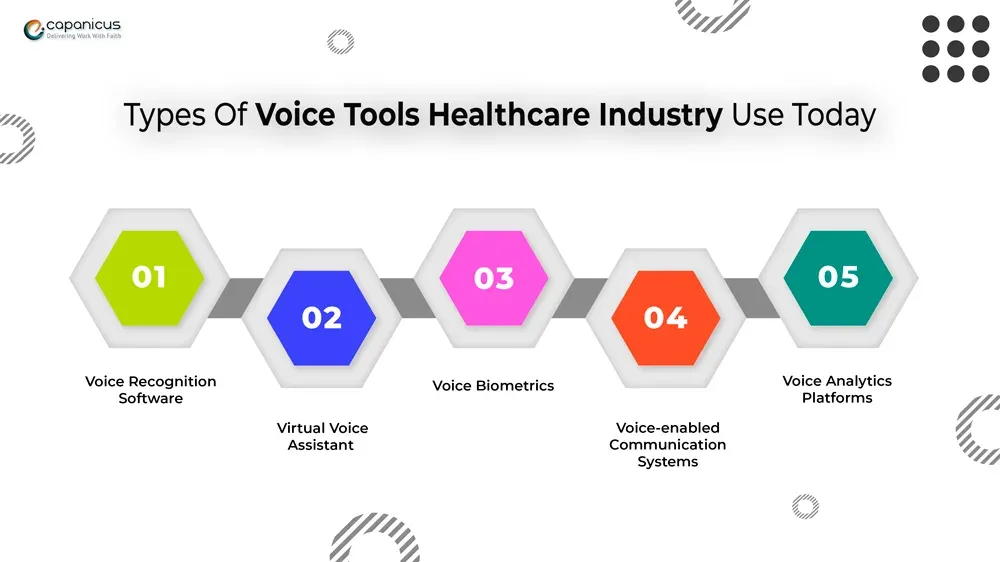
You must have heard of voice tools before you understand their purpose and benefits. Their primary objective is not confined to offering pre-recorded answers only. They also help listen, interpret, and impact healthcare.
- Voice Recognition Software
Voice recognition is a pioneering technology bracing healthcare software solutions. This technology advancement transcribes words into text for easy and optimal records. For example, you say, and the voice-activated software writes directly into your electronic health record (EHR).
- Virtual Voice Assistant
VA, aka Voice Assistant, offers healthcare-specific knowledge to users like Alexa or Siri. You can use them to inform patients regarding medication or follow-up, considering their vital and health status. To add, healthcare organisations can integrate lab reports with VA.
- Voice Biometrics
These software solutions leverage voice as a password. This means that voice biometrics doesn’t depend on login credentials. Indeed, with this tool, medical records of patients are safe and only accessible to the permissible practitioners.
- Voice-enabled Communication Systems
Voice-enabled communication tools in healthcare have streamlined and revolutionised communications for all the right reasons. They are cloud-connected, HIPAA-compliant, and can be easily integrated with internal routing systems, scheduling tools, and EHRs.
Their core purpose is not just improving interaction but accelerating coordination. Whether a voice is routed and transcribed, everyone in the medical institution is interconnected, and one delay can cause fatal damage.
- Voice Analytics Platforms
These are another type of voice identification tool. They assess tone, sentiments, word choice, speed, and stress level when providing critical insights. A trusted medical software development company can help in interpreting these sentiments that sometimes remain unnoticed or unidentified.
Benefits of Integrating Voice Technology In Healthcare Process
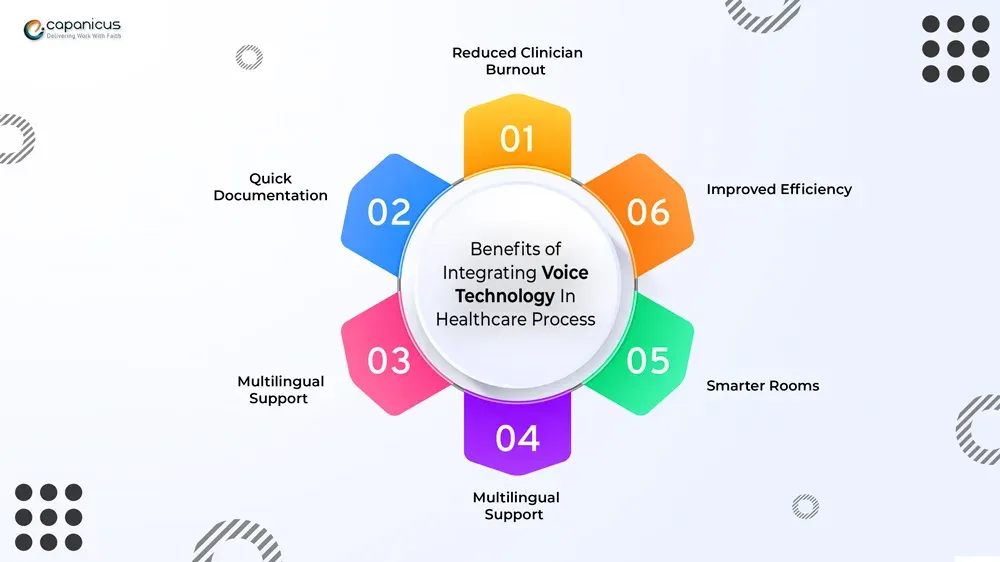
Let’s look at some of the benefits healthcare providers and organisations are experiencing by integrating it.
- Reduced Clinician Burnout
As aforementioned, EHR burnout is real. Doctors spend long hours clicking through templates after patients leave. Voice technology saves time exponentially by cutting the load.
- Quick Documentation
Voice technology helps providers to speak notes directly into the EHR. It’s fast, reliable, and lets physicians focus on the patient’s care rather than the screen. Voice technology is also improving in its ability to pixelate images from diagnostic scans, offering clearer visual information for clinicians.
- Multilingual Support
Today’s voice technology provides multilingual support that transcends geographies. In essence, voice technology bridges the gap between doctors, patients, and nurses who face challenges in language or don’t understand a specific dialect or language.
- 24*7 Care Connection
Usually, in distributed systems, communication often faces challenges or breakdowns. But with voice technology integration, patients and caregivers are connected in real-time across zones and shifts.
- Smarter Rooms
Patients with special needs can use the voice-oriented platform to adjust lights, temperature, or blinds without needing to press a button or wait for a staff member. All of this can be done by merely speaking and still feeling independent.
- Improved Efficiency
Voice technology reduces the time healthcare professionals spend on administrative work by ensuring the documentation stays up-to-date and accurate. This enables the medical practitioners to invest more time in patient interaction and research to enhance health care plans and results.
Explore Similar Topics
How Healthcare Software Supports Daily Medical Operations
AI-Driven Telemedicine Apps Shaping the Next Generation of Patient Care
Final Thoughts
Today, voice technology is all about actively improving how healthcare works.
It is reducing the burden on providers, giving patients more control and comfort, and bringing disconnected systems together into one smooth flow. What in the past felt like extra work is now being handled in the background.
In fact, AI-driven healthcare solutions are expected to save the industry up to $150 billion annually by 2026, largely by automating repetitive tasks and improving operational efficiency. This is what makes healthcare leaders choose voice-first Healthcare Software Services, companies like Capanicus, in simplifying their everyday operations. From managing front-desk tasks to capturing clinical notes in real time, the focus shifts back to patient care instead of paperwork.
For healthcare leaders today, voice technology is not just about saving time; it is about working smarter, responding faster, and delivering better care without overloading teams.
And that is exactly where the future of healthcare is headed.