





The Common Challenge of IT Industry
The IT industry’s work primarily revolves around development or use of innovative and custom software applications. They offer a range of IT services to their clients and customers. The services can include cloud computing, cyber security, and network management. Moreover, they can include IT consulting, troubleshooting and maintenance.
IT businesses face a common challenge. This is how to make their IT workflows more efficient and productive. Furthermore, they need to reduce their IT-related costs without affecting their products and services’ quality. Here, AI-powered automation comes to their aid.
How AI-Powered Solutions Can Help?
AI-Powered Solutions help automate both simple and complex IT tasks without impacting precision and quality. The complex IT tasks include software development, deployment, networking, and patching. Some other complex tasks include decision-making, data analysis, fraud detection, predictive maintenance, and the formulation of personalized marketing strategies. AI solutions can manage complex processes by learning, adapting, and making decisions.
AI solutions can also automate simple and repetitive tasks like data entry and scheduling. This saves IT professionals’ time which they can devote towards innovation and performing other high-value tasks. Automation thus helps improve their efficiency and productivity. Moreover, it saves costs for the organization and helps it gain a competitive edge.
AI-driven automation solutions are also useful to detect anomalies in advance. Therefore, IT personnel can fix them quickly. This ensures continuity of operations. Moreover, it leads to reduced downtime.
Furthermore, the solutions help businesses optimize their systems’ performance and improve their reliability.
Furthermore, AI solutions help automate troubleshooting. Furthermore, they improve decision-making by analyzing identified patterns and trends in the data. The data analysis provides businesses with critical insights for improved decision-making.
Businesses can easily scale AI solutions as per their growing business demands and needs. Therefore, businesses can handle increasing workloads and complexity.
Technologies Used
AI-powered automation combines AI technologies with other components to automate complex tasks. The AI technologies include machine learning, NLP, and computer vision. The other components include Robotic Process Automation (RPA) and Business Process Management (BPM).
Moreover, AI-driven automation can use other essential components for reading documents and APIs for integrating different systems. Optical character recognition (OCR) is one such essential component used for document reading.
Roles of AI Automation:- AI automation primarily performs two roles. In the first role, AI serves as the Eyes and in the second one, it serves as Hands.
AI Automation Serves As Eyes:- In the first role, AI serves as eyes to see and perceive the situation. Here, AI gathers and interprets data from its environment. It uses technologies such as computer vision and natural language processing for this purpose.
Computer vision sees images and videos. Natural language processing reads and understands text or hear spoken language. Moreover, AI uses data analytics to process complex datasets and identify patterns or anomalies. The purpose is to understand the current state, context, or intent.
AI enhances visibility and predictive power by seeing and perceiving. Human eyes cannot match this power. This promotes proactive IT management instead of reactive IT management.
AI Automation Acts as Hands:- In the second role, AI acts as hands to perform certain actions or steps. Insights gathered during the previous seeing and perceiving phase help determine the actions. The actions can automate and streamline the resolution of the issue identified during the previous (seeing) phase. Other actions can be performing simple and repetitive digital tasks like doing data entry or generating reports.
The actions can also include controlling physical machinery like robotic arms in a factory or self-driving car components. Some other actions can be sending communications like automated emails or chat responses. AI automation can perform some other actions. These can be modifying systems such as adjusting climate controls or cyber security responses.
These two roles work alongside each other within an AI system. The AI first sees and perceives the situation. Then it performs a suitable action upon it to achieve a particular goal or automate a process.
Prominent AI Automation Tasks in the Seeing Stage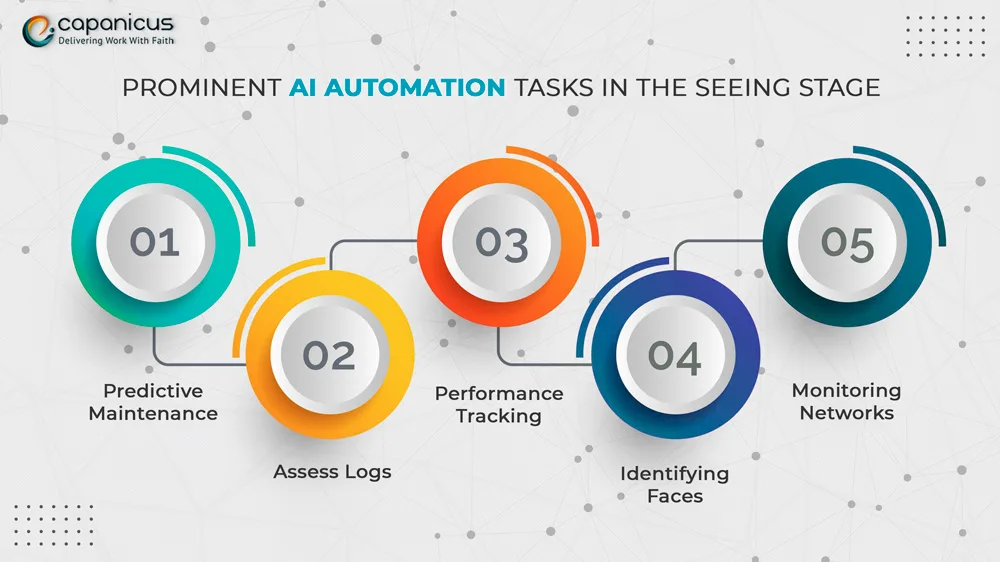
AI automation interprets visual data to perform various seeing and perceiving tasks. The tasks help automate processes. Moreover, they improve security and efficiency of operations.
To do these tasks, AI automation employs various AI-Driven Technologies. They include Deep Learning, Machine Learning and Large Language Models. Moreover, they include Natural Language Processing and Computer Vision.
- Predictive Maintenance:- Artificial intelligence in predictive maintenance analyzes performance data of the past. Here, AI algorithms can predict failures associated with hardware or system-related outages before they actually take place. This enables IT teams to act proactively to resolve the factors responsible for causing these failures or outages. This eventually prevents downtime and its impact on the company’s operations.
- Assess Logs:- AI-powered systems can process huge amounts of log data in real-time. The data relates to various applications and networks. This enables them to identify patterns in the log data that are uncommon.
They can identify possible security risks or threats. They can compromise the security of the company’s networks and applications. The AI systems can identify anomalies in the data or security threats much faster than manually performed reviews.
- Performance Tracking:- AI-driven agents monitor metrics related to systems on a constant basis. Insights from the metrics enable agents to automatically adjust the company’s resources according to variations in the demand. Capacity of the company’s servers is an example of such a resource. This ensures IT systems have optimal performance and enhanced efficiency.
- Identifying Faces:- AI-based systems perform recognition or verification of employees, team members and other persons. After successful verification and identification, they grant people secure access to controlled server environments. This enhances authentication beyond traditional security methods such as passwords.
- Monitoring Networks:- Data Centers make use of AI-enabled thermal imaging and cameras to track physical equipment. This helps them identify early warning signs related to problems. Some of them can be overheating or physical damage. This enables businesses to perform predictive maintenance.
Noteworthy AI Automation Tasks in the Execution Stage
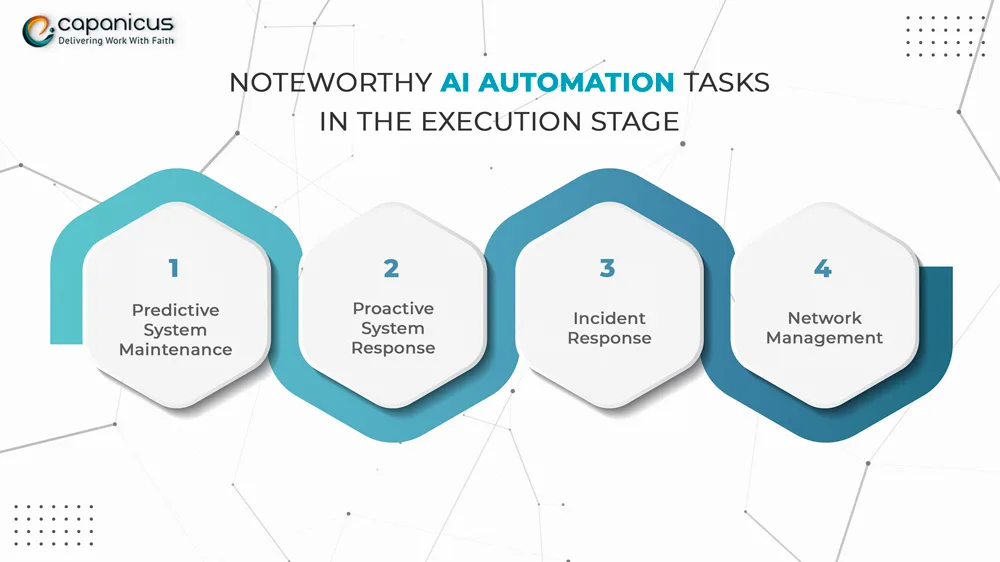
During the action or execution phase, AI-driven tools perform various IT automation-related tasks. They include manipulating IT systems and data and executing multi-step workflows without constant human intervention.
These tasks relate to the IT Operations and Security category.
- Predictive System Maintenance:- AI-driven automation systems assess sensor data from IT infrastructure and equipment. Accordingly, they can predict potential failures. They can be in terms of a server crash or a hard drive failure.
Before these failures occur, AI-powered tools for automation can automatically schedule maintenance tickets. They can alternately initiate migration of the data or implement backup-related processes. Thus, automation systems help prevent downtime.
- Proactive System Response:- AI-enabled systems track traffic conditions of the network. Moreover, they monitor the performance of various systems in real-time. While monitoring, they can automatically identify irregularities.
Moreover, they can implement containment or mitigation protocols upon identifying a security-related threat or risk. Isolating an impacted system is one such protocol.
- Incident Response:- There are some common, defined issues in terms of a service restart or a file system cleanup. AI-based automation systems can accordingly trigger and execute pre-defined incident response playbooks to resolve problems quickly.
- Network Management:- Based on real-time conditions and without manual reconfiguration, AI automation can automatically optimize network performance and route traffic.
- Generation of Code:- Generative artificial intelligence tools can build significant parts of application-related code. Moreover, they can generate documentation related to it. Alternately, these tools can suggest effective solutions for any problems identified in the code. Later, the professionals can later integrate and execute the created code and documentation within application development’s workflows.
- System Migration:- AI can streamline the process of migrating legacy applications. Alternately, it can integrate diverse sources and services related to data. To streamline the process, AI manages data reformatting and orchestrates data flows of complex nature.
- Automated Testing:- AI automates procedures for testing and manages the software updates’ deployment. This ensures consistency and brings down human error in the software building life cycle.
- Drawing Out Data:- AI-enabled automation systems draw data from various sources. They use computer vision and natural language processing for drawing the data. The sources include unstructured documents. Moreover, they include images, forms, or emails.
Then systems automatically enter the data into customer relationship management systems and databases. This helps bring down the amount of manual effort required for managing the data. Furthermore, it minimizes the number of errors caused by the manual entry of the data.
- Cleaning of Data:- AI automation helps recognize and eliminate certain data points from the company’s datasets. These data points are irrelevant, erroneous or duplicate. Afterwards, it prepares the data for review or model training. AI automation doesn’t need human input for performing review or training.
- Generating Reports:- AI-based systems collect and aggregate the data from various sources and format it. According to the data, the systems can create routine reports related to system performance or compliance to regulatory standards.
These tasks belong to the Administration and End-User Support category.
- IT Helpdesk Services:- Virtual assistants and chatbots powered by artificial intelligence can manage information technology-centered questions of basic nature. These include managing requests for allowing access to the company’s systems. Moreover, they relate to resetting of user passwords.
The chatbots and agents can independently implement the necessary actions to resolve particular issues. These actions are as per the IT-related queries.
- Managing Schedules:- There are insights obtained from assessment of participants’ schedules and involved constraints. AI recommends optimal meeting times as per the insights. Moreover, it sends invitations to participants. Moreover, artificial intelligence performs automated management of RSVPs.
- Provisioning Users:- Artificial intelligence can perform automatic management of system access in certain situations. They can include a new employee joining an organization or an existing one leaving it. Moreover, it can automatically create accounts or withdraw permissions across various systems.
It’s time to know about the positive impact and benefits granted by AI-driven automation.
The advantages and impact include increased efficiency and productivity through automation of repetitive tasks. Moreover, they include decreased operation-related costs and human errors.
Furthermore, the advantages include better decision-making through data analysis. AI automation can also provide 24/7 support and personalization to customers. This results in better customer experiences. Moreover, AI-Powered Solutions and Tools offer greater scalability for management of varying workloads.
Let’s now know about the impact and benefits of AI-enabled Automation in some more detail.
Major Advantages and Impact of Artificial Intelligence Automation
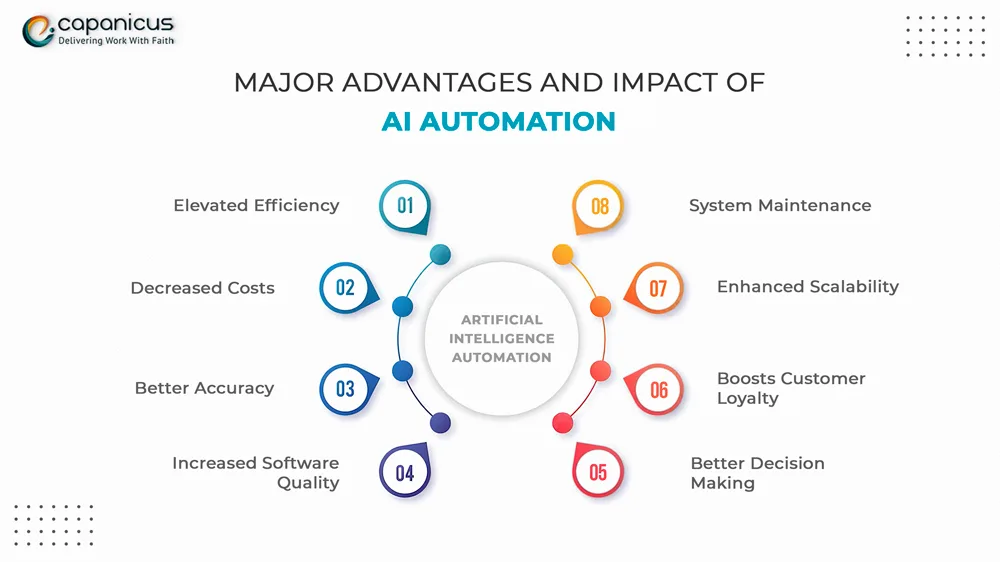
- Elevated Efficiency:-Artificial Intelligence automates tasks of repetitive and mundane nature and quickens their completion. Therefore, processes can be executed in less time. Moreover, their execution requires fewer resources.
The automated tasks include AI chatbots handling a major share of customer inquiries in an independent manner. Moreover, they include intelligent document analysis.
Automation of these tasks makes employees free to focus on innovation and perform increasingly strategic, creative, and complex activities. Thus, AI helps reduce the workload of IT professionals and increases their output. Moreover, AI contributes to improving the company’s efficiency.
- Decreased Costs:- AI-Powered Solutions and Tools automated repetitive tasks. This helps bring down the workload of developers and lessen infrastructure costs. Moreover, the use of these tools reduces errors, resulting in decreased operation-related costs.
Furthermore, AI-enabled automation lowers the need to rework. Furthermore, it reduces downtime. This also contributes to decreased expenses.
- Better Accuracy:- AI systems can do tasks with increased degree of accuracy and consistency. This is critical for processes that involve large volumes of data. This helps decrease errors that can occur while performing manual input of data.
Artificial intelligence also enables businesses to implement software-based projects with elevated accuracy. It does this by suggesting realistic deadlines as per the assessment of past development cycles. The assessment also helps lower the risk of overpromising and underdelivering.
- Increased Software Quality:- AI-driven software testing identifies various bugs and vulnerabilities before the production stage.
- Better Decision-Making:- AI has advanced data processing capabilities. This enables businesses to assess vast amounts of data in real-time. Moreover, businesses can obtain valuable insights from the data.
The insights help businesses make informed and strategic business decisions regarding capitalizing on emerging beneficial opportunities. Moreover, the decisions enable them to respond effectively to risks.
- Boosts Customer Loyalty:- AI-powered tools like chatbots and recommendation engines help offer swift and personalized customer support. Moreover, they can offer customer support on a 24/7 basis. This consequently boosts customers’ satisfaction and they become more loyal to the company.
- Enhanced Scalability:- Scalability is one of the significant considerations while designing AI-driven automation systems. They make use of distributed architectures and cloud-enabled computing to scale information technology resources in a dynamic way.
Moreover, the systems adopt scalable AI-related frameworks and platforms. They enable businesses to scale up or down their operations to meet their changing demands. Moreover, they needn’t increase their resources significantly or undertake major process overhauls for their varying demands.
- System Maintenance:- AI-Powered Solutions for automation can track performance and data of systems in real-time. Moreover, they can recognize any potential threats, issues, and vulnerabilities in advance. The solutions can even take corrective actions in an automated manner before critical failures actually take place.
The solutions can perform predictive maintenance. This helps predict failures associated with IT hardware or software. Moreover, AI solutions can protect data which prevents compromising of data. Furthermore, they can contribute towards improving the quality of service.
Your business may also want to avail these benefits granted by the AI-Powered Automation Tool and Systems. To achieve these benefits for your company or business, you need to develop a custom AI automation system.
Therefore, you need to partner with a reliable and established software development company like Capanicus. The company has exceptional expertise in building tailored, innovative, scalable, and secure AI-Powered Solutions for Automation. The solutions serve IT and other industries. Share your unique business needs with our experts to allow them to proceed towards building the system for you and