These days, businesses more and more make use of AI Virtual Agents and AI Virtual Chatbots to provide better customer service, perform administrative duties, and gain effectiveness with the use of smart machines. From improving customer support instantly to simplifying workflows, AI-powered tools are disrupting industries worldwide.
At Capanicus, we are the experts in cutting-edge Artificial Intelligence Services that can help businesses succeed in the AI age by scaling new heights.
AI Virtual Agent Development: The Future of Customer Engagement
An AI Virtual Agent does not just represent an automated chatbot; it is a highly advanced AI system designed to operate on its own, just like a human. Smart applications that take care of things like customer support and business process automation are the main reason why industries are getting transformed by AI tech worldwide and are seen to be the ideal solution for the future of customer engagements. Our release of AI Virtual Agents provides the following:
- Give customer service that functions day and night. Automatically perform the same task
- Gain better response rates in NLP (Natural Language Processing) due to work precision.
- Make an Experience Personal with Tenure Interactions
- Make a Cut in Operation Costs
AI Virtual Chatbot Development: Smart Automation for Businesses
Chatbots are the quintessential tool for organizations to improve interaction with users and to make communication easier. Thanks to our AI Virtual Chatbot Development services, companies can:
- Automate the frequently asked questions and customer inquiries. Connect chatbots with CRM, ERP, and other systems.
- Customize customer satisfaction with the help of AI technology and analytics
- Curtail the usage of organic sources and the done-by-hand selling behaviors of the sales team
Our chatbots get their power from AI and ML algorithms that unfold and progressively learn from discussions, results enhancement, and getting better at keeping the business at the desired level.
Why Choose Capanicus – A Leading AI Consulting Company?
Artificial Intelligence Consulting Company functions as your reliable guide in the world of business transformation. Our company offers everything, from Artificial Intelligence Services to full-service AI Consulting for businesses who are looking to integrate AI into their existing workflows. That may be bringing AI to your analytics suite, it may be machine learning models, conversational agents, or even chatbot development. Anyway, our team of professionals is ready to provide you with the best service tailored to your business needs.
Our AI Services Include:
- AI & Chatbots Development
- Machine & Solutions
- Predictive & Business
- NLP
- AI automation
Transforming Businesses with AI: The Power of Virtual Agents & Chatbots
In today’s fast-evolving digital landscape, businesses are actively seeking innovative ways to enhance customer experiences, improve operational efficiency, and drive revenue growth. Artificial Intelligence (AI) is leading this transformation, providing businesses with smart, automated solutions that improve communication and decision-making.
At Capanicus, we specialize in AI Virtual Agent development, AI Virtual Chatbot development, and end-to-end Artificial Intelligence Services that help businesses leverage the power of AI-driven automation. As a trusted AI Consulting Company, we guide organizations in implementing cutting-edge AI solutions that enhance customer engagement, streamline operations, and boost overall efficiency.
What is an AI Virtual Agent?
An AI Virtual Agent is a sophisticated AI-based setup for conducting a lifelike and natural conversation. As opposed to the typical rule-based bots, these virtual agents incorporate Machine Learning (ML), Natural Language Processing (NLP), and Artificial Intelligence (AI) technologies to comprehend, interpret, and react to user requests in real-time.
Various Types of AI Virtual Agents
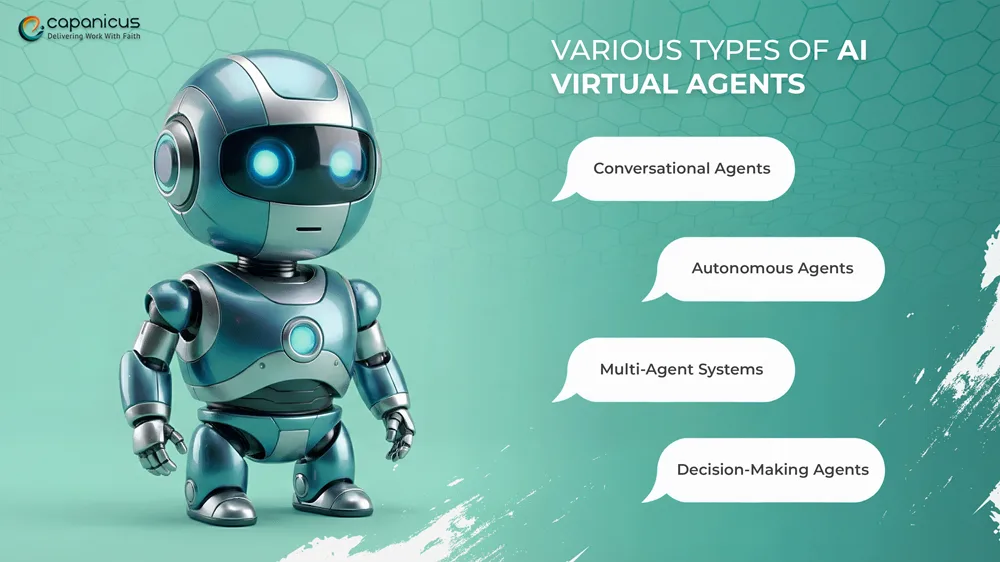
There are several types of AI virtual agents. Each one of them possesses different capabilities.
Conversational Agents:- These include virtual assistants. They communicate with humans with the help of natural language processing. Siri is a fine example of conversational AI virtual agents.
Autonomous Agents:- These agents function in an independent manner. Moreover, they do not require human oversight. They find use in robotic systems and smart factories.
Moreover, they are used in automatic vehicles. Here, they are used for decision-making and real-time processing.
Multi-Agent Systems:- MAS are multiple AI agents. They work together to achieve a specific goal. A multi-agent system can deal with tasks requiring coordination and collaboration. This makes these systems useful for various industries. They include healthcare, the financial sector, and logistics.
Decision-Making Agents:- These agents perform analysis of the data, review various options and take optimal decisions as per an already defined criteria.
Decision-making AI agents are applied in various sectors. They include insurance and banking. Here, these agents perform risk assessment and analyze investments. Moreover, they optimize pricing-related models.
Main Components of AI Agents

AI agents are built on several foundational components. They work together to enable agents to perceive, reason, act, and learn. These fundamental components enable agents to interact with the world.
Moreover, the components allow agents to make informed decisions. Furthermore, they help them improve over time.
- Perception:- Perception is the way an AI agent collects information from its environment and interprets it. This information can be in the form of text input. Alternatively, it can be data derived from sensors and cameras.
Perception functions in this way. Perception helps provide visual, auditory, or textual data to AI agents. They then perform processing of the data to understand the specific context of the situation.
- Reasoning:- AI-driven agents use the reasoning process to analyze the perceived data and make decisions accordingly. It comprises logical thinking, problem-solving, and drawing conclusions on the basis of available information.
Reasoning works in this way. The AI agent first collects the information. Then it utilizes algorithms to do reasoning about the situation.
- Action:- Action consists of the steps that an AI agent implements according to reasoning done by it. AI agents first do processing of the information and then they analyze it. Then they perform tasks to give response to a situation. Alternatively, they perform tasks to achieve their goals.
Action works in this way. The agent performs actions according to its goals and the reasoning behind those goals. Giving a suitable response to a customer’s inquiry or making adjustments to the inventory levels are the examples of action.
- Learning:- Learning enables AI agents to adapt themselves and improve over time according to new data and past experiences. With the help of machine learning, agents can continuously fine-tune their capabilities.
This is how learning functions. AI agents use various algorithms to make adjustments to their decision-making process. These algorithms include supervised learning and reinforced learning. Alternatively, they may include deep learning.
Moreover, agents use them to improve their accuracy and efficiency with each interaction. This enables them to manage increasingly complex tasks. Moreover, this enables them to adapt themselves as per the changes in their environment.
How AI Agents Work?
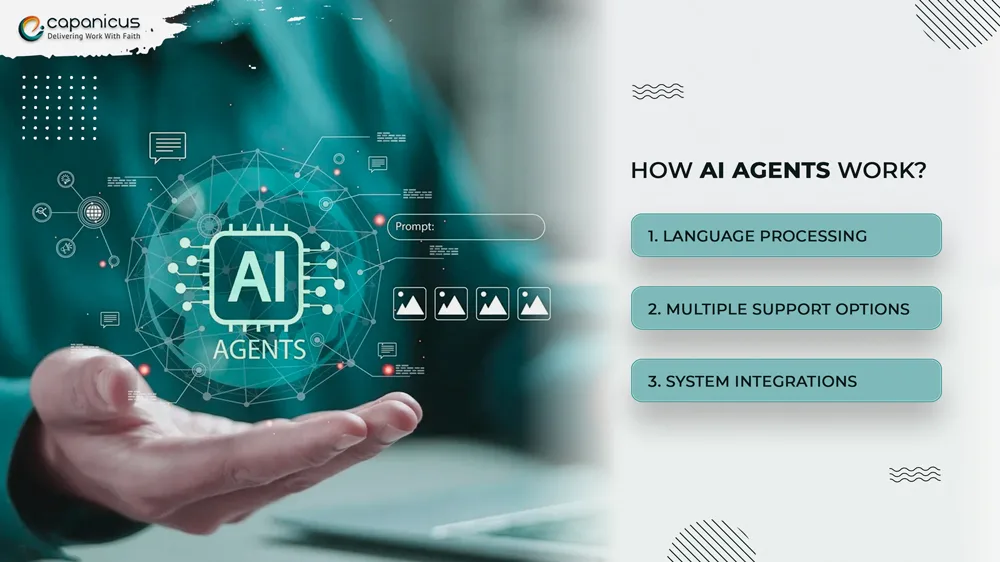
AI-driven virtual agents transform customer support service by offering intelligent and multi-channel support. They perform these core functions to boost customer support.
Language Processing:- Virtual agents make use of natural language processing to understand customer queries and respond to them in a more effective way. They gain an understanding of the subtle nuances and context of customer conversations. Then they accordingly provide customized customer responses.
Multiple Support Options:- AI agents gain an understanding of the language. Moreover, they offer consistent support to customers over different communication channels. They advance their language capabilities to offer seamless customer support across various platforms. These include email, voice, and web. They also consist of social media, and mobile. This elevates customer satisfaction and decreases operational costs.
System Integrations:- Virtual agents can be integrated with existing business systems within an organization. The integration lets them access customer data. Moreover, it enables them to automate tasks and personalize interactions. Furthermore, virtual agents can seamlessly transfer interactions to human agents when required.
Setting Up Virtual Agents
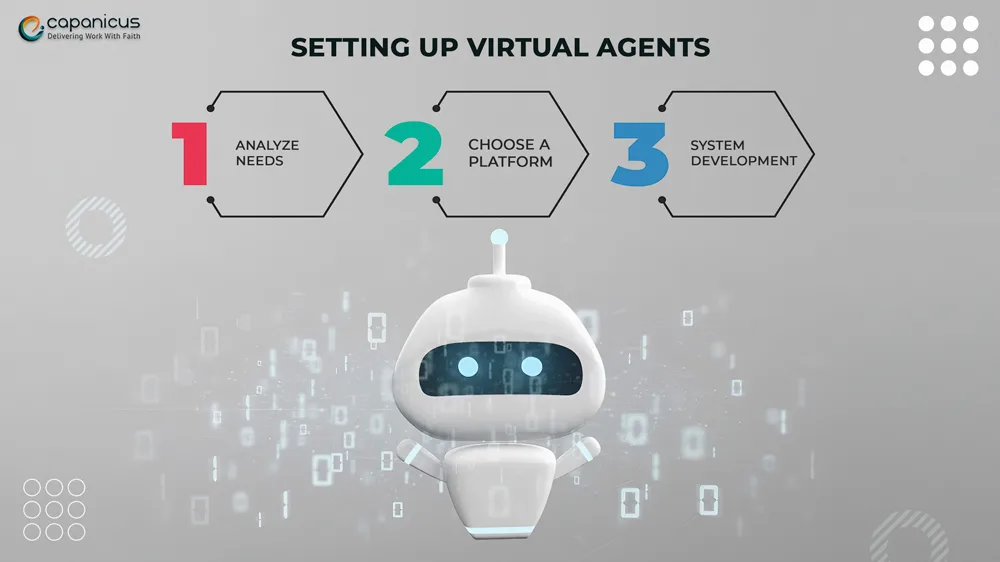
- Analyze Needs:- The first step is to perform analysis of your existing support operations. This will help you identify particular key areas where AI can have the greatest impact. Call volume is one such area. It consists of various metrics to consider. They include average daily calls, peak times, and seasonal trends. The impact analysis helps determine the capacity needs of an organization.
Customer inquiries are another significant area. Key metrics falling in this area are frequency and complexity of queries and time spent in their resolution. It shapes knowledge base requirements.
Yet another area is self-service demand. It considers metrics like website traffic, use of FAQs, and customer feedback. The impact analysis guides automation priorities.
Allocation of resources is another area. It pertains to metrics like workload of agents. It also includes response times and cost per interaction. The impact analysis helps identify efficiency improvements.
- Choose a Platform:- Opt for that virtual agent system which is in alignment with your particular technical infrastructure. Moreover, it should align with your business goals. To choose the system, you have to consider some critical factors. One of them is making sure the system integrates with your existing tools in a seamless manner. Moreover, the platform should provide desired customization options. Furthermore, it should flexibly align with the particular voice of your brand.
The platform you choose should comply with the given compliance standards. This includes PCI compliance for payment processing. It should also meet security requirements related to a particular sector. Moreover, the platform should be scalable as per the growth of your business.
- System Development:- The development of your selected system requires creating a comprehensive knowledge base. It is equipped with well-organized conversation flows and responses. They are in alignment with your brand.
After the AI system is developed, it is used for the desired purposes. The system is continually updated and optimized for maintaining effective performance over time. This will require undertaking data-driven training of the system. Moreover, it will require performing various quality assurance tasks. Continual training helps maintain the accuracy of the system over time. Furthermore, the training helps maintain its effectiveness and performance over time.
Data-driven training involves development of training datasets. They are relevant and well-rounded. Training also involves monitoring performance of agents on a consistent basis. This helps identify areas where improvement is needed. Furthermore, the training involves utilizing advanced analytics to gain a better understanding of customer interactions.
Quality assurance involves developing workflows that include regular performance reviews. Moreover, it includes updating algorithms based on interaction data. Furthermore, QA tasks involve continuously fine-tuning responses for increased accuracy.
Key Benefits of AI Virtual Agents
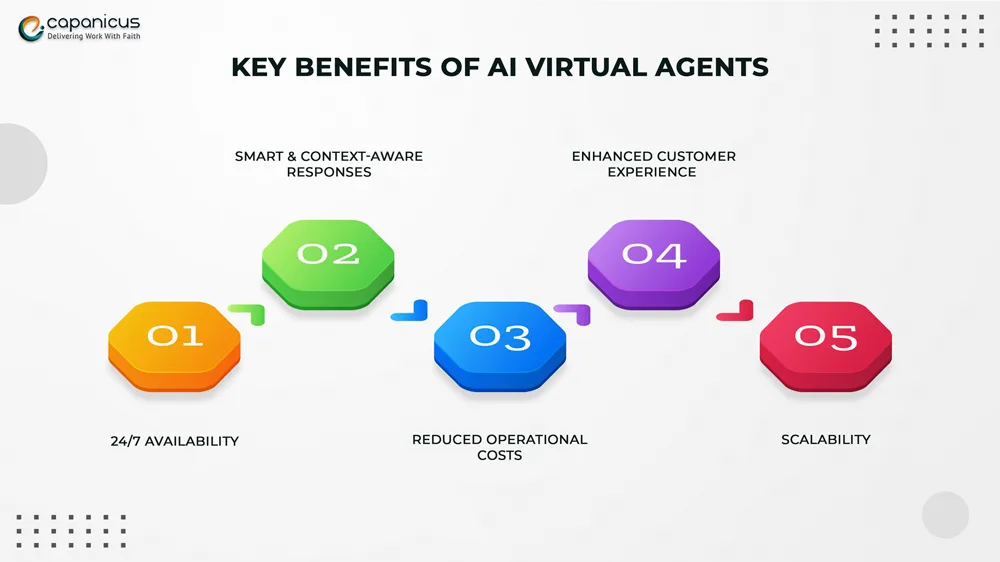
24/7 Availability– By delivering AI-based virtual agents, organizations ensure non-stop support that enables clients to get the answers almost immediately, without waiting in long queues.
Smart & Context-Aware Responses – Virtual agents can leave behind the usual chatbot limitations as they can understand the context and are thus able to constantly be learning from the conversations and provide the user with accurate, relevant responses.
Reduced Operational Costs – Automation of customer service is bound to bring about the elimination of repetitive tasks thus directly reducing the operational costs of companies. On the other hand, it will also improve the response time of the customers who have approached the service.
Enhanced Customer Experience – Virtual agents can offer personalized interactions, thus customer encounters become more memorable as they feel a connection with the brand.
Scalability –AI-driven virtual agents can handle multiple client interactions at the same time; thus, they are the most preferred among the big, medium, and small-sized enterprises.
At Capanicus, we provide AI Virtual Agent development solutions to firms operating across different domains such as e-commerce, healthcare, money, and customer support. Our websites, mobile applications, and messaging platforms are powered by AI-enabled tools that smoothly connect with them and hence improve interaction capabilities for the users. AI virtual agents become even more powerful when integrated with an omnichannel communication platform. By connecting voice, live chat, email, SMS, WhatsApp, and social media into a single interface, businesses can deliver faster, more consistent, and personalized customer support across every touchpoint.
AI Virtual Chatbot Development: Revolutionizing Customer Support
Effective customer engagement requires businesses to provide immediate and uninterrupted communication channels. AI Virtual Chatbot development has a huge impact on the success of the entire process. A smart chatbot is distinct from the common chatbot that relies on a pre-defined script. AI-powered chatbots are known to use machine learning and NLP to comprehend user intent, give accurate answers, and further refine their interactions by learning from previous exchanges.
How AI Virtual Chatbots Improve Business Efficiency
🔹 Automate Repetitive Queries – AI talkbots address the majority of frequent customer inquiries, including FAQs, checking the status of an order, and setting an appointment, which lets the human agents concentrate on harder cases.
🔹 Omnichannel Integration – AI chatbots can be used on different devices such as websites, mobile apps, WhatsApp, Facebook Messenger, etc.
🔹 Personalized Interactions – AI can provide every customer with specific responses that are based on his/her preferences, their history, and the analysis of their tasks.
🔹 Lead Generation & Sales Assistance – Chatbots can also conduct conversations with potential clients, recommend products, and, if necessary, process the transactions.
🔹 Seamless Handoff to Human Agents – A chatbot positioned to pick up on a query would automatically transfer the conversation to a live agent should one be needed.
Capanicus is the home of our AI specialists who design chatbots that are so intelligent and indistinguishable from real humans that they can be used in many different industries. In other words, the kind of bots, whether it is a customer support chatbot, an AI-powered virtual assistant, or sales chatbot, the AI can make scalable andefficient AI chatbot solutions that are exactly what you asked for.
Implementation Challenges
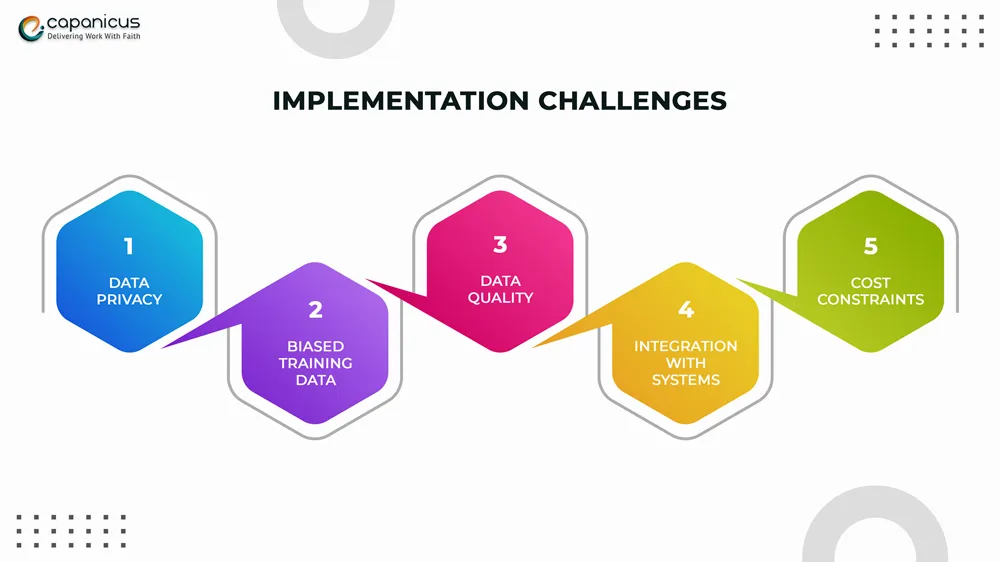
AI agents have immense potential. Implementing them comes with various challenges. These include technical obstacles and ethical considerations. Businesses must address these challenges. Their understanding is crucial for the successful adoption of AI agents.
- Data Privacy:- AI Virtual agents depend on vast amounts of data. It often contains sensitive information. Organizations have to maintain data security. Moreover, they need to strictly comply with data privacy regulations. Inability to maintain data security and comply with data privacy regulations can lead to legal risks. Moreover, this can cause financial risks.
- Biased Training Data:- The data used for training AI agents can cause biases in them. This can result in unfair or biased outcomes.
- Data Quality:- AI agents require different and precise data to work well. Inaccurate or biased data can lower the effectiveness level of the agent. This can affect decision-making. Moreover, this can potentially harm the business’s reputation.
- Integration with Systems:- The AI agents’ integration with current legacy systems can be technically demanding. There are instances where an outdated IT infrastructure doesn’t support technically advanced AI solutions. Replacements or upgrades are required in these situations that can cost businesses a lot of money.
- Cost Constraints:- The implementation of AI agents can be a costly affair, particularly for small businesses. They have to bear expenses for AI development. Moreover, the businesses need to hire skilled personnel for continual maintenance of the AI agents. This adds to their expenses.
Emerging AI Trends

AI agents are evolving at a fast pace. Their potential to transform industries is increasing continuously. AI technology advancements are shaping several key trends and innovations. They are contributing towards redefining the AI agent realm.
The trends and innovations are helping to make the agents more intelligent. Moreover, they are making them increasingly autonomous, and capable.
Here are some of the most important developments in the field of AI agents.
- Frameworks:- Advanced frameworks are increasingly driving modern AI virtual agents. The frameworks include reinforcement learning and deep learning. They also include transformer models.
These frameworks enable AI agents to process huge amounts of data. Furthermore, they enable agents to recognize patterns. They also empower agents to make increasingly precise decisions.
- MAS:- Multi-agent systems are a robust solution for resolution of complex problems. Businesses are adopting them more and more today. Using multiple collaborative AI agents lets businesses manage tasks that require coordination and teamwork. They are especially useful for certain industries. One of them is logistics. Here, different AI agents can work together to handle inventory levels. Moreover, they can collaboratively optimize travel routes. Furthermore, they can make sure the products are delivered on-time.
- Agentic AI:- Certain innovations are furthering the AI agents’ capabilities. One of them is Agentic AI. They are advanced intelligent agents that function in an autonomous manner. These agents gain an understanding of context. Moreover, they reason about problems, and take action with minimal human oversight.
- Industry Use:- Autonomous AI agents have advanced capabilities. They enable them to manage tasks in various sensitive and complex industries. These include healthcare and finance. AI agents can analyze patient-related data.
Moreover, they can make predictions about health-associated outcomes. Furthermore, agents can help make treatment-related recommendations.
AI agents are already performing various tasks in the financial sector. These include improving risk assessments and detecting fraud. Moreover, the tasks include automation of trading. These innovations are enabling increasingly precise and swifter decision-making. This results in better outcomes for both businesses and their customers.
Why Choose Capanicus as Your AI Consulting Company?
AI projects carry great importance in terms of knowing, structuring, and planning sufficiently. As an AI Consulting Company, our business scope involves the ability to guide people and connect them with AI solutions that are embedded in their daily work. Our expert team offers:
✅ AI Strategy & Implementation – We evaluate your business and come up with an AI plan that can be tailored to your specific business needs.
✅Custom AI Development – Our professionals will work with you to create a (unique) custom AI solution for your needs. They will be designed to your exact industrial and business vision.
✅Machine Learning & NLP Solutions – We make AI models that are so smart they can learn and improve by themselves, like chatbots and virtual agents.
✅AI-Powered Analytics – Get data from your business analyzed with the help of AI-driven analytics and predicate intelligence. The findings could be actions that need to be implemented.
✅Seamless AI Integration – We can help you include AI features into the systems you already have – CRM, ERP, and your customer support platform.
In AI Virtual Agent development, AI Virtual Chatbot development, and the Artificial Intelligence Services area, we have teams that have been doing this for quite a while. This is how we help establishments seek new grounds for their business
The Future of AI-Powered Virtual Assistants
Artificial Intelligence technology is advancing rapidly and AI-based assistants like AI Virtual Agents and AI Chatbots will get more intelligent in the future, being embodied with new features which will afford complicated tasks and personalized experiences. Businesses that implement AI automation at present will be able to outperform their competitors through quality, unique, and immersive customer experiences, and lower costs, thus, they will be able to improve their performance.
At Capanicus, we are the preferred developers that deliver the most advanced Artificial Intelligence Services that allow companies to prosper in the internet era. In case you require an AI Virtual Agent, an AI Virtual Chatbot, or expert AI consulting, we can assist you.