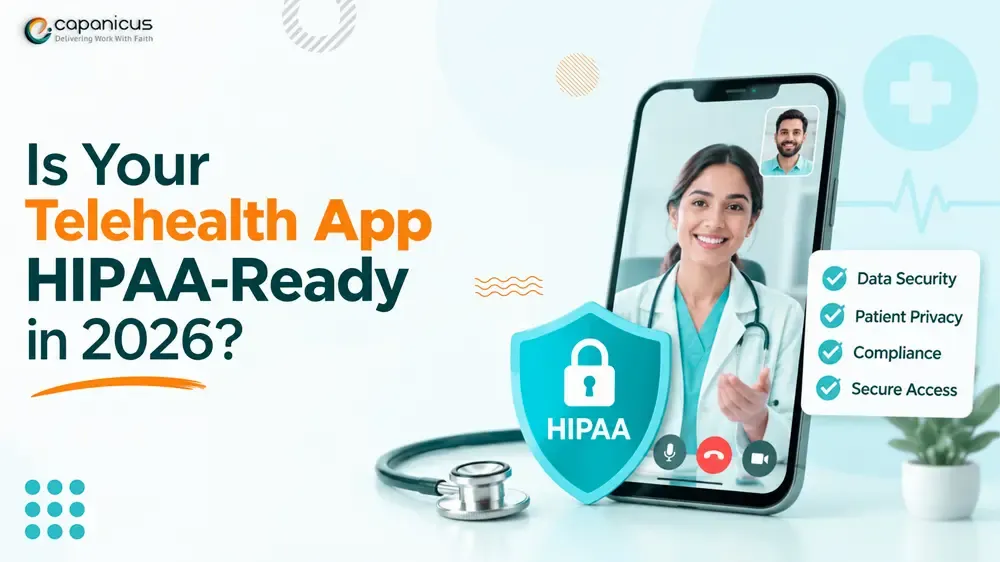
A telehealth startup wins a pilot with a regional hospital, the demo goes well, and then the security questionnaire arrives. Where do session recordings live? Who can open them? When was your last risk analysis?
Teams that can answer in an afternoon keep the deal. Teams that need three weeks of digging often don’t. This guide explains what HIPAA-ready telehealth app development takes in 2026: what regulators are focused on right now, and how to build compliance into the video and AI infrastructure. We also look at two of our own healthcare projects, DrNewMed and Clinicvo, to show why access control and data handling belong in the architecture.
What Does HIPAA Readiness Mean?
First, let’s bust a myth. HHS does not certify apps, so that “HIPAA certified” label on a vendor’s website means nothing in terms of legal compliance.
Compliance is the responsibility of covered entities and business associates, and their compliance is demonstrated through documentation, policies, and controls. HIPAA readiness, in this context, is the engineering side of the process. A ready platform has the Security Rule’s technical safeguards built in and keeps the documentation that proves them. The simplest test we know: can a clinic use your product and stay compliant without workarounds?
What OCR Is Focused on in 2026
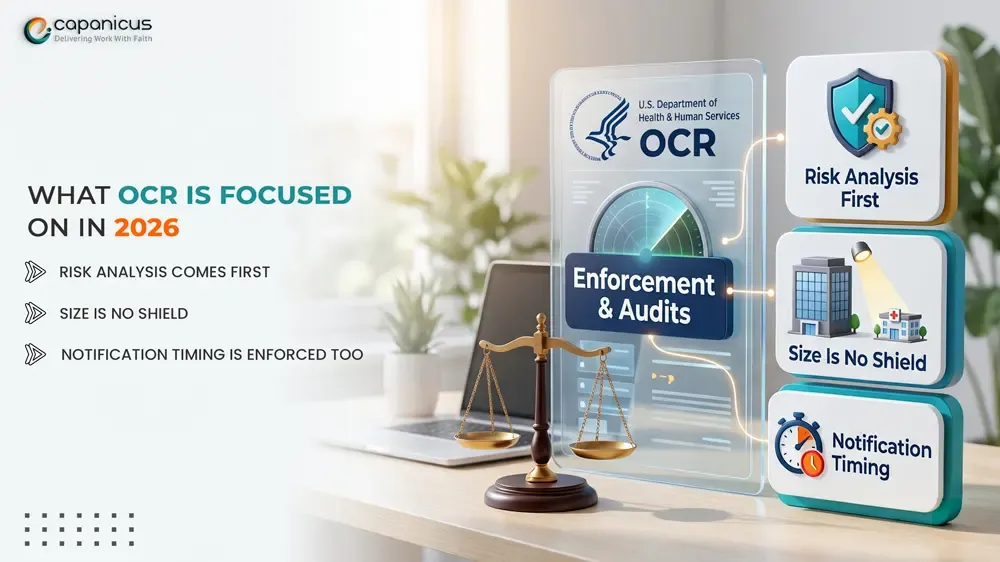
Rulemaking grabs the headlines, but enforcement is where the pressure is. Three patterns stand out in 2026.
Risk analysis comes first. On April 23, 2026, OCR announced four ransomware settlements totaling $1,165,000, tied to breaches that exposed data on more than 427,000 people. Each one cited a missing or inadequate risk analysis. On June 18, OCR added a $450,000 settlement with an employer’s group health plan.
Size is no shield. The smallest of the April breaches affected about 9,300 people, and one of the four settling parties was a third-party administrator acting as a business associate, the same role most telehealth vendors play.
Notification timing is enforced too. On July 29, OSF HealthCare agreed to pay $552,250 over a 2021 ransomware attack, and OCR’s findings included a late breach report.
Why Waiting for the Final Security Rule Is a Mistake
The proposed overhaul is easy to file under “later,” but the details explain why that’s risky.
What the Proposal Would Change
HHS published a proposed Security Rule overhaul on January 6, 2025. In its mid-2026 regulatory agenda update, HHS moved final action from May 2026 to July 2027 and listed it as a long-term action, so that date can still change. If the rule is finalized as written, the HHS fact sheet lists several firm expectations it would add:
- Encryption and multi-factor authentication as requirements instead of addressable items
- Written documentation for security policies, procedures, and analyses
- A technology asset inventory and a network map showing where ePHI lives and moves
The current rule is fully enforceable, and OCR is already using it through the risk analysis requirement. Building toward the proposed standard now is simply cheaper than scrambling later.
Technical Safeguards Mapped to a Telehealth Stack
The technical safeguards in 45 CFR 164.312 turn into design decisions fairly directly. Here is how they map to a telehealth product.
| Safeguard | What the Rule Asks For | How It Shows Up in the Product |
| Access Control | Unique user IDs, emergency access, automatic logoff | Role-based permissions, short-lived tokens, idle timeouts in both clients |
| Audit Controls | Records of activity in systems holding ePHI | Append-only logs for record views, recording playback, and exports |
| Integrity | Protection against improper alteration | Checksums on stored media and versioned clinical notes |
| Person or Entity Authentication | Verification of who is asking for access | MFA for staff and signed single-visit tokens for patients |
| Transmission Security | Protection of ePHI in transit | DTLS-SRTP media, TLS 1.2 or higher signaling, encrypted chat and uploads |
Encryption is still an “addressable” specification: you implement it where reasonable and appropriate, or document why not and use an equivalent measure. It is hard to defend a telehealth design that skips it, and the proposed rule would end the debate anyway.
Building HIPAA-Ready Video With WebRTC
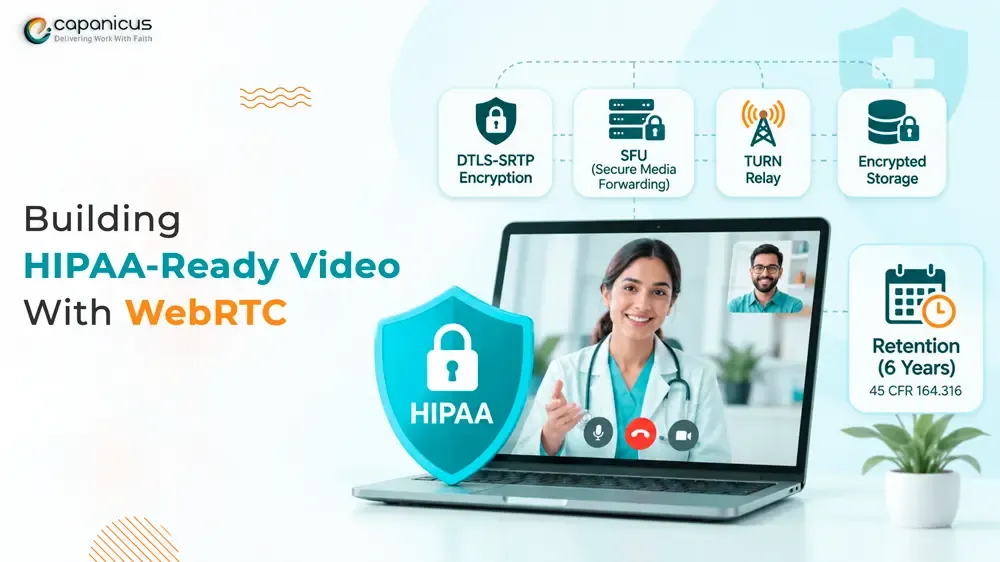
Any WebRTC application used for telehealth starts from one assumption: the media path is a regulated data path, so it has to be designed like one.
WebRTC requires DTLS-SRTP, so all media is encrypted in transit. In a peer-to-peer call, that encryption runs end to end. In a group visit, a selective forwarding unit (SFU) terminates each participant’s encrypted stream and re-encrypts it before forwarding, so the SFU can access the media and sits inside your ePHI boundary.
For one-to-one consultations, peer-to-peer media is the safer choice, with a TURN relay as the fallback when no direct path exists. TURN forwards packets without decrypting them, so the call stays end-to-end encrypted. For group visits, the SFU should run in a segmented network with tight administrative access. Where the risk profile demands it, end-to-end encryption can be added with Insertable Streams, at the cost of extra key management.
Once a visit is recorded or transcribed, that file is PHI. It should be stored encrypted in object storage with tenant-scoped keys and served only through role-restricted, logged requests.
Retention needs more thought than it usually gets. HIPAA’s six-year retention rule under 45 CFR 164.316 applies to policies and documentation, not to video recordings. How long recordings are kept is set by state medical-records law and your clients’ policies, so agree a written retention rule with each client.
How to Handle PHI in AI Scribes, Captions and Summaries
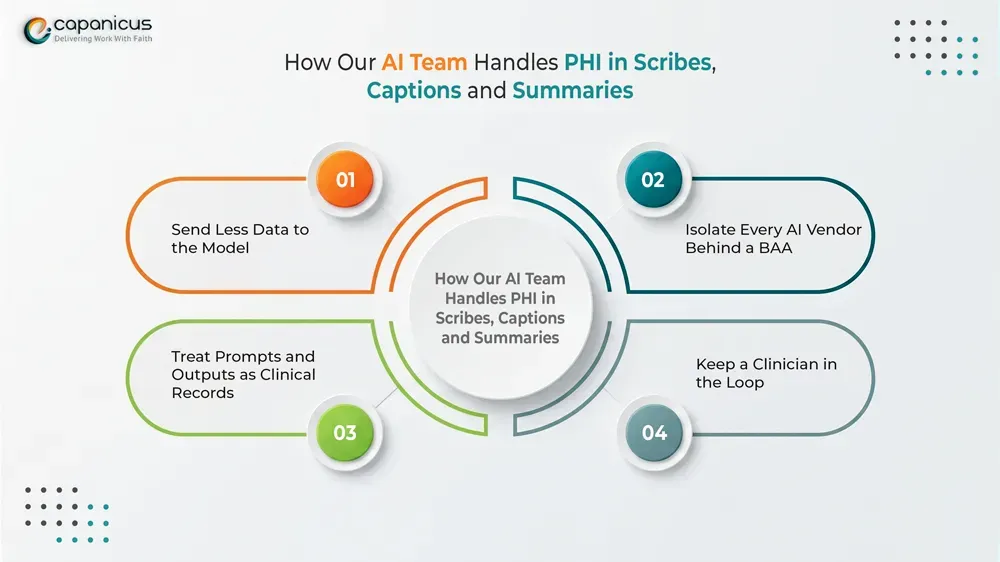
Ambient scribes, live captions, triage helpers, and visit summaries all send patient language through a model. That makes AI features one of the hardest parts of HIPAA readiness in 2026. Four rules keep these features safe in HIPAA-ready telehealth app development.
Rule One: Send Less Data to the Model
The summarizer receives only the necessary part of the transcript segment and no extra data. Where possible, identifiers are stripped inside a controlled environment before anything is sent. Sending a small slice instead of the whole chart limits the damage if something goes wrong later.
Rule Two: Isolate Every AI Vendor Behind a BAA
Every vendor that creates, receives, maintains or transmits PHI signs a business associate agreement. Get two commitments in writing:
- PHI is never used to train models.
- PHI is deleted after a defined retention period.
A HIPAA-ready platform can’t rely on a vendor’s marketing page for either.
Rule Three: Treat Prompts and Outputs as Clinical Records
Prompts, model outputs, and retrieved context can all contain PHI. Apply the same access controls and logging to them as to any other clinical record, so an auditor can see who viewed what and when.
Rule Four: Keep a Clinician in the Loop
Model output stays a draft until a licensed professional accepts it. This protects patients from confident but wrong summaries, and it keeps responsibility for clinical content with the people trained to carry it.
Where Readiness Reviews Usually Find Problems
Most findings come from ordinary shortcuts, not sophisticated attacks. Shared admin accounts erase individual accountability and leave audit logs close to useless. Patient identifiers turn up in URLs, room names, and error trackers. Chat or analytics SDKs get added mid-sprint without a BAA.
The costliest one is a risk analysis done once at launch and never touched again. Given OCR’s pattern, a stale analysis is a liability even when the controls underneath are sound. Updating it with every major release or vendor change is one of the easiest ways to improve HIPAA readiness.
Case Studies: DrNewMed and Clinicvo
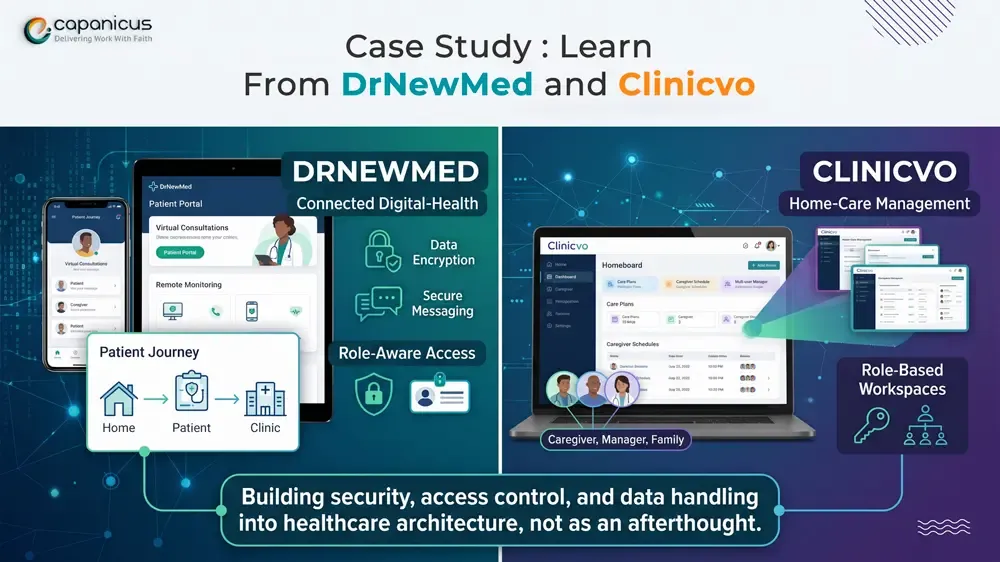
DrNewMed
DrNewMed is a connected digital-health platform that links in-clinic visits, virtual consultations, remote health monitoring, mobile engagement and wellness coaching into one patient journey, through a patient web portal, a mobile app, provider workflows and care notifications.
Almost every one of these features moves sensitive data between patients and providers, so role-aware access and traceable messaging had to be built alongside the features, not added later. Read the DrNewMed case study.
Clinicvo
Clinicvo is a home-care management platform that brings patient records, care plans, caregiver schedules, appointments, attendance, tasks, medication updates and reporting into one system, with 25+ integrated care features.
Caregivers, managers and family members each need a different view of the same patient. Designing those role-based workspaces at the architecture stage costs far less than retrofitting permissions once the platform is in daily use. Read the Clinicvo case study.
Neither project is a compliance badge. Both show how access control and data handling are designed into healthcare software at the architecture stage.
HIPAA Readiness Checklist
Be honest with these questions. Every “no” is a backlog item.
- A written risk analysis covers every system that touches ePHI and was reviewed in the last twelve months.
- Every vendor in the video, messaging, SMS, analytics, and AI path has a signed BAA.
- Video, chat, files, and recordings are encrypted in transit and at rest.
- Clinicians and administrators use unique accounts with MFA.
- You can show who opened a specific patient record on a given date.
- Identifiers stay out of logs, URLs, and error trackers.
- Your incident plan can notify affected individuals without unreasonable delay and within 60 days of discovering a breach, and meets any shorter deadline in your BAAs.
- AI features have been reviewed for training exclusions, retention, and clinician oversight.
Why Choose Capanicus for HIPAA-Ready Telehealth App Development
Choosing a development partner for a regulated product comes down to how well the team handles the places where systems meet. If you are still deciding whether to build at all, compare custom vs white-label telehealth first. Here is how we approach it.
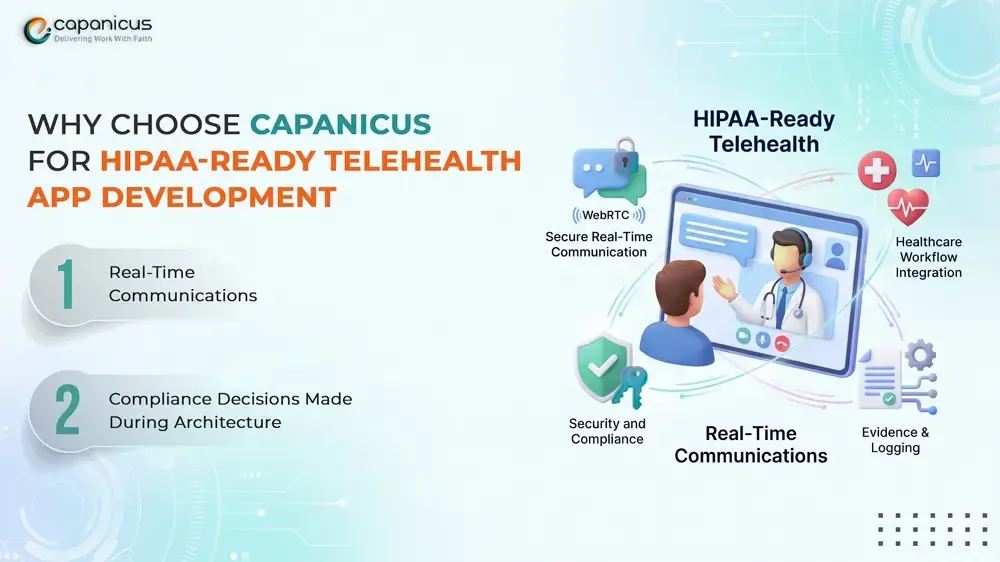
Real-Time Communications, AI and Healthcare in One Team
Most development partners are strong in either real-time communications or healthcare workflows, rarely both. We work across WebRTC, AI and healthcare software, so relay infrastructure, transcription pipelines and data handling are planned together. Security gaps usually open where one system hands data to another, and planning them together helps close those gaps.
Compliance Decisions Made During Architecture
We settle encryption, logging and access control during architecture, before features are built on top of them. Changing these after launch is far harder than getting them right in the design.
Conclusion
The Security Rule update has slipped to 2027, but the direction hasn’t changed. Documented risk analysis, authentication, encryption and vendor control are what OCR keeps checking first. Fixing this during development costs far less than a last-minute change.
If your app isn’t HIPAA-ready yet, or you are planning a new one, contact Capanicus to plan the safeguards it needs across video, data and AI.
Frequently Asked Questions
1. Is there an official HIPAA certification for telehealth apps?
No. HHS doesn’t certify or endorse software. The obligation sits with covered entities and business associates to meet the Privacy, Security, and Breach Notification Rules. Third-party audits can support that effort, but they don’t replace it.
2. What is the difference between HIPAA compliant and HIPAA-ready?
Compliance describes an organization’s ongoing behavior, including policies, training, risk analysis, and incident response. HIPAA readiness describes whether the product makes that behavior possible, with encryption, access controls, audit logs, and vendor agreements built in. A ready app helps a clinic comply, but it can’t do the clinic’s job for it.
3. Is WebRTC safe for HIPAA telehealth video?
WebRTC encrypts media in transit with DTLS-SRTP. That is a good start, not a compliance guarantee. Overall safety depends on the rest of the deployment: SFU configuration, TURN credentials, recording storage, logging and signed BAAs with hosting vendors.
4. Do you need a BAA for an AI transcription service in a telehealth app?
Yes, if the third-party company creates, receives, maintains or transmits any PHI for you. Also, get written confirmation on how long it keeps audio and transcripts and for what purposes. Feeding only what is needed to the model lowers the risks even further.
5. Should you wait for the final Security Rule before making changes?
No. The current Security Rule is fully in force, and OCR keeps enforcing risk analysis, authentication and encryption. The proposed update, now listed for final action in July 2027, shows where requirements are heading, including mandatory encryption and MFA, so building toward it now avoids costly retrofits.