The term “SIP trunk” gets used constantly across telecom and IT documentation, yet the underlying architecture is rarely explained in full. It gets treated as a single purchasable service rather than what it really is: a layered system of signaling protocols, media transport, security enforcement, and routing logic that all have to function together with precision. Understanding this architecture matters for any organization evaluating mobile or SIP dialer software development, because the reliability of a deployment depends entirely on how well each of these layers is designed and maintained.
According to Mordor Intelligence’s industry analysis, the global SIP trunking market was valued at USD 85.07 billion in 2026 and is projected to reach USD 181.58 billion by 2031, growing at a compound annual growth rate of 16.38 percent. That forecast is available in full in the SIP Trunking Market Size and Share Analysis report. This growth curve reflects how quickly enterprises are moving away from legacy PRI infrastructure, but adoption numbers alone don’t guarantee implementation quality. A lot of organizations deploying a SIP trunking system do so without really understanding the architecture they’re buying into, and that gap is usually where degraded call quality, security vulnerabilities, and unreliable failover behavior end up coming from.
This piece walks through SIP trunking architecture layer by layer, covering what actually determines whether a deployment holds up in production rather than just in a demo environment
The Basic Structure of a SIP Trunk
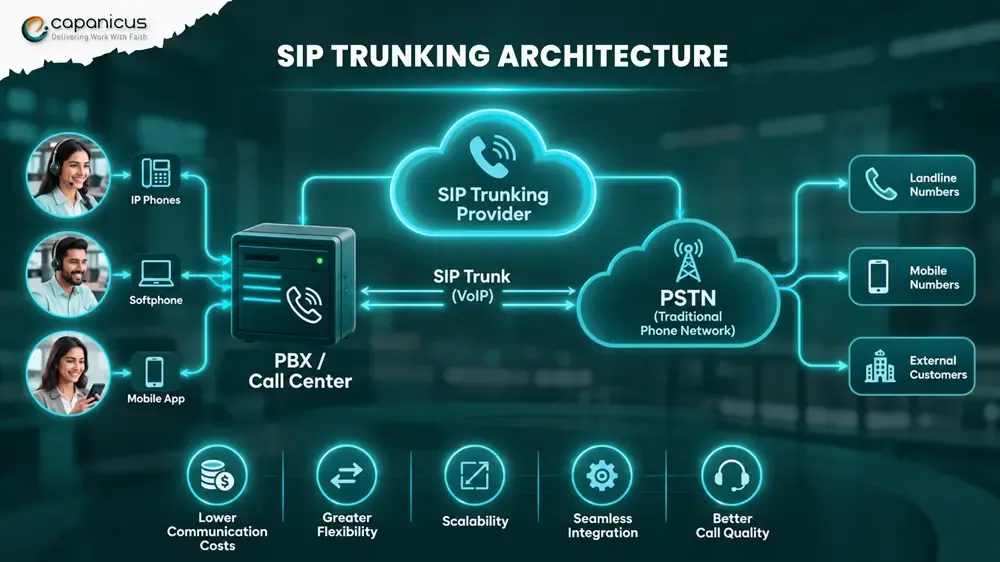
A SIP trunk establishes a virtual connection between an organization’s telephony infrastructure, whether that’s a PBX, a contact center platform, or a softphone application, and a service provider that bridges that connection to the public switched telephone network. It replaces physical circuits like ISDN PRI lines with an IP-based data connection carrying voice as digitized packets.
This SIP trunk architecture splits into two operational layers that behave very differently and need to be understood separately.
What Does the Signaling Layer Actually Control During a Call?
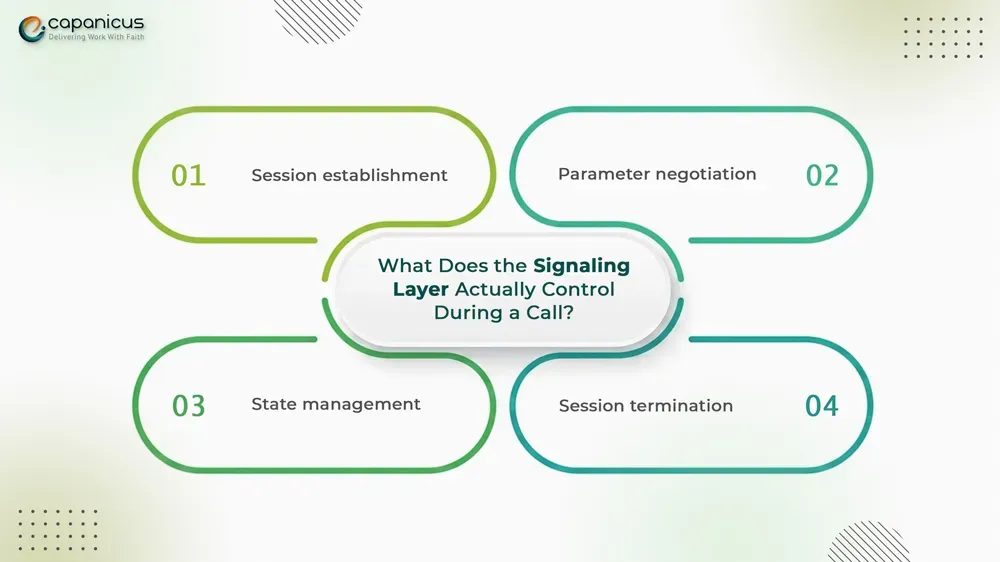
The signaling layer governs call setup, state management, and termination, and it’s handled entirely through the Session Initiation Protocol itself.
- Session establishment happens through an INVITE request, which locates the destination endpoint and kicks off the call
- Parameter negotiation determines which audio codec, transport protocol, and session attributes both endpoints will actually use
- State management tracks the call through ringing, answering, holding, and transfer events for the duration of the conversation
- Session termination is handled through a BYE message once either side ends the call
The Media Layer Operates Completely Separately From Signaling
Once signaling establishes a session, the voice audio itself doesn’t travel over SIP at all. It moves through the Real-time Transport Protocol, a separate stream running on its own network path. This separation is one of the more common sources of deployment problems, since SIP and RTP traffic can end up traveling different routes entirely, particularly in environments involving Network Address Translation or firewall rules that weren’t configured correctly for both protocols.
Codec Selection and Its Impact on SIP Trunking Solutions
Codec selection determines how audio gets compressed for transmission, and the codec you choose has real, measurable consequences for both call quality and network resource consumption.
G.711: Uncompressed Voice Quality at a Bandwidth Cost
G.711 delivers the highest achievable voice quality among common codecs because it applies minimal compression, at the cost of higher bandwidth consumption, typically around 87 Kbps per call including packet overhead. Organizations with sufficient bandwidth headroom generally default to this codec without much debate.
G.729: Bandwidth Efficiency With a Modest Quality Tradeoff
G.729 applies far more aggressive compression, cutting bandwidth requirements per call substantially at a modest cost to audio fidelity. This makes it a reasonable choice for organizations operating over bandwidth-limited connections or handling a high volume of simultaneous calls on constrained infrastructure.
Opus: The Adaptive Codec for Variable Network Conditions
Opus has picked up steady adoption in modern SIP trunking implementations because it adjusts compression dynamically based on real-time network conditions, instead of locking into one fixed quality tier. That adaptability tends to make a noticeable difference in environments where bandwidth availability fluctuates.
What Happens When Codec Negotiation Fails Between Systems?
Codec mismatches during SIP negotiation are among the most frequently encountered configuration errors in multi-vendor deployments, where PBX systems, SBCs, and carrier infrastructure may each default to different codec preferences. When negotiation goes wrong, it typically shows up as degraded audio quality or added transcoding overhead that introduces latency into every call.
The Session Border Controller’s Role in SIP Trunking Architecture
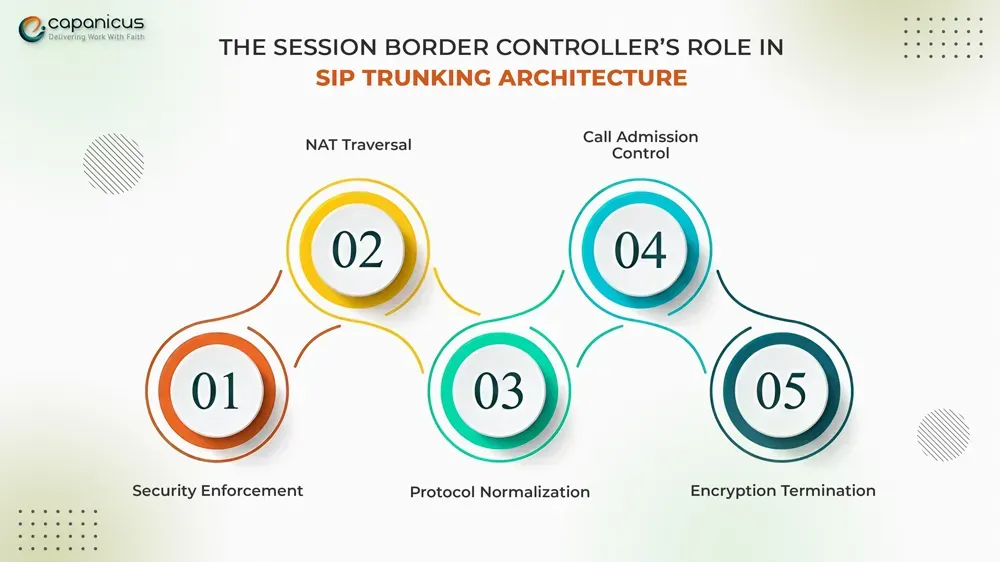
The Session Border Controller sits at the boundary separating internal telephony infrastructure from public network exposure, and its responsibilities go well beyond basic call routing.
- Security enforcement at the network edge, filtering malicious SIP traffic, blocking toll fraud attempts, and rejecting unauthorized registration requests before they reach internal PBX infrastructure
- NAT traversal, making sure both SIP signaling and RTP media correctly navigate Network Address Translation and firewall configurations, which addresses one of the most common causes of one-way or no-way audio
- Protocol normalization across vendors, since SIP implementations vary slightly between PBX platforms and carrier networks, and the SBC smooths over those differences so sessions establish correctly
- Call admission control, enforcing limits on concurrent call volume and bandwidth allocation so a single misconfigured process can’t consume the entire trunk’s capacity
- Encryption termination, typically managing TLS for signaling and SRTP for media at the network edge, which centralizes encryption rather than distributing it across internal systems
Organizations that skip the SBC and connect PBX infrastructure directly to a trunking provider give up every one of these protections. For any deployment supporting business-critical or contact center operations, the SBC should be treated as foundational infrastructure, not an optional add-on layered in later.
Capacity Planning for Concurrent Call Channels
SIP trunking uses concurrent call channels rather than fixed physical circuits, meaning capacity gets provisioned according to simultaneous call volume rather than a hardware-imposed ceiling. That flexibility is genuinely useful, but it also means capacity planning has to be deliberate rather than assumed.
Why Peak Concurrent Volume Matters More Than Average Call Volume
Capacity planning needs to be based on peak concurrent call volume, not average traffic, because peak volume is what actually determines whether calls get blocked during high-demand periods like business hours or a promotional campaign.
Bandwidth Allocation Ties Directly Back to Codec Choice
Bandwidth requirements are tied directly to codec selection, which means capacity planning and codec choice function as one interdependent decision rather than two separate considerations made in isolation.
Building in Burst Capacity From the Start
Extra headroom above baseline capacity accommodates unexpected volume spikes, which matters a lot for contact centers running outbound campaigns or dealing with seasonal demand swings that don’t show up in average usage numbers.
How Redundant Paths Protect Capacity During a Trunk Failure
Spreading capacity across redundant trunk paths ensures that a single trunk failure doesn’t wipe out the organization’s entire calling capacity at the same time.
Redundancy and Failover in a Production SIP Trunking Platform
A production-grade SIP trunking implementation shouldn’t depend on a single point of failure anywhere in the architecture.
Provisioning Trunks Across Multiple Carriers
Provisioning trunks across multiple carriers, or at least multiple physical paths to a single carrier, provides a structural safeguard against carrier-level outages taking down all voice traffic at once.
Continuous Health Monitoring Catches Problems Before Callers Notice
Automated health checks continuously verify reachability between internal infrastructure and provider SIP endpoints, which allows degraded or failed connections to get caught early instead of discovered mid-outage.
What Makes Automatic Failover Logic Actually Reliable?
Failover mechanisms need to reroute new call attempts the moment a primary trunk becomes unresponsive, without requiring someone to manually intervene while calls are actively failing.
Geographic Distribution of Trunk Endpoints
Distributing trunk endpoints across multiple data center regions protects against localized outages that could otherwise eliminate calling capacity for an entire geographic area at once.
Security Requirements for a Reliable SIP Trunking Configuration
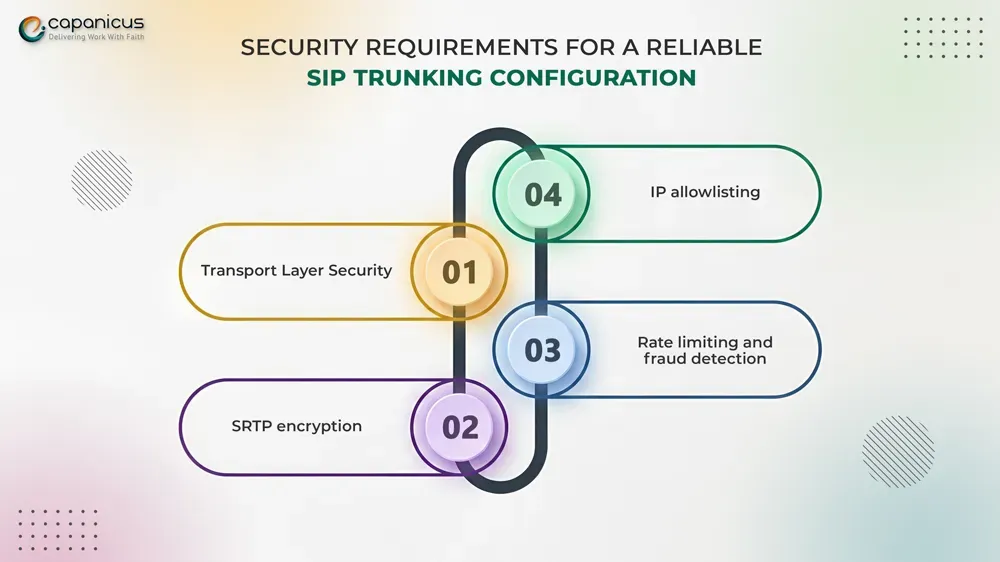
Because a SIP trunk is effectively a direct interface between internal infrastructure and public network traffic, security has to be built into the architecture from the start rather than bolted on afterward.
- Transport Layer Security for SIP signaling, so call setup information isn’t transmitted in plaintext across the network
- SRTP encryption for the media stream itself, ensuring voice content stays protected even if traffic is intercepted
- IP allowlisting, restricting which addresses are permitted to send SIP traffic to internal infrastructure in the first place
- Rate limiting and fraud detection, since SIP trunks are a well-known target for toll fraud, where attackers exploit a misconfigured trunk to route expensive international calls at the organization’s expense
None of this is exotic engineering. It’s the layer most likely to get skipped when a deployment is rushed, and it’s almost always the layer responsible for the most expensive problems later on.
Custom SIP Trunking Development: Why Capanicus Is the Right Partner for This Work
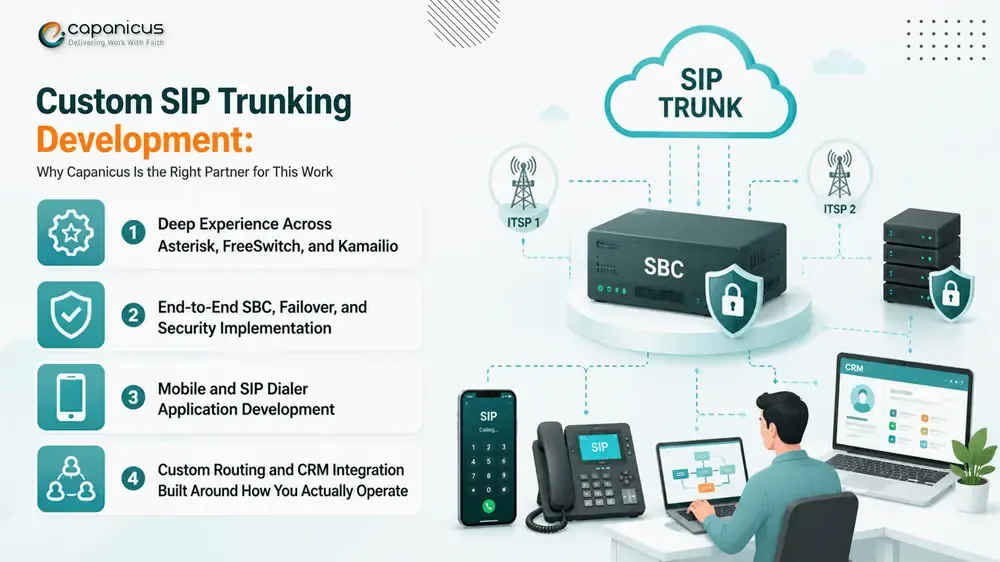
Standard configurations work fine for straightforward deployments, but plenty of organizations need something more specific: custom routing logic based on time-of-day rules or caller data, integration with a predictive dialer or CRM platform, failover behavior tuned to a particular carrier relationship, or mobile SIP dialer applications that let agents place and receive calls securely from a smartphone using the same underlying trunking infrastructure as the desk phones. This is exactly the kind of work we focus on at Capanicus, and it’s worth walking through what that actually looks like in practice.
Deep Experience Across Asterisk, FreeSwitch, and Kamailio
Our engineering team builds and configures SIP infrastructure directly on Asterisk, FreeSwitch, and Kamailio-based systems, rather than working through a black-box platform we don’t fully control. That matters because trunking issues, whether they involve codec negotiation, NAT traversal, or call admission control, usually need to be debugged and adjusted at the platform level, not just through a provider’s dashboard settings.
End-to-End SBC, Failover, and Security Implementation
We handle the full architecture stack described throughout this piece: SBC configuration, multi-carrier failover logic, encryption for both signaling and media, and fraud detection controls. Rather than treating security and redundancy as add-ons, we build them into the trunking architecture from the initial design phase, so the system is production-ready rather than something that needs to be hardened later after a problem surfaces.
Mobile and SIP Dialer Application Development
Beyond the trunking infrastructure itself, we build the SIP and mobile dialer applications that sit on top of it, giving agents the ability to place and receive calls securely from smartphones using the same trunking backbone as desk-based systems. This matters for distributed teams and remote call center agents who need reliable calling without a hardware desk phone tying them to one location.
Custom Routing and CRM Integration Built Around How You Actually Operate
Because we work across both the telephony layer and the applications built on top of it, we can design routing logic, time-of-day rules, and CRM or predictive dialer integrations calibrated to how a specific business actually handles calls, rather than forcing operations to adapt to a generic, off-the-shelf configuration.
Conclusion
SIP trunking technology often gets presented as a simple substitute for physical phone lines, but the architecture underneath it, spanning signaling, media transport, the Session Border Controller, codec negotiation, capacity planning, redundancy, and security, is what actually determines whether a deployment succeeds once it’s carrying real traffic. Each layer carries its own technical requirements, and neglecting any single one is a common reason deployments perform fine in testing but break down under real operational load.
The organizations getting the most out of SIP trunking aren’t necessarily the ones who adopted it first. They’re the ones who treated the underlying architecture with the rigor it actually requires. If your organization is evaluating a new SIP trunking implementation, migrating away from legacy PRI lines, or trying to fix a deployment that isn’t holding up under real call volume, Capanicus builds this kind of infrastructure end to end, from trunk configuration and SBC setup through the mobile and SIP dialer applications your team actually uses to make and receive calls. That combination of telephony infrastructure expertise and application development is what turns a SIP trunking system from technically functional into something your business can actually depend on.