In a world where anything is digital, and people spend most of their time online, the only thing customers expect now is fast, personalized support that they can access through any channel of communication. The only way businesses can bridge these expectations of customers and have an efficient operational management system is by using conversational AI solutions.
Conversational AI is more than just voice-based agents that handle intricate phone transactions or chatbots that respond to high-volume queries – it is the ultimate solution for round-the-clock service, cost-cutting, and customer satisfaction boost.
Here at Capanicus, we create conversational AI platforms and custom-designed virtual agents that combine deep NLU (Natural Language Understanding), pragmatic interface design, and integration with enterprise systems to deliver concrete changes in business results.
Why Conversational AI Is the Way Forward for Businesses
- Customer demands are everywhere: Nowadays, customers want not only quick answers but also to switch channels seamlessly. Conversational AI makes this possible by providing interaction that is conversational and context-sensitive, which imitates human service but without having to wait.
- Cost reduction and greater efficiency: The tasks that are handled by people repeatedly, for example, password resetting, monitoring of orders, booking of appointments, etc., can be fully delegated to automated systems. This frees up people’s time for more important work and reduces overall operational costs and average handling time.
- Improving via data: Throughout the whole conversation, conversational systems are collecting data on dialogues, that is to say, the conversation between the user and the machine. This dataset is used for analytics in order to identify user intents and to deliver a personalized user journey. Thus, the product, marketing, and customer experience teams are helped to improve by providing insights for these areas.
- Enhanced AI: Advances in natural language understanding (NLU), speech models, and retrieval-augmented generation make virtual agents’ dialogues more accurate. Today’s virtual agents are much more intelligent, precise, and helpful in their responses.
Core Components of Conversational AI Solutions
- Voice Agent and Chatbot Deployment Solution (Conversational AI Platform): This is the main platform for deploying, monitoring, and scaling voice agents, as well as chatbots. It incorporates natural language understanding (NLU) engines, dialog flow managers, integration interfaces, analytics dashboards, and tools that handle the lifecycle.
- NLU and Dialog: Design of a system that can classify intent, extract important information, collect related information, and track dialog over multiple turns to understand human utterances and compose appropriate answers.
- Voice pipeline: The speech-to-text (STT), text-to-speech (TTS), and voice activity detection have been adjusted for accents, noise, and prosody to create agents that are not only voice assistants but also conversation partners on steroids, so to speak.
- Integration layer: APIs to CRM, ERP, ticketing systems, payment gateways, and knowledge bases that will allow virtual agents to perform actions and provide personalized information.
- Analytics and optimization: Visualization tools that help monitor intent coverage, fallback ratio, sentiment analysis, and commercial KPIs, which serve as inputs for improvement processes.
- Security & compliance: The use of enterprise-level cryptographic systems, access control based on a user’s privileges, and data handling regulations that comply with legal requirements.
Capanicus Method of Conversational AI Development
- Mission and vision alignment: We analyze the paths customers take to understand their problems and find the use cases with the highest ROI. At the end of this stage, we establish the objectives (higher containment, lower cost per contact, higher customer satisfaction, etc.). Also, how the AI agents will be supported (human or not) and what channels they will use will be discussed.
- Technical Feasibility Proof (PoC): For instance, the feasibility of a voice assistant (IVR) for appointments or online chatbots (website) for returns is checked through the proof of concept that is done on one channel or use case. It is meant to give an early return-on-investment and a basis for the full-scale plan decision.
- Platform selection based on the architecture: We create conversational AI environments that you are really going to benefit from. Depending on your case, it can be a private solution, one that requires you to do very little work, or even an approach that combines models you’ve already trained with ones specific to the domain of your data.
- UX and Dialog Design: A design that shows respect to the user, reduces the number of times the user will interact with the system, and also has good fallback and customer service handoff features.
- Coding and Integration: Programming of the NLU elements, voice pipeline, analytics, and secure integration channels to the back-end systems by a team of engineers!
- Testing the system, validating the features: By running a set of dialogues, doing role-play scenarios, stress testing, and checking compliance before launching on production, we verify the system’s quality in terms of performance and user satisfaction.
- Deployment and supervision: The system should be deployed on different channels, KPIs must be monitored, and, as one of the feedback mechanisms, new training sessions should be set up to keep improving system accuracy and user satisfaction.
- Refinement and growth: We look at interaction data and find ways to improve the coverage of our intents, optimize dialogue, and spread the solution into new areas or channels.
Intelligent Voice Assistants: Making Telephony and IVR Systems More Natural and Personal
Old-school IVR systems are nothing less than forced navigation of users through pre-set menus. Conversational AI voice agents are, by contrast, able to understand human language and respond accordingly. Thus, callers get faster resolutions simply by speaking naturally.
- Conversational interface: Users speak freely without being bound to rigid menus. The AI voice agent understands the user’s intent and extracts all that is needed through follow-up questions.
- Robust STT and TTS features: State-of-the-art speech tech transcribes spoken words into text with high accuracy even if there is background noise and creates speech with natural prosody to be more human-like.
- Handling conversation context: Agents have full call history so that they can offer personalized service based on understanding past interactions, account details, and resolutions.
- Action execution: Voice agents can securely check identity, perform payments, book appointments, and modify customer records by connecting to backend systems.
- Language and accent support: AI voice agents are designed or adapted to work with the dialects and languages native or preferred by the user audience.
- Failure management: When the voice agent cannot resolve a request, it hands the call to a human agent with full context, so the customer does not have to start over.
Measuring Success: KPIs That Matter
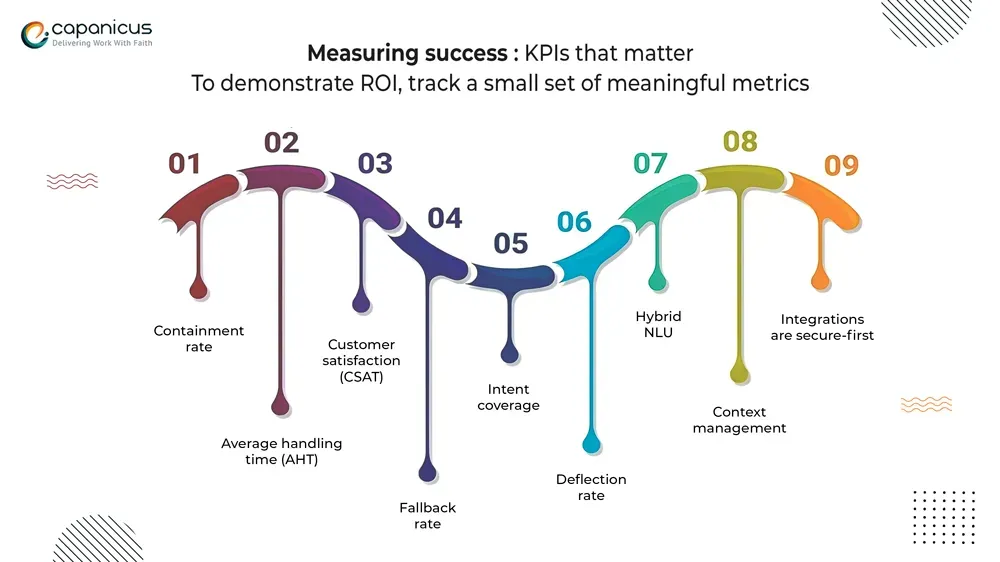
To demonstrate ROI, track a small set of meaningful metrics:
- Containment rate: Percentage of queries resolved without human intervention.
- Average handling time (AHT): Time taken per interaction, including handoffs.
- Customer satisfaction (CSAT): Post-interaction ratings or NPS for conversational experiences.
- Fallback rate: How often the system fails to map intent and returns generic responses.
- Intent coverage: Proportion of common customer intents supported by the system.
- Deflection rate: Reduction in calls or tickets to human support channels.
Capanicus sets a baseline during discovery, builds dashboards to track these KPIs, and runs continuous improvement cycles to hit targets.
Technical Practices Behind Reliable Conversational AI
- Hybrid NLU: Combining a large pre-trained language model with a narrow supervised, domain-specific intent classifier results in a system that is both flexible enough to understand natural language and very reliable on the important parts like the intent recognition.
- Context management: Context is very important for the understanding of a multi-turn dialog, and it is not possible with a stateless system. We introduce context stores and have dialog managers that are aware of the context for smooth multi-turn dialogs.
- Integrations are secure-first: Secure channels (OAuth, tokenization for storing sensitive information, and encryption in transit and at rest for private info), together with role-based admin access controls, are employed to protect all user data and maintain its privacy.
Industry Use Cases and Outcomes
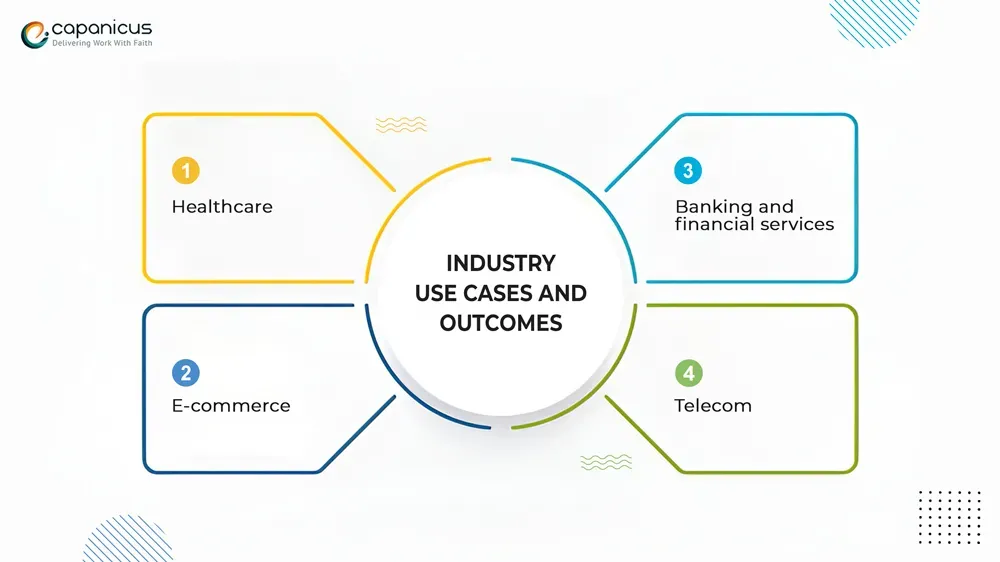
- Healthcare: Patient identity verification, appointment making, sending reminders – AI voice assistant performs all these without manual intervention – resulting in lower no-show rates and less staff workload. One client reported a 60% reduction in manual booking calls and 30% fewer no-shows after adding proactive AI notifications.
- E-commerce: An AI chatbot on web chat & WhatsApp channels handles order status inquiries, returns, and refunds, resulting in 70% of self-service conversations being contained and a higher resolution rate on the most common order issues.
- Banking and financial services: Through secure voice and chat channels, customers may use Conversational AI for their balance inquiries, card activation, and simple payments; thus, service accessibility will increase without compromising compliance requirements.
- Telecom: A conversational voice assistant can be used by the customer to make a SIM swap, plan an upgrade, or even report a fault, and that would result in a lot less manual labor, shorter response times, and agent workload reduction during peak hours.
A Practical Roadmap for Implementation
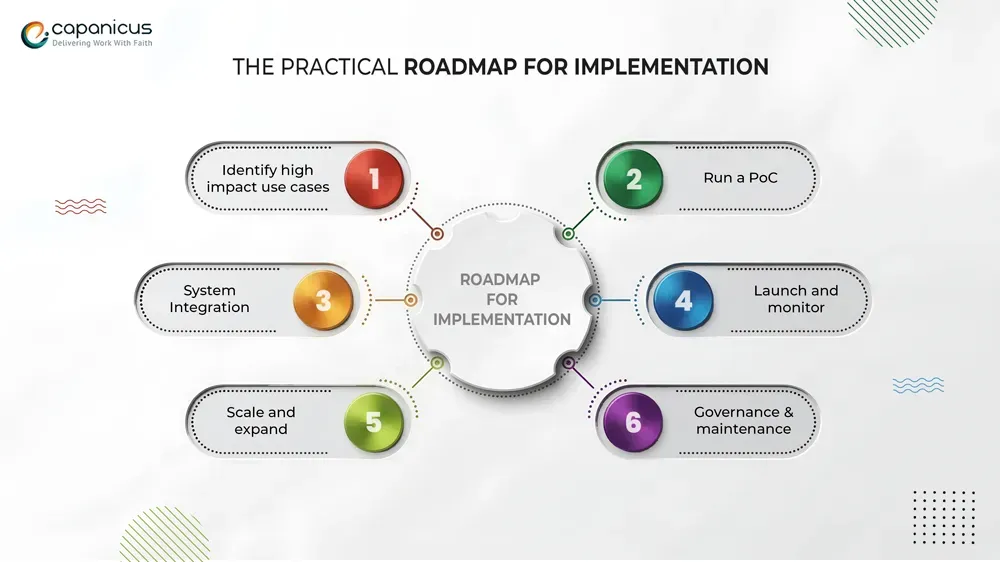
- 1. Identify high-impact use cases: Spot tasks that are done repeatedly, generate a lot of work, and have clear measures for success (bookings, billing, checking order status, etc.).
- 2. Run a PoC: Make a focused voice or chatbot flow for one use case to test the approach and see early results.
- 3. System Integration: Connect to the CRM, ticketing systems, and knowledge bases so that it’s not only answers but also actions that agents can do.
- 4. Launch and monitor: Go live with a limited group of people, follow key indicators, and improve through real conversations.
- 5. Scale and expand: Incorporate more intents, multiple communication channels, languages, and, at the same time, gradually automate sophisticated workflows while keeping human-in-the-loop options available.
- 6. Governance and maintenance: Have a governance framework in place that controls the intent lifecycle, data storage, and monitoring performance.
How to Design Humanized AI Conversations
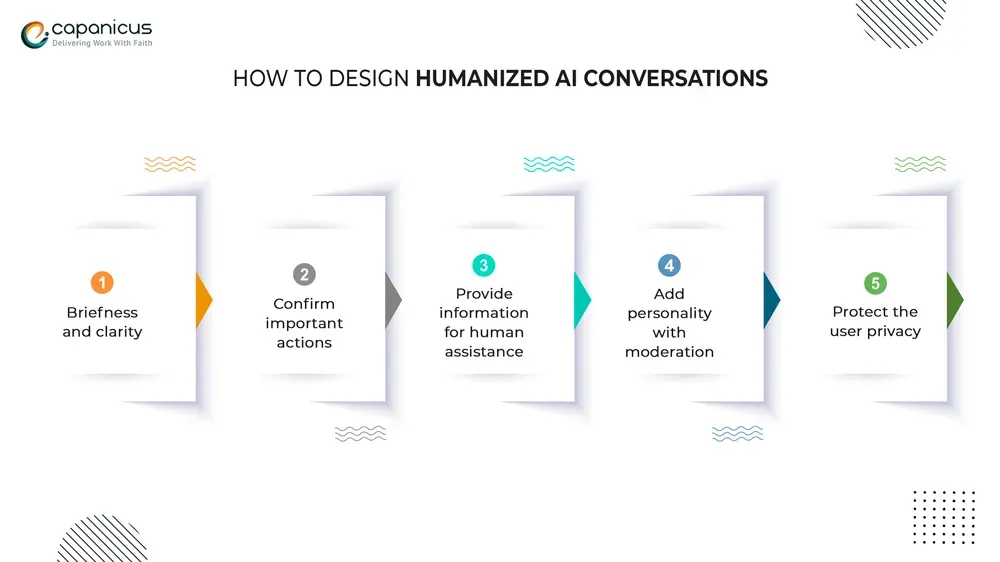
- Brevity and clarity: Short, direct answers are easier for users to follow and reduce mental effort.
- Confirm important actions: When users carry out sensitive things like payments or deletions, the AI should double-check with them in order not to cause any errors.
- Provide information for human assistance: Let users understand how to talk to a real person and make sure conversation context gets kept when it is escalated.
- Add personality with moderation: Align the AI’s speaking style with the company and situation. A serious tone is suitable for finance, while a friendly one can be more appropriate with retail. However, do not make it sound too informal in matters that are delicate.
- Protect the user’s privacy: Clearly state any data use and be ready to ask for permission if there is going to be processing of sensitive personal data.
Choosing Capanicus as a Partner: What’s in it for You
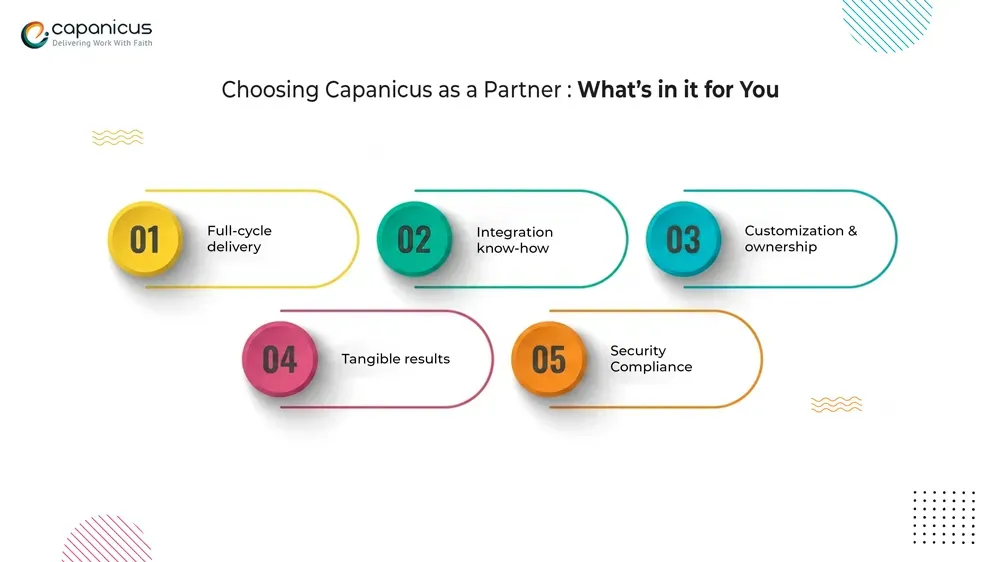
- Full-cycle delivery: We take care of things from strategy development and the conversation’s user experience, building, and interfacing with various third-party services, right down to optimizing once the project is deployed.
- Integration know-how: We are able to plug the bot into various systems such as, for instance, CRM, ERP, payment systems, and so on, so that the virtual agent can trigger real work behind the scenes.
- Customization & ownership: Our deliverables are highly configurable. After the delivery, the customers can take full charge or modify the features, etc., as the situation warrants. We make sure there is a smooth handoff process along with clear written guides.
- Tangible results: We build the development plan around the desired KPIs, with the main focus being to increase conversation containment, raise customer satisfaction scores (CSAT), and lower costs.
- Security Compliance: We follow corporate data privacy standards and the legal requirements that apply to your industry.
Frequently Asked Questions
1. Will AI replace human agents?
Not quite. Conversational AI is a tool that supports human agents rather than competing with them. It takes repetitive tasks off their plate so they can focus on solving complicated cases.
2. How do you keep the AI accurate over time?
Continuous training loops, a hybrid NLU approach, and analytics data help maintain the models’ performance.
3. How well does voice recognition work in a noisy environment?
Modern STT systems, combined with noise suppression and domain tuning, perform accurately in most real-world conditions.
4. How long does it take to see ROI?
With the right use case and a focused PoC, visible results usually appear within weeks to a few months.
Implementation Checklist
- Identify 3 primary use cases and their KPIs.
- Select voice or chat for the PoC as the first channel.
- Set up integration endpoints (for example, APIs for CRM, payments, and bookings).
- Gather sample conversation logs to be used in training.
- Determine privacy policies and retention rules for data gathered from conversations.
- Build the dashboards to monitor progress and design the methods of handling errors.
Conclusion
A conversational AI system equipped with smart voice agents and chatbots is a strategic initiative for companies, not an auxiliary novelty. It can enhance customer experience, lower operational costs, ease the load on your workforce, and surface business insights at the same time. By combining conversation design, reliable engineering, and enterprise-level integration, Capanicus helps businesses build conversational AI platforms that are secure, adaptable, and result-oriented.
Interested in using chatbot or voice bot services?
At Capanicus, we develop custom AI virtual agent solutions to fit various business needs. We also offer business consulting, software development, system integration, and chatbot deployment services. To discuss your use case, talk to our team.