Have you pulled out your CSAT dashboard recently?
Chances are, the number sitting there almost looks identical to what you saw last quarter, regardless of every ounce you have put into support this year. And somewhere, while doing the maths on that spend, you must have blamed your team for it too.
Here is what maths will never show you. The problem was never with the people answering your customers. It was with the tools they were using, because a real omnichannel platform was never actually put in place, no matter how many separate tools you kept adding in your support queue.
Today, only 13% of businesses can actually prove that customer context follows a customer across every channel they use. The remaining 87% are sitting on some conventional communication platform they paid good money for, without the one thing that actually matters – a platform where every channel knows what the customer already said. As a person who signs off on this spend, you are not just losing efficiency here; you are losing clients who stop renewing and never tell you why.
This is honestly the biggest force behind business owners investing in proper omnichannel development services over another round of disconnected tools. The right omnichannel communication software pays for itself the moment your team stops repeating work across channels. What comes next is a clear look at omnichannel software development done right, built for someone who has to answer for this investment at Capanicus.
Why the Tools You Already Bought Are Not Solving the Problem
We understand you have probably approved more than one support tool invoice in the last few years, each one pitched as the answer to slow response times or scattered customer data. Still, the complaints have not really vanished; they have just evolved.
A customer starts with a chat, moves to email when nobody replies fast enough, and then calls in a day later still waiting for a clear answer. By the time they reach a human agent, they have already repeated their story three times, and unfortunately your agent will again start from zero.
It may sound uncomfortable, but this is not a training issue. It happens because each tool you brought was built to solve one problem in isolation, not to work together with everything else. Organizations with strong omnichannel strategies retain 89% of their customers, compared to just 33% for those running disconnected setups. Satisfaction numbers follow the same pattern, with connected support pushing CSAT to 67 percent, against only 28 percent for the fragmented experience most enterprises are still delivering.
In reality, you are not short on tools. You are short on a system that connects the ones you already have.
What Omnichannel Actually Means for the Business You Are Running
Somewhere along the way, omnichannel turns out to be the next constant every vendor is using to describe a product that simply exists on numerous channels. In reality, that’s not what it means; the difference is exactly what decides whether your investment pays off or quietly becomes obsolete that nobody wants to discuss in the next QBR (Quarterly Business Review).
Multichannel means your business is omnipresent on email, social media, and phone, with each one running as its own separate island, holding its own version of the customer’s history. An omnichannel communication platform connects those same channels into one continuous conversation, so a customer’s conversations from morning to afternoon stay visible to those who call in the evening.
The financial case for getting this right is not subtle either. Omnichannel customers spend 16 percent more per order and carry a 30 percent higher lifetime value than customers who only ever engage through a single channel.
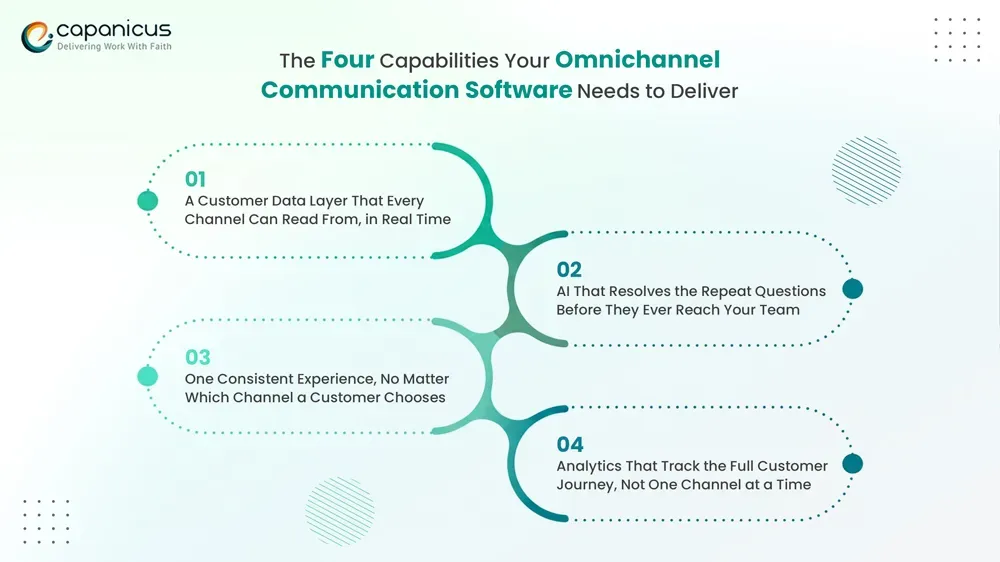
The Four Capabilities Your Omnichannel Communication Software Needs to Deliver
Developing this properly is not about approving one more software subscription and hoping it finally works better than the last one. It is about putting a layer underneath everything your business already runs on. A foundation that unifies every channel, every conversation, and every piece of customer history into a single, shared source of truth.
Here, we’ve pocketed four capabilities that need to be non-negotiable when you are evaluating what to build or buy.
-
A Customer Data Layer That Every Channel Can Read From, in Real Time
Every channel your team touches needs to extract data from the same customer record, updated the instant something changes. When a customer moves from chat to email to a phone call, whoever picks up should see the entire history immediately, not a fragment somebody has to piece together after the fact.
At the moment, only 13 percent of businesses have actually solved this, which tells you exactly how much room there is to get ahead of competitors still guessing in context their systems were never given.
-
AI That Resolves the Repeat Questions Before They Ever Reach Your Team
Not every request that comes in needs a person handling it first. AI can triage incoming queries, resolve the straightforward ones outright, and route the complicated ones to the right specialist with full context attached, so your best people are not wasting time on questions a system could have closed in seconds.
Over 70 percent of businesses already use AI-powered chatbots or automation to handle repetitive queries, and the return shows up fast, with agents using AI assistance resolving 15 percent more issues per hour, with the biggest gains going to your newer, less experienced hires. This is where the right omnichannel development services actually earn their fee, because routing logic that works has to be built around your real ticket volume and your real team structure, not copied from someone else’s playbook.
-
One Consistent Experience, No Matter Which Channel a Customer Chooses
Your customer should never feel like they are dealing with a different company depending on whether they messaged you on WhatsApp or called your support line. Tone, response speed, and the information available to your agent all need to hold steady across every channel a customer might pick on any given day.
After all, this consistency shows up directly on your revenue line too, since your existing customers already spend 67 percent more than new ones, and every disjointed handoff quietly puts that spend at risk.
-
Analytics That Track the Full Customer Journey, Not One Channel at a Time
Most dashboards you are probably reviewing right now are on different channels like chat numbers in one place, email numbers somewhere else, and call metrics in a completely different tool. What you actually need as a decision maker is journey-level analytics that follow a single issue from the first message to full resolution, no matter how many channels it crosses along the way. And that is the only real way to know whether a problem got solved, instead of just knowing how fast someone typed a reply.
How to Approach Omnichannel Software Development Without Disrupting What Is Already Working
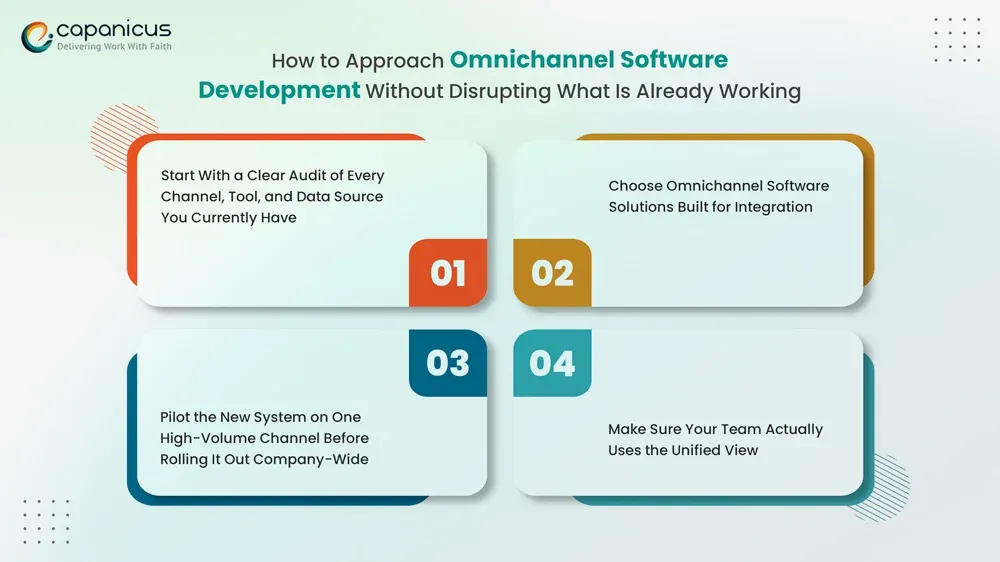
Start With a Clear Audit of Every Channel, Tool, and Data Source You Currently Have
Before you approve a single line of new spend, map every channel your team uses, every tool sitting behind it, and every place customer data currently lives. This exercise alone tends to surface duplicate systems, half-working integrations, and the exact points where customers are being forced to repeat themselves. It also becomes the actual blueprint for what your new platform needs to connect to, instead of a guess dressed up as a strategy.
Choose Omnichannel Software Solutions Built for Integration
You are rarely trying to throw away every tool you have already paid for. You are trying to connect the ones worth keeping, through a platform designed for integration from day one. Look closely at open APIs, native CRM connections, and support for agentic AI workflows, because these are exactly what determine how easily this system scales alongside your business a year or two from now.
Pilot the New System on One High-Volume Channel Before Rolling It Out Company-Wide
Launch the unified system on your busiest channel first, measure resolution time and CSAT honestly against your old setup, and only expand once the numbers actually confirm it is working. This keeps your risk contained and gives you a real proof point to bring to your board before committing to a full rollout across the business.
Make Sure Your Team Actually Uses the Unified View
A new platform only pays off if your agents genuinely rely on the unified customer view in front of them, instead of falling back into the old habit of asking the customer to repeat themselves anyway. Here, training needs to focus specifically on how context now follows the customer automatically, and how that should change the way every single ticket gets handled from the first message onward.
Choosing the Right Partner for Omnichannel Communication Software
Very few businesses have the internal bandwidth to design, build, and maintain a system like this entirely on their own. And that is exactly where the right development partner changes what is actually possible for you. Before you choose your development partner, ensure they have real, hands-on experience delivering enterprise-grade omnichannel development services, a proven record of integrating with existing CRM and helpdesk systems without disrupting them, and the ability to build AI routing logic around your specific data, not a generic model borrowed from a different industry entirely.
The partners worth working with treat your support stack as connected infrastructure you are investing in, not a pile of separate tickets someone closes one at a time. That distinction is exactly what separates a platform that looks impressive in a sales demo from one that actually holds up under your real ticket volume, month after month, quarter after quarter.
Final Thought
Think back to that support budget you keep approving every year, the one that grows while the repeat complaints barely change. Somewhere in your queue right now, a customer is explaining their issue for the third time today, and every one of those moments is quietly chipping away at renewals you will never get a clear explanation for. The businesses pulling ahead are not doing this by buying more tools. They are doing it by connecting the ones they already own, through AI that actually understands the full customer journey instead of one isolated piece of it.
Capanicus works with business owners on exactly this kind of build, turning fragmented support stacks into unified, AI-driven omnichannel platforms that customers barely notice, because for once, everything simply works the way you were always told it would.
Frequently Asked Questions
- What is the difference between an omnichannel communication platform and multichannel tools?
Multichannel means your business exists on email, chat, phone, and social, but each channel runs in isolation with its own version of customer history. An omnichannel communication platform connects all of them into one continuous conversation, so context follows the customer automatically.
- How long does omnichannel software development take for an enterprise team?
It depends on how many existing tools need connecting, but a phased rollout, piloted on one high-volume channel first, usually shows measurable results before a full company-wide expansion.
- Do I need to replace my current CRM and helpdesk tools to build this?
No. The right omnichannel software solutions integrate with what you already use through open APIs and native CRM connections, rather than forcing a rebuild from scratch.