In many mid-sized VoIP installations, you’ll likely find Asterisk involved, which is why Asterisk development remains a core telephony skill. It has a long, reliable track record in production. Sangoma maintains this open-source telephony engine, written in C. It supports SIP (through the PJSIP channel driver), WebRTC, IAX2 and traditional TDM hardware.
Launching Asterisk may take you just an afternoon. Supporting it for hundreds of daily users is something completely different. Far fewer teams have the experience to do that well. Asterisk development requires more than building a dialplan. You also need to adapt it to real-world customer requirements.
Why Asterisk Development Still Matters in 2026
Many people assume Asterisk is old technology. That isn’t true. Since Asterisk 12, the Asterisk REST Interface (ARI) has let an external app control call flow over REST and WebSocket. Therefore, there is absolutely no need to have your business logic written in an extensions.conf file. In fact, Asterisk gives you the same programmable call control as CPaaS solutions, without per-minute platform fees or vendor lock-in.
Asterisk also compares well with a hosted UCaaS solution. With a hosted plan, you rent the vendor’s roadmap, which you have no control over. In other words, you are waiting for the vendor to provide an update.
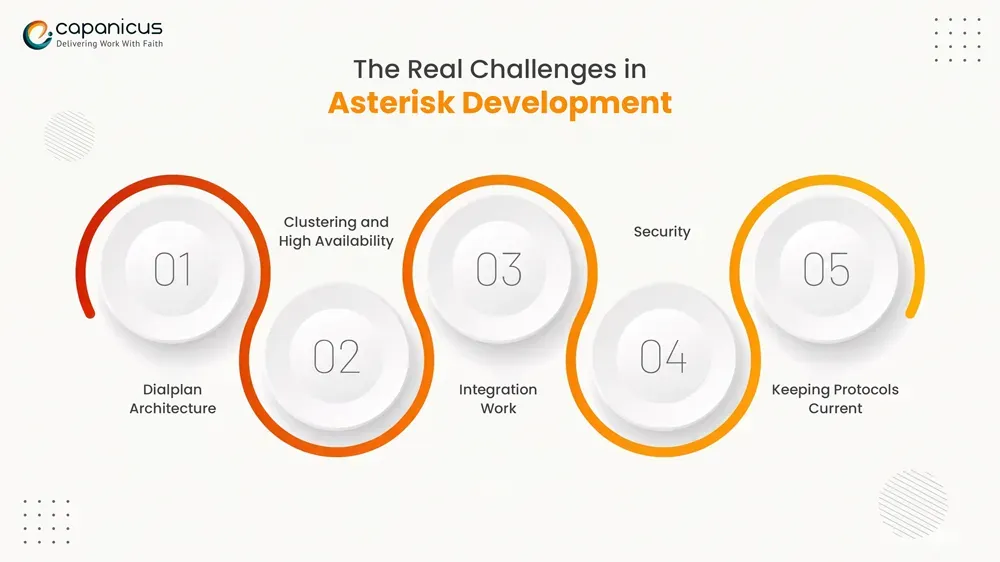
The Real Challenges in Asterisk Development
Nobody talks about this part enough. Asterisk systems don’t fail in testing. They fail three months in, usually at 2 a.m., usually during the one weekend nobody’s watching.
Dialplan Architecture
Ten extensions, no problem, anyone can write that dialplan in twenty minutes. Thousands of calls routed across departments, time zones, and layered failover paths? Different job entirely. Skip Gosub subroutines and proper context isolation, and you end up with a tangle of includes. Nobody can trace it without core set verbose, core set debug and a lot of praying. Asterisk Realtime, provisioning endpoints, queues and routing data from a database instead of hardcoding them, helps here. Most teams never set it up correctly, or at all.
Clustering and High Availability
One Asterisk box has a definite limit. Transcoding, RTP processing and PJSIP’s CPU use together set how many concurrent calls one box can handle. Past that limit, you need to cluster the boxes, typically with Kamailio or OpenSIPS as the load balancer. The proxy handles registrations and keeps dialog state, often in a shared database. A failed Asterisk node can then leave rotation without users re-registering. This is where many in-house deployments stall.
Integration Work
Asterisk standing alone, doing nothing but routing calls, barely exists anymore in production. It talks to a CRM. Call records flow into an analytics pipeline. Audio goes to an AI voice agent through a Stasis app. Each connection point is its own failure mode waiting to happen. AMI floods under load, ARI WebSocket connections drop and need reconnection logic, and a mid-call CRM lookup adds unplanned latency. Building these so a slow API call doesn’t block call setup entirely takes real thought, not a quick webhook.
Security
Toll fraud goes after Asterisk constantly. The pattern repeats everywhere: weak PJSIP secrets, AMI or ARI sitting open on the public internet, dialplans with zero calling-class restrictions on international routes. Fixing this properly means fail2ban or something SIP-aware doing the banning, IP-restricted registration wherever that’s realistic, and concurrency limits enforced at the dialplan level. Not just a firewall rule and a prayer.
Keeping Protocols Current
Asterisk 17 deprecated chan_sip and Asterisk 21 removed it, so PJSIP is now the only SIP stack Asterisk supports. That transition alone broke more than a few deployments that nobody migrated properly. WebRTC compatibility keeps shifting under you too: DTLS-SRTP negotiation, ICE candidates, all of it moving. Opus adoption versus G.711. A system that sounded perfect at launch starts dropping calls eighteen months later, and usually it’s stale codec negotiation order or NAT config nobody revisited, not some mysterious bug.
Case Study: How We Built CallMama on Asterisk

CallMama’s brief was blunt: a global virtual phone and VoIP platform with international virtual numbers, cheap global calling, SMS and OTP flows, SIP routing, WebRTC, call forwarding, voicemail, recording, and native apps across web, iOS, and Android.
The dialplan had to route across dozens of carriers and countries without collapsing into spaghetti. Media servers had to sit close to users in each region. SIP and WebRTC had to behave identically for every user. Security had to be part of the design from day one.
What shipped now runs at real global scale, with calling to more than 200 countries and virtual numbers in more than 60.
Read the full CallMama case study →
What Makes Capanicus Different

Actual Depth, Not a Line Item
A lot of shops list Asterisk next to nine other technologies on a capabilities page. At Capanicus, Asterisk isn’t a checkbox; our VoIP engineers work in its internals every day. PJSIP endpoint config, ARI-driven Stasis apps, AGI scripting for the legacy stuff that refuses to die, Asterisk Realtime for database-provisioned configuration at real scale. That’s the background an Asterisk team needs when a client asks for something with zero prior art. Think dynamic IVR logic reacting to live CRM state, or failover that survives a full data center going dark.
Built to Scale, Not Patched to Scale
We design clustering in from day one: SIP-aware proxies up front, realtime-backed config underneath. That beats retrofitting it in a panic once a single node starts choking on unplanned traffic.
Security Isn’t Bolted On
Given how often toll fraud specifically targets Asterisk, calling-class segmentation and PJSIP auth hardening go into the build itself, not added after an incident forces the issue. That’s standard here, not a premium add-on.
People Who Actually Stick Around
New clients often share a familiar story. A previous vendor built something and vanished the second it shipped. Now internal staff maintain code nobody on their side understands. At Capanicus, the team that builds your Asterisk system also supports it after launch, just as we did for CallMama.
When Should You Bring in Asterisk Specialists?
Not everyone needs this. A simple hosted PBX is fine for plenty of businesses, and there’s no reason to overbuild something nobody needs.
But a few situations change that calculus fast. Call volume’s outgrown what one server can handle without duct tape. Integrations you need, CRM-triggered routing, AI voice handoff, odd compliance rules, go past what any off-the-shelf platform offers. There’s been a toll fraud scare, or worse, a real one, and now security needs rebuilding from the ground up instead of patched over. Or telephony isn’t a feature sitting on top of your product, it is your product, the way it was for CallMama.
In those cases, the gap between a generic Asterisk provider and a team that’s actually shipped something this complex under real pressure is the whole ballgame. One of them scales. The other one becomes a liability inside a year.
Final Thoughts on Asterisk Development
Asterisk rewards people who actually learn its internals, the channel layer, the realtime config model, the ARI event system, and it punishes anyone who treats deployment like flipping a light switch. The same openness that makes it powerful is exactly what makes it so easy to get wrong, in the dialplan, at scale, in security, in every bolt-on integration added six months after launch.
If you’re evaluating Asterisk partners for something with genuine complexity behind it, Capanicus has built and scaled platforms that handle precisely this, CallMama included. Explore our Asterisk development services or reach out. We’ll talk through what your system actually needs, not a pitch deck.
FAQs
1. Is Asterisk still maintained in 2026?
Yes. Sangoma maintains Asterisk and ships regular releases, including long-term-support (LTS) versions with extended bug and security fixes. Modern releases include ARI for application-level call control and PJSIP as the SIP channel driver, so Asterisk remains a current choice for custom telephony.
2. What is the difference between ARI, AGI and AMI?
AGI runs a script from the dialplan to control a single call. AMI is a TCP interface for monitoring events and issuing system-wide commands, such as originating or hanging up calls. ARI is a REST and WebSocket interface that lets your own application fully control channels and bridges.
3. Does Asterisk still support chan_sip?
No. chan_sip was deprecated in Asterisk 17 and removed in Asterisk 21. Current versions use PJSIP (chan_pjsip) for SIP. Systems still running chan_sip are on unsupported versions and need a planned migration of endpoints, trunks and dialplan references before upgrading.
4. Can Asterisk support high-volume calls and global VoIP platforms?
Yes. Asterisk can support high-volume telephony when configured with an appropriate architecture, optimized dialplans, and suitable infrastructure. For larger deployments, developers can use SIP proxies such as Kamailio or OpenSIPS, clustering, and regional media servers to improve scalability and call performance.
5. How can custom Asterisk development improve VoIP security?
Custom Asterisk development can strengthen security through robust PJSIP authentication, IP-based access restrictions, secure management interfaces, calling-class restrictions, concurrent-call limits, and fraud monitoring. These measures help reduce unauthorized access and protect businesses against toll fraud.
6. How many concurrent calls can one Asterisk server handle?
There is no fixed number. Capacity depends on codecs, transcoding, recording and server hardware, and transcoding is usually the biggest CPU cost. Load-test your real call mix with a tool such as SIPp before going live, and plan to scale out with a SIP proxy.