You’re on a call with a high-value client, walking them through a proposal. Things are going well. Then suddenly, silence. The call dropped.
You call back. They don’t answer. The moment is gone.
This happens to businesses every single day. And while it might seem like a minor technical glitch, dropped VoIP calls are actually one of the most damaging and most preventable problems in modern business communication.
Over the last decade, the way businesses communicate has changed completely. Traditional landlines that once ran on copper wire have been replaced by internet-based calling. Today, a business phone system doesn’t sit in a server room collecting dust. It lives in the cloud, runs on your internet connection, and works from any device, anywhere in the world.
The global VoIP market is projected to reach $194.5 billion by 2030, growing at a rate of over 9% annually
This guide is built to help you understand exactly why VoIP call drops happen, how to fix them when they do, and how to build a VoIP & Telephony software that prevents them from happening in the first place. Whether you’re managing a small team or running a large enterprise, the principles here apply directly to your situation.
Common Causes of VoIP Call Drops
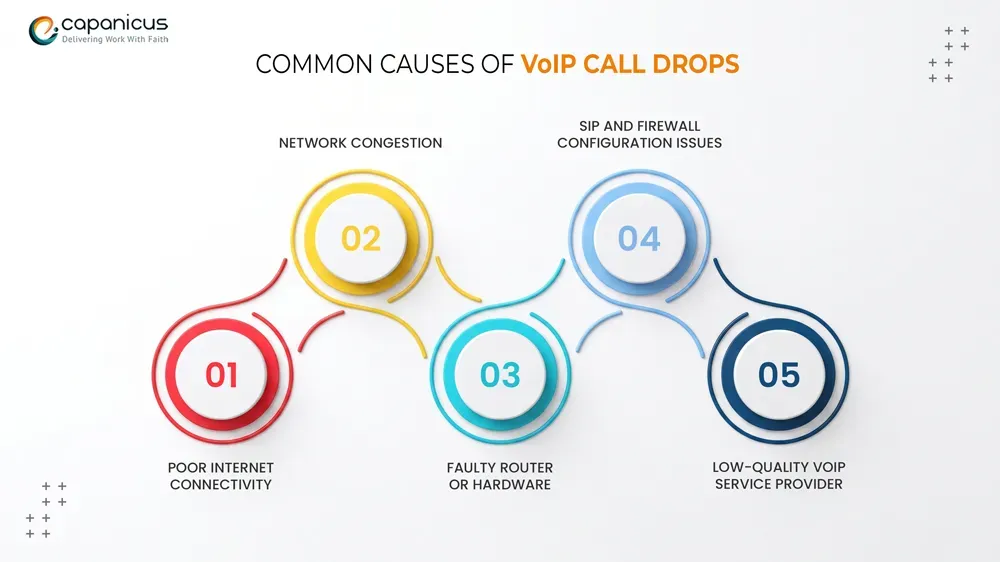
A VoIP call drop isn’t always the same thing. There are a few different types, and knowing the difference helps you fix the right problem. This is why your VoIP phone system is directly tied to your network quality. Unlike a traditional landline, there’s no dedicated copper wire protecting your call. It’s all data.
Poor Internet Connectivity
This is the most common cause of dropped VoIP calls, and it’s also the most misunderstood. People assume that because they have “fast internet,” their VoIP calls should work fine. Speed alone isn’t the issue. Stability is.
This is the biggest hidden killer of call quality. Packet loss means some of the data packets carrying your voice are getting lost before they arrive. Even 1 to 2% packet loss causes noticeable audio problems. Above 5%, calls become genuinely painful to have. A good VoIP phone system connection should have 0% packet loss or as close to it as possible.
Network Congestion
Your internet connection is shared across all devices and applications in your office. When everyone uses it at the same time, VoIP calls compete for bandwidth with everything else, and voice traffic often loses out.
Common congestion scenarios that drop calls include someone running a large file backup in the background during business hours, multiple employees streaming video or doing large downloads, too many devices connected to the same router without any traffic management in place, and no Quality of Service rules telling the network to prioritize voice packets over everything else.
Faulty Router or Hardware
Your router is the gatekeeper of every call. A bad one causes more problems than most people realize.
- Outdated routers- Older routers can’t handle modern VoIP traffic efficiently
- Wrong firewall settings- Firewalls that are too strict will block VoIP packets
- Defective IP phones or headsets- Hardware issues cause audio problems that look like network problems
SIP and Firewall Configuration Issues
This is technical, but important. SIP (Session Initiation Protocol) is what sets up and manages VoIP calls. When it’s misconfigured, calls drop.
- SIP ALG (Application Layer Gateway)- Many routers have this enabled by default. It’s supposed to help VoIP, but it usually breaks it. Most VoIP providers recommend turning it off.
- NAT traversal issues- NAT (Network Address Translation) can interfere with how VoIP packets travel between your network and the internet.
- Port blocking- VoIP uses specific ports. If your firewall blocks them, calls won’t connect or will drop mid-conversation.
Low-Quality VoIP Service Provider
Even if your network is perfect, a bad provider will still give you bad calls. Not all VoIP companies invest equally in their infrastructure, and the differences show up directly in your call quality.
Signs that your business VoIP service provider is the problem:
- Their uptime guarantee is below 99.9%, or they don’t publish one at all
- They have limited server locations, which means your voice data travels further and experiences more latency
- They have no redundant infrastructure, so when one server has a problem, your calls go down with it
- Their support response time is slow and their team doesn’t have deep VoIP technical knowledge
- They offer rock-bottom pricing with no explanation of what’s being cut to offer it
A cloud phone system built on weak infrastructure will always underperform, regardless of how well your internal network is configured. The provider is half the equation.
How VoIP Call Drops Affect Businesses

It’s easy to dismiss a dropped call as a minor inconvenience. But when you look at the cumulative effect on a business over weeks and months, the picture is very different.
Missed Customer Calls
Every dropped call is a missed opportunity. Whether it’s a sales inquiry, a support request, or a partnership discussion, calls that disconnect before they’re resolved force customers to repeat themselves, wait longer, or give up entirely. None of those outcomes serve your business.
Reduced Team Productivity
When employees spend time redialing, troubleshooting call quality, or waiting for IT to fix their VoIP phone system, they’re not doing the work they’re supposed to be doing. The hidden productivity cost of poor call quality is significant and rarely shows up directly on any report.
Disrupted Remote Work
For remote teams, the business phone system is often the only reliable communication channel for real-time collaboration. When it’s unreliable, remote employees become isolated, response times slow down, and team coordination breaks down in ways that affect output across the entire organization.
Lost Sales Opportunities
A dropped sales call at a critical moment can kill a deal. The prospect doesn’t know it was a technical problem on your end. They just know the call ended and you weren’t there. Research consistently shows that response speed and communication reliability are major factors in purchase decisions.
Customer Dissatisfaction
Customers who experience repeated call quality issues with a business lose confidence in that business. They start looking for alternatives. According to industry research, 75% of customers say they won’t call back after a poor communication experience. That’s not just one lost call. That’s a lost customer relationship.
Increased Support Costs
Poor call quality generates its own support burden. IT teams spend time diagnosing call problems. Customer service teams handle complaints about unreachable phone lines. Management time gets consumed by problems that a properly configured cloud phone system would have prevented entirely.
Brand Reputation Impact
Your phone system is often the first real interaction a new customer has with your business. If that interaction involves dropped calls, bad audio, or long silences, it creates an immediate negative impression that’s very hard to reverse. Reliability in communication signals reliability in everything else your business does.
How to Troubleshoot VoIP Call Drops
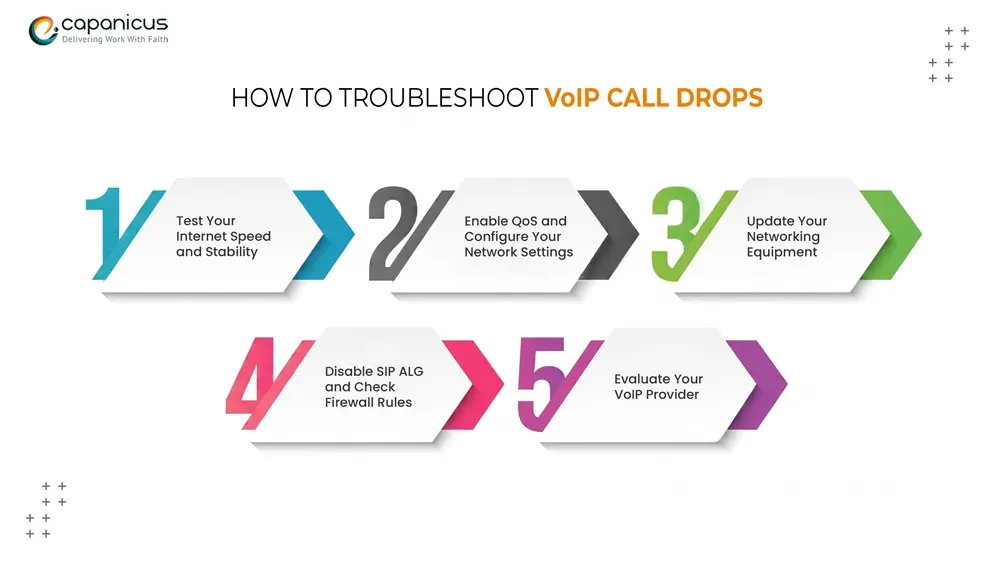
Step 1: Test Your Internet Speed and Stability
Instead of only checking your internet connection speed, you should run a test specifically designed for VoIP. A proper VoIP test will examine important factors such as the latency, jitter, and packet loss along with the raw speed. There are several tools that you can use to measure the performance of your VoIP service. Some of these tools include PingPlotter, VoIP Spear, and the diagnostic tool provided by your VoIP provider.
Step 2: Enable QoS and Configure Your Network Settings
In your router settings, you will find an option to configure Quality of Service (QoS), a feature that lets you prioritize different types of network traffic. By properly configuring QoS on your router, you will give priority to your VoIP calls before file downloads, video streaming, and web surfing on your network even when network congestion occurs.
To configure QoS on your router, first log in to the router’s administration area, then look for QoS or traffic prioritization settings. Mark your VoIP traffic and/or the IP addresses associated with your VoIP devices as high priority. Configuring QoS for VoIP traffic will resolve many issues causing lost calls due to congestion without requiring any hardware changes.
Step 3: Update Your Networking Equipment
To ensure your network is functioning optimally, regularly check your router manufacturer’s website for firmware updates. There are frequent bugs in older firmware versions that can interfere with your VoIP service and/or put your security at risk. If your router is more than three years old, consider replacing it with a business-grade router designed to properly manage VoIP calls.
For wired connections, you should use managed switches rather than unmanaged switches. Managed switches let you configure VLANs to completely separate voice and data traffic, which is the most effective way to protect call quality from other network activity.
Step 4: Disable SIP ALG and Check Firewall Rules
Go into your router settings and disable SIP ALG. This is almost universally the right move for any business VoIP service setup. Then work with your VoIP provider to verify that the correct ports are open in your firewall and that your NAT traversal settings are configured properly.
Your provider’s technical team should be able to give you a specific list of ports and settings required for their platform. If they can’t, that’s a red flag about the quality of their support.
Step 5: Evaluate Your VoIP Provider
After you’ve ruled out network-side issues, look critically at your provider. Ask them directly for their uptime statistics for the past 12 months. Ask about their server redundancy, their failover process, and how they handle service degradation. Review your SLA and understand exactly what they’re committed to delivering and what happens when they fall short.
Why Businesses Are Moving to Cloud-Based VoIP Solutions
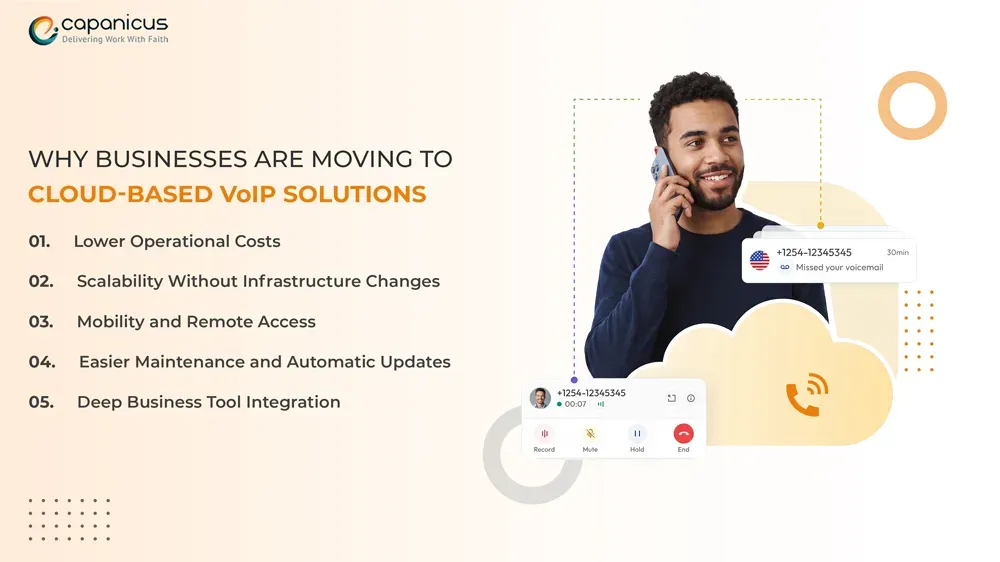
Traditional PBX systems had their time. For decades, they were the only real option for running a multi-line business phone operation. But that time has passed, and the gap between what a legacy system offers and what a modern cloud phone system delivers continues to widen.
Lower Operational Costs
On-premise phone systems require expensive hardware, dedicated server space, specialist maintenance contracts, and significant upfront capital investment. A cloud-based VoIP phone system replaces all of that with a predictable monthly subscription. Most businesses see a return on investment within the first year of switching.
Scalability Without Infrastructure Changes
Adding a new employee to a traditional PBX requires physical hardware changes. Adding them to a cloud phone system takes minutes and a few clicks. The same is true in reverse. If your team contracts, you simply adjust your subscription. No stranded hardware, no wasted capacity.
Mobility and Remote Access
A business VoIP service runs on any device with an internet connection. Your employees’ business phone number goes with them whether they’re working from the office, home, a hotel room, or an airport. Customers call one number and reach the right person regardless of where they’re physically located.
Easier Maintenance and Automatic Updates
When your cloud phone system provider pushes an update, your system gets it automatically. No scheduled downtime, no IT project, no compatibility testing. The operational burden of maintaining a modern business communication system drops dramatically when it lives in the cloud.
Deep Business Tool Integration
Modern business VoIP services are built with integrations in mind. CRM connections, helpdesk integrations, calendar sync, analytics platforms. The ecosystem around cloud VoIP has matured to the point where it fits naturally into almost any existing business technology stack without requiring custom development work.
Why Choose Capanicus for VoIP Telephony Solutions
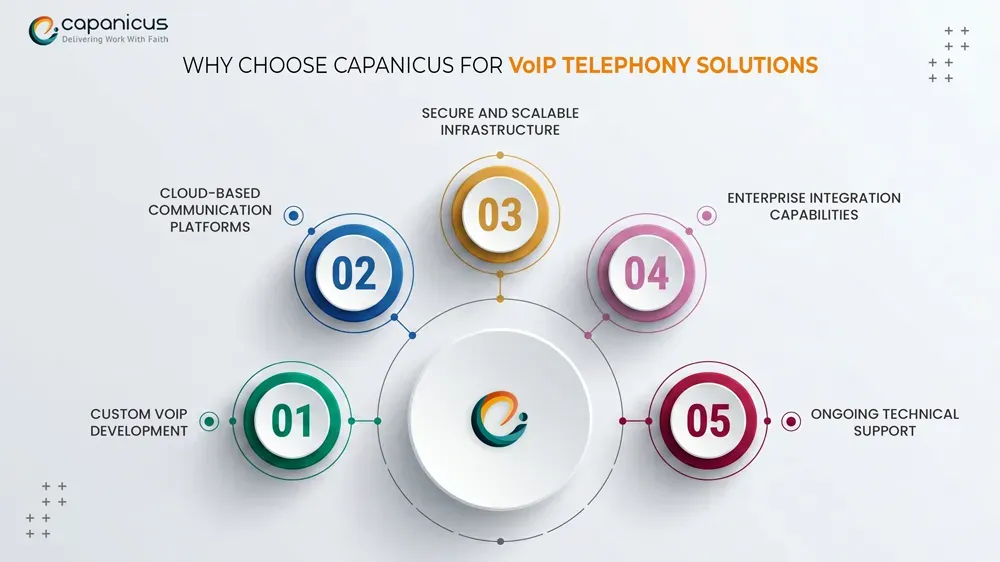
Most businesses in the market for a VoIP solution face the same problem. Providers offer off-the-shelf products with fixed feature sets, and when those features don’t quite fit how the business actually operates, the answer is usually “work around it.” Capanicus takes a different approach entirely.
Capanicus specializes in VoIP telephony software and app development, which means they build communication infrastructure around your business requirements rather than asking your business to adapt to their product’s limitations.
Custom VoIP Development
No two businesses communicate the same way. A logistics company, a legal firm, and a healthcare provider all have fundamentally different requirements for how their business phone system should function. Capanicus builds custom VoIP solutions that reflect those specific needs, from call routing logic to compliance requirements to user interface design for internal teams.
Cloud-Based Communication Platforms
Every solution Capanicus builds is architected for the cloud from the ground up. That means geographic redundancy, automatic failover, elastic scaling for traffic spikes, and the kind of uptime guarantees that a serious business VoIP service deployment demands. You’re not getting a product designed for the average customer. You’re getting infrastructure engineered for your actual usage patterns.
Secure and Scalable Infrastructure
Security in business communication isn’t optional; it’s foundational. Capanicus builds end-to-end encryption, fraud detection, and regulatory compliance directly into its VoIP systems. Whether you operate under HIPAA, GDPR, or industry-specific communication requirements, the infrastructure is built to meet those standards without adding friction to daily operations.
Enterprise Integration Capabilities
A standalone VoIP phone system that doesn’t connect with your CRM, helpdesk, or ERP is a missed opportunity. Capanicus builds integrations that make your phone system a functional part of your broader business technology stack, not an island. Calls log automatically, customer data surfaces in real time, and your teams spend less time on manual processes and more time on actual work.
Ongoing Technical Support
After deployment, Capanicus stays involved. Their support comes from engineers who built the system, not a generic help desk reading from a troubleshooting script. When something needs adjusting, the people who fix it understand the architecture intimately. That’s a fundamentally different support experience than what most VoIP companies offer after the sale is closed.
Conclusion
VoIP call drops have causes — bad internet, wrong settings, weak hardware, poor providers — and each has a fix.
The businesses that suffer from dropped calls are usually the ones that set up their VoIP system and never look at it again. The businesses that have rock-solid call quality are the ones who monitor it, maintain it, and choose the right partner from the start.
If you’re still on old hardware or a traditional PBX, a cloud phone system will immediately improve reliability
Your phone system is how your business talks to the world. It should work every time, without question.
Ready to upgrade with a communication system that performs reliably, scales cleanly, and fits how your business actually operates? Capanicus VoIP Telephony Software and App Development is the right way to start.