Design Challenges of a Multi-Tenant VoIP Platform
The core idea is to develop a single telephony infrastructure capable of serving multiple tenants securely by keeping each of them completely separate from the others and yet sharing the underlying compute, storage, and networking resources. It is not as such just about providing a feature-rich telecom experience like a traditional PBX system; achieving tenant isolation and ensuring consistent quality of service, as well as keeping maintenance operations straightforward, are much more difficult aspects. This blog is mainly for business and technical decision-makers who are planning or implementing a multi-tenant, VoIP-native cloud-based product.
Multi-Tenant VoIP Platform: A Closer Look
Multi-tenant VoIP
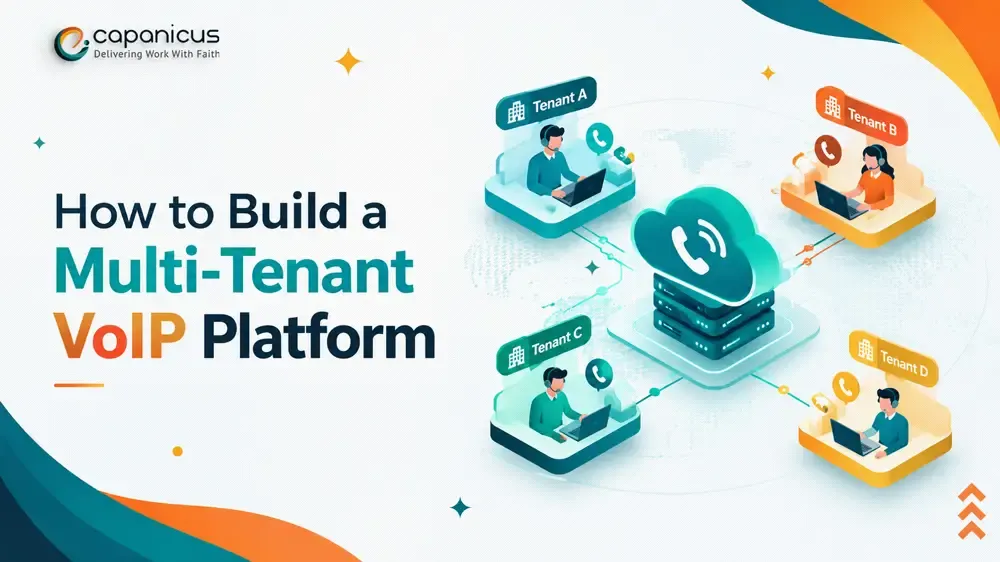
A multi-tenant VoIP (Voice over IP) platform, at its heart, is simply a hosted phone system that allows several different companies to have their own virtual office telephone services without them owning any physical equipment, the service provider’s equipment, or their own premises. That means, although they might be sharing the same hardware (servers, switches, etc.), each tenant’s system is completely segregated in their own virtual space.
Each tenant will typically have a:
- Separate SIP domains (e.g., tenantA.voipdomain.com, tenantB.voipdomain.com)
- Unique phone directories and user access control
- Custom
Call handling features like music on hold, custom greeting messages, different ring groups, and even voicemail systems. Independent CDRs (Call Detail Records), billing, etc.
In other words, each tenant’s PBX is a mirror image of their company’s office telephone system, and they can access, control, and customize it without any restrictions or need for physical equipment. In a way, it’s a PBX system, without any PBX hardware. Bear in mind that these systems are based on cloud technology. As with cloud computing, this means the service is highly scalable, and it’s delivered from the internet. If one’s business grows, the cloud PBX provider increases their PBX space without noticing, and the cost goes up and down depending on usage, i.e., one’s actual number of calls.
Main Architectural Components
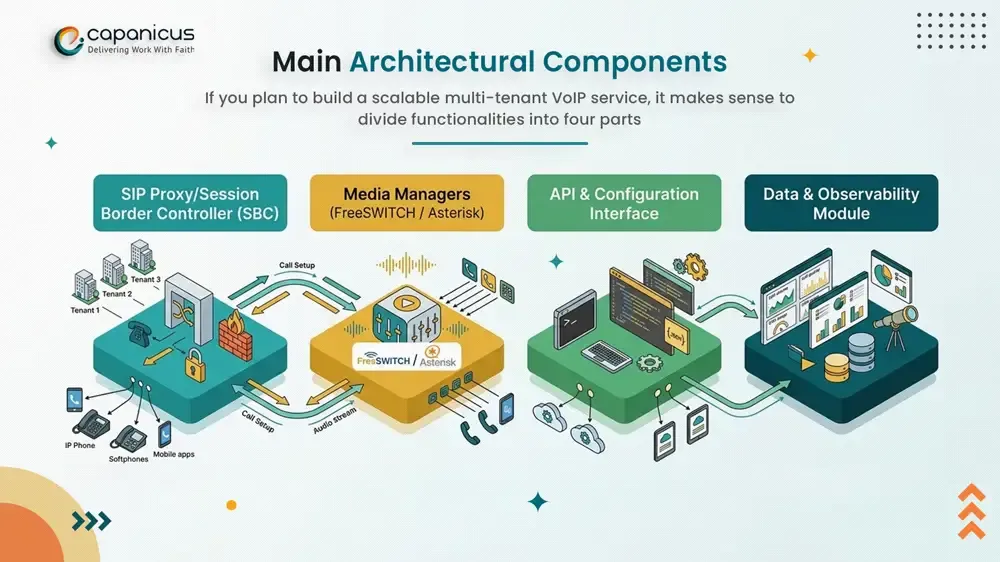
If you plan to build a scalable multi-tenant VoIP service, it makes sense to divide functionalities into four parts:
-
SIP Proxy/Session Border Controller (SBC)
SBC, like Kamailio or even OpenSIPS, basically represents the entry point in the system:
- SIP endpoint authentication and registration
- Routing of INVITEs to respective tenant contexts
- Rate limiting, topology hiding, etc.
- Media relay coordination and NAT traversal.
To handle a very high load of tenants (say >500), the SBC CPU may get overwhelmed by complex regular expressions used for routing decisions. A workaround is to decouple signaling proxies and cache the routing table.
-
Media Managers (FreeSWITCH / Asterisk)
Media managers do the following:
- Broadcast RTP and translate codecs.
- Voice response (IVR), conferences, and making call recordings.
- The operation of a tenant-specific dial plan.
For isolation between tenants and to have good audio quality for all, you can use different levels of media networks:
Apart from routing the call traffic of big tenants to special media groups, regular tenants will be sharing other general-purpose nodes.
-
API & Configuration Interface
An API interface will be responsible for the following:
- Setting up and taking down the tenants.
- The retrieval of dialplans via HTTP (e.g., FreeSWITCH mod_curl, Asterisk Realtime)
- Settings per tenant for codecs, routing, and features
One more benefit is that by using a central API, the need for exceptions for a tenant will no longer exist, and during updates, the configuration drift problem will not occur.
-
Data & Observability Module
- Saving: Use databases for metadata storage of tenants, call detail records (CDRs), and billable usage data. Separate reads from writes via Kafka or Redis. Do use read replicas.
- Monitoring: Provide call statistics per tenant, such as MOS values and counts of simultaneous calls as well as errors.
- Reporting: Offer CDR exports separated per tenant and tenant-level dashboards reporting the usage of services.
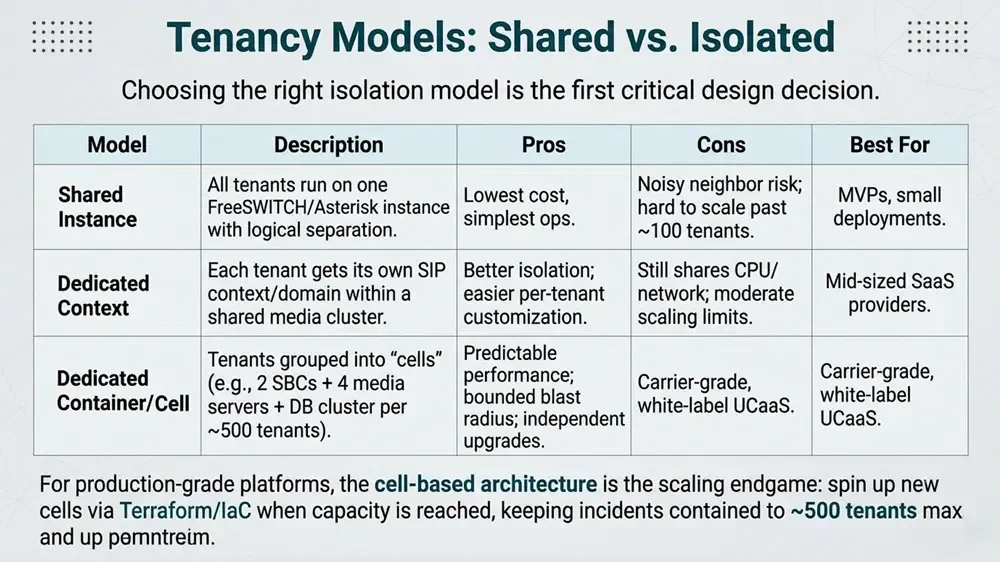
Tenancy Models: Shared vs. Isolated
Key Technical Challenges & Issues – & Solutions
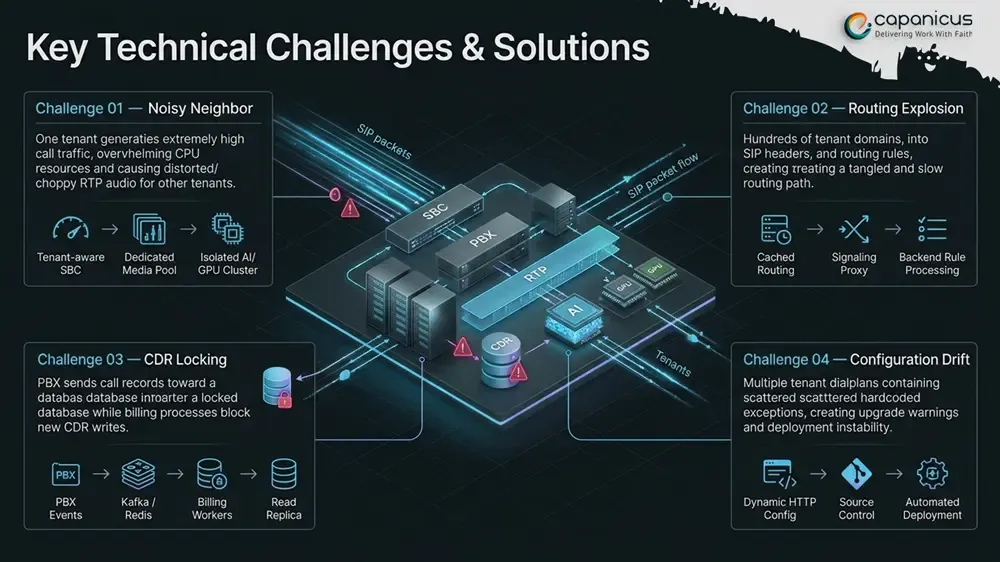
Noisy Neighbor RTP Degradation
Problem: A dialing campaign by the automated call tenant has saturated the server’s CPU. Other tenants’ audio is now choppy.
Fix:
- Use tenant-aware SBC routing so that high-volume tenants can be directed into media pools that are specifically dedicated.
- Move all AI and DSP-heavy workloads (such as transcription & summarization tasks) that consume GPU resources to isolated GPU clusters using WebSocket audio extraction.
SBC Routing Rule Explosion
Problem: More than 500 tenants having personalized domains plus header manipulations lead the per-packet regex evaluation process to break the latency requirements.
Fix:
- Routing decisions could be cached, and decoupled signaling proxies could be used.
- To reduce the logic complexity per invite to a minimum, complex rule processing could be shifted to the backend APIs, which would be used during registration and not per-INVITE.
CDR Database Locking
Problem: A cron job that initiates billing locks the CDR table, so other PBX tasks cannot write the PBX to record new data, and call processing is stopped.
Fix:
- Implement event-driven dataflow pipelines in the PBX that send CDR events to Kafka or Redis.
- Persistence and billing can be performed by downstream workers.
- Read replicas can be used for reporting purposes to alleviate database lock issues.
Configuration Drift
Problem: Tenant-specific exceptions, hardcoded in the dialplan, are making platform upgrades risky and full of errors.
Fix:
- Tenant settings can be dynamically retrieved via HTTP at call setup.
- Source control for all the scripts that handle provisioning. The deployment will be done following patterns to avoid any modifications or changes post-deployment.
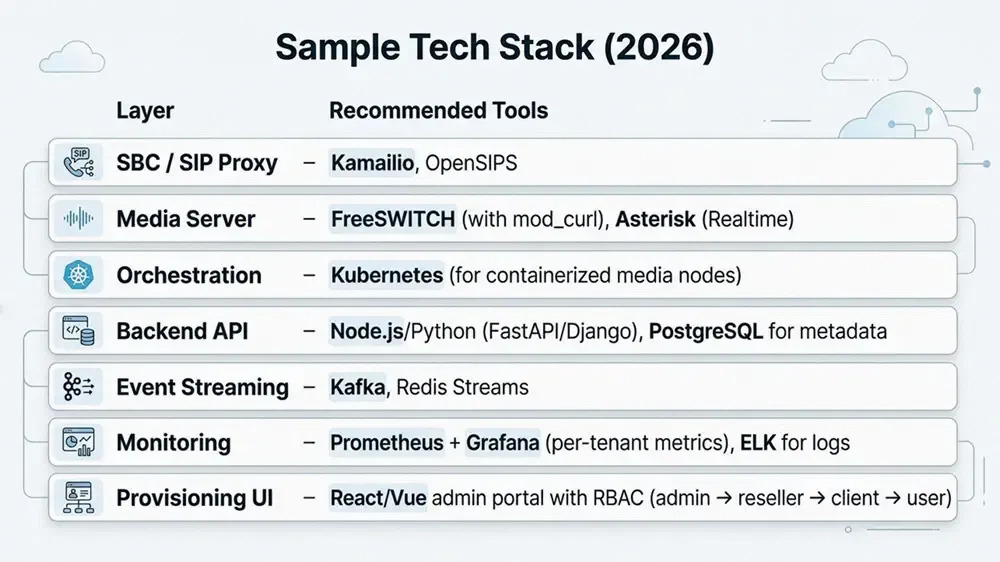
Sample Tech Stack (2026)
Operational Best Practices
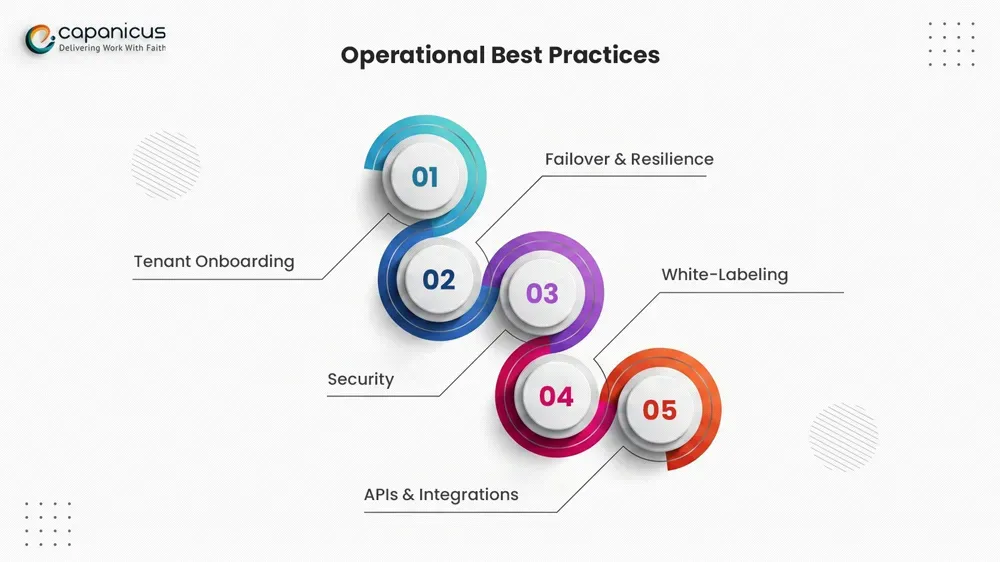
- Tenant Onboarding: You may automate domain provisioning, SSL cert issuance, and SIP
- Failover & Resilience: If a failure occurs, you’ll have to switch over to the standby SBCs and media servers for that cell at once. So, you have to plan active/standby pairs per cell.
- Security: You should do SIP over TLS and SRTP for media. Besides that, you should limit each tenant’s rate in a way that it cannot overwhelm your system.
- White-Labeling: Resellers will need to be able to change the branding, like the theme, the logo, and the domain per tenant.
- APIs & Integrations: It’s necessary to provide REST APIs and open up integrations for the CRM, help desk, Microsoft 365/Google Workspace.
The Reason Behind It for Capanicus
Capanicus has a strong record of delivering cloud PBX development with IVR, queues, and routing workflows. Going from that to a multi-tenant SaaS product will meet the demand for scalable, white-label UCaaS platforms from a new generation of MSP, telco, and vertical SaaS providers requiring embedded voice.
In order to scale beyond hundreds of tenants without degradation in call quality or operational control, Capanicus will have to build a platform with cell-based isolation, API-driven configuration, and event-driven CDR pipelines.
Your Team’s Next Steps
- Clarification of tenancy models: Dedicated context first; cell-based scaling by day one.
- Prototyping of SBC routing: Performance of Kamailio/OpenSIPS validation for 200-500 tenants.
- Development of Tenant Management Module: Automating tenant onboarding, domain binding, and credential issuance, and
- Provisions for observing tenant-level MOS, concurrent calls, and errors
- AI task planning: The design of a WebSocket audio extraction for possible transcription/summarization features in the future.
Frequently Asked Questions (FAQs)
Q: What is a multi-tenant VoIP platform?
A: it is one phone system in the cloud that supports a number of different companies with their own virtual PBX, extensions, and features — without having a separate hardware for each tenant.
Q: Is multi-tenant VoIP secure?
A: If a multi-tenant VoIP service is built with proper isolation between the tenants, then it can definitely be secure. Each tenant’s SIP domains, user data, CDRs, and billing are logically separated, so there is no access from a tenant to another.
Q: FreeSWITCH or Asterisk, which one is better?
A: FreeSWITCH is often the better choice for a large deployment of multi-tenancy due to its native support for this. On the other hand, Asterisk requires workarounds, or else, you might end up having multiple Asterisk instances which makes it harder to scale.
Q: Kamailio vs. OpenSIPS for SBC routing?
A: Both are routing protocols that are suitable for SBCs but with different areas of applications and different complexities. OpenSIPS, for example, can handle even complicated routing logic. That’s ideal for CPaaS/MVNO. On the other hand, the popularity of Kamailio is a factor which might be good enough reason to choose Kamailio for your enterprise SBC and WebRTC gateway roles.
Q: How many tenants can one platform support?
A: The shared instance is limited to about 100 tenants at maximum. If you want to scale up beyond that, a cell-based architecture is the way to go.
Q: What is “noisy neighbor” degradation?
A: A “noisy neighbor,” in this context, would be the high-volume tenant which completely uses up the server resources, thereby making audio calls choppy for others. The only way to prevent that is the tenant-aware routing and cell-based isolation techniques.
Q: Why does CDR database locking matter?
A: If the billing process locks the CDR table, no more calls can be processed. The answer is to stream CDRs to Kafka/Redis and read replicas to report against.
Q: What is the typical tech stack in 2026?
A: Kamailio/OpenSIPS (SBC), FreeSWITCH (media), Kubernetes (orchestration), Node.js/Python (API), PostgreSQL (metadata), Kafka/Redis (events), Prometheus + Grafana (monitoring).
Q: What is the automated onboarding process for tenets?
A: With your central API, you can automatise the provisioning of domains, SSL certificates, SIP credentials, dial plans, etc. Deploy Terraform/IaC-based cells repeatedly for the onboarding of new tenants.
Q: Is it possible to make the product look like a reseller’s own by changing some aspects and white-labeling?
A: Yes, you can set up per-tenant branding such as themes, logos, and subdomains Additionally, you will be able to offer CRM, helpdesk, and Microsoft 365/Google Workspace integration through REST APIs.
Q: Which errors are more fatal and should be avoided?
A: Kamailio/OpenSIPS are usually not treated as full SIP BCS (Session Border Controllers), tenant exceptions are hardcoded, CDR pipelines are skipped by a lack of event-driven approach, cell-based isolation is completely disregarded.
Q: How is Capanicus involved here?
A: Capanicus demonstrates cloud PBX know-how via the development of IVR, queues, and routing. Constructing a multi-tenant SaaS based on cell isolation with a strong emphasis on API-first config is positioning Capanicus as a solution for the scalable UCaaS.