If you’ve been researching phone answering options for your business lately, you’ve probably landed on Capanicus’s AI Receptionist Solutions page at some point, and for good reason. The question of whether to stick with a human receptionist or move to an AI virtual receptionist isn’t a small one anymore. It touches your budget, your customer experience, and honestly, how many calls actually get answered in the first place. This isn’t a hype piece about robots taking over front desks. It’s a straight comparison, the kind you’d want before actually spending money on either option.
AI Receptionist vs Human Receptionist: Why This Comparison Matters Right Now
A few years back, “AI receptionist” mostly meant a clunky phone tree that frustrated everyone who called. That’s changed fast. The global AI receptionist market was valued at roughly $2.3 billion in 2025 and is projected to reach $23.8 billion by 2035, according to market research published by Globe Market Research, growing at a compound annual rate above 26%. That’s not a niche trend, that’s a genuine shift in how businesses handle their front line.
And the reason isn’t really about novelty. It’s about a problem that’s existed forever and is only now getting solved properly: calls going unanswered. A single overwhelmed receptionist, or a small team stretched across too many responsibilities, simply can’t catch every call, every time, especially outside standard business hours. That gap has real financial consequences, and it’s exactly what’s pushing so many businesses to at least evaluate AI receptionist software seriously.
What Is an AI Receptionist? Understanding AI Receptionist Software
Before comparing the two options fairly, it helps to actually define what an AI receptionist is, since a lot of people are still picturing the frustrating phone trees of a decade ago rather than what this technology has become.
How AI Receptionist Software Actually Works
Modern AI receptionist software uses natural language processing to hold a real, flowing conversation rather than forcing callers through rigid menu options. It listens to what a caller actually says, understands intent, and responds conversationally, the same way a trained human would, just without needing a coffee break.

The Case for a Human Receptionist
Let’s be fair to the human side of this comparison first, because there are genuine strengths here that shouldn’t get glossed over.
Where Human Receptionists Genuinely Excel
A skilled human receptionist reads tone, picks up on frustration or urgency in a caller’s voice, and adjusts on the fly in ways that still feel more natural than most automated systems, even good ones. They build familiarity with regular clients, remembering context from previous conversations without needing to look anything up. For businesses where relationship-building genuinely drives revenue, a warm, personable human voice on the other end of the line still carries real weight.
The Real Limitations of a Human-Only Front Desk
Humans also come with limitations that are easy to underestimate when you’re only thinking about the good calls:
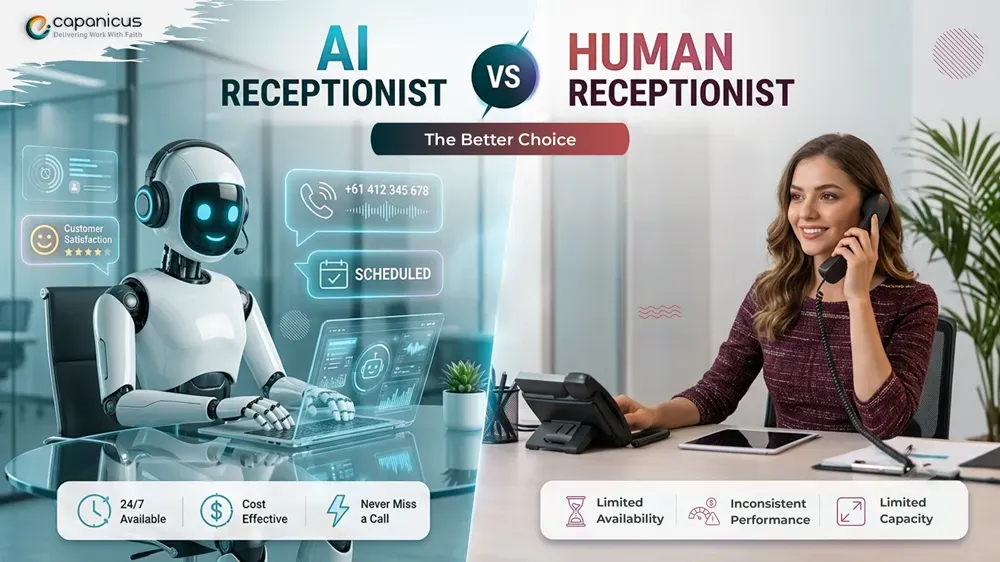
- Fixed working hours, meaning every call outside that window goes to voicemail or rings out entirely
- Sick days, breaks, and the occasional off day that shows in how a call gets handled
- Ongoing cost, salary, benefits, training, and turnover, all adding up whether or not the phone is actually ringing
- A hard ceiling on how many calls one person can handle at once, regardless of how good they are at the job
The Case for AI Virtual Receptionist Solutions

An AI virtual receptionist isn’t the same thing as a phone tree that makes callers punch numbers until they give up. This is where AI receptionist solutions genuinely start pulling ahead for a lot of businesses.
Availability Is the Biggest Practical Advantage
The biggest practical difference is straightforward: an AI receptionist doesn’t take lunch breaks, doesn’t call in sick, and doesn’t stop answering at 6 PM. Every call gets picked up, every time, which matters enormously given how many businesses lose potential customers simply because nobody was there to answer.
AI Receptionist Development Scales in a Way Human Teams Structurally Can’t
It also scales in a way a human team structurally can’t. Whether a business gets five calls a day or five hundred, a properly built AI virtual receptionist handles each one the same way, without needing to hire and train additional staff to keep up during busy periods, seasonal spikes, or after a marketing campaign drives a sudden jump in inquiries.
The Cost Comparison Is Hard to Ignore
Cost is the other obvious factor. A full-time human receptionist typically runs a business tens of thousands of dollars a year once salary and overhead are factored in. AI receptionist solutions generally cost a fraction of that, which is exactly why adoption has moved so quickly from enterprise budgets down to small and mid-sized businesses that could never have justified a dedicated receptionist role in the first place.
Where Each Option Genuinely Wins
It’s worth being honest that this isn’t a case where one option wins across the board.
Human receptionists still make more sense for businesses where every interaction is high-stakes, deeply relational, and low-volume, think a boutique wealth management firm with a handful of long-term clients who expect a familiar voice every time they call. They’re also better suited to situations demanding genuine emotional nuance that current AI systems still can’t fully replicate, though that gap keeps narrowing every year.
AI receptionists make more sense for businesses dealing with high call volume, frequent after-hours inquiries, repetitive but important tasks like appointment scheduling, or situations where missed calls translate directly into lost revenue. Service businesses, clinics, law firms handling intake, real estate offices, and e-commerce support desks are exactly where AI receptionist development has focused most heavily, because the return on investment shows up fast and clearly.
AI Receptionist Solutions and Human Teams: The Hybrid Approach Most Businesses Land On
In practice, a lot of businesses don’t pick one side of this comparison exclusively, they blend both.
How a Hybrid Front Desk Actually Works
An AI receptionist handles the first line, answering every call instantly, gathering information, and handling routine requests like scheduling or basic FAQs. Calls that genuinely need a human touch, a complex complaint, a high-value client, a sensitive situation, get escalated smoothly to a real person.
Why This Model Tends to Work So Well
This hybrid model tends to capture the best of both worlds: nothing falls through the cracks because of unanswered calls, but the moments that genuinely benefit from human judgment still get one. It’s also usually the most cost-effective path, since it reduces how much human staff time gets spent on routine, repetitive call handling, freeing that time for higher-value work.
Questions to Ask Before Choosing an AI Receptionist Solution
A few practical things are worth thinking through before committing either way:
- How much of your current call volume is actually routine, appointment booking, basic questions, information requests, versus genuinely complex?
- What percentage of your calls currently go unanswered outside business hours, and what’s that actually costing you in missed opportunities?
- Does your business need the kind of deep, ongoing relationship-building a human voice provides, or is speed and consistency of response the bigger priority?
- Would a hybrid setup, AI handling the front line with human escalation, fit your team’s structure better than an all-or-nothing switch?
Answering these honestly usually makes the decision a lot clearer than starting from the assumption that one option is simply “better” than the other in the abstract.
How Capanicus Delivers AI Receptionist Development That Fits Your Business
This is exactly the decision Capanicus works through with every business that comes to us. We don’t push AI receptionist software as a blanket replacement for your team, we start by actually understanding your call patterns, your customer expectations, and where the real gaps are costing you business.
From there, our AI receptionist development process builds a solution tailored to how your business actually operates, whether that means a fully automated AI virtual receptionist handling everything from scheduling to lead capture, or a hybrid setup where AI handles the front line and hands off seamlessly to your human team when a conversation genuinely needs it. We configure the AI’s conversation flow around your specific industry and common caller needs, integrate it with your existing scheduling and CRM tools, and keep refining performance based on real call data once it’s live. Our goal isn’t to sell you the most advanced AI receptionist solution available, it’s to get you the one that actually fits your business and stops calls from slipping through the cracks.
Conclusion
Neither AI nor human receptionists win this comparison outright, the right answer depends entirely on your call volume, your customers’ expectations, and where missed or mishandled calls are actually costing you money. What’s clear is that businesses ignoring the AI option entirely are increasingly leaving revenue on the table simply because nobody was available to pick up the phone.
If you’re trying to figure out whether an AI receptionist, a human team, or some blend of the two makes the most sense for your business, Capanicus can walk you through your actual call data and build a solution around it rather than a generic template. Reach out to our team to see what an AI receptionist could realistically do for your front desk.