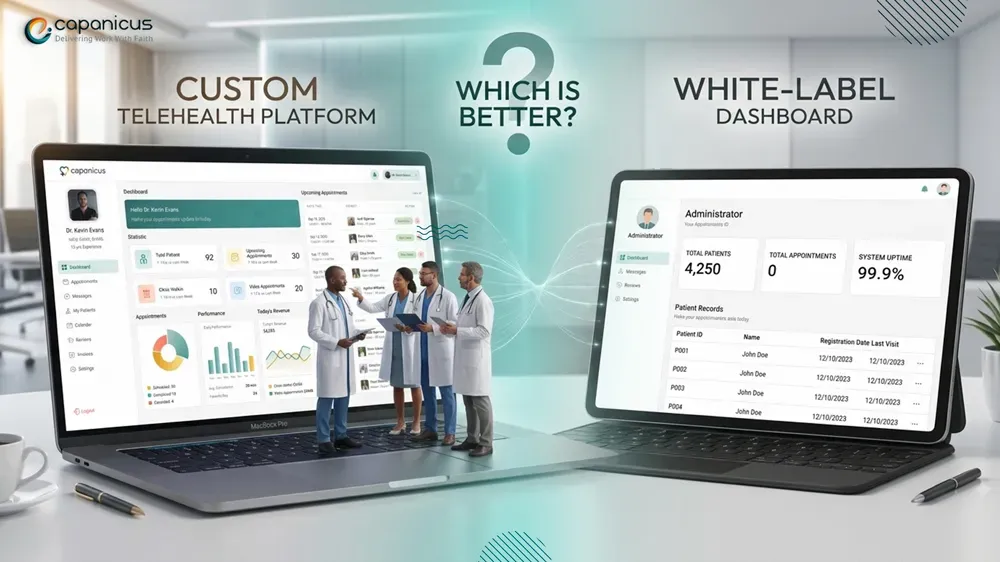
Telehealth platform development decisions rarely feel simple once real budgets and real timelines enter the picture. Picture a founder with two proposals open on a laptop. One promises a working app in six weeks, built on a shared codebase already running for a dozen other clinics. The other asks for four months, a larger budget, and patience, but promises something built only for their patients and their exact workflow. Both proposals technically deliver a telehealth platform. Only one of them will still fit the business three years from now.
This is the real question behind every conversation about a white-label telehealth solution versus a custom build. It has little to do with which option sounds more impressive in a pitch deck. It comes down to what a clinic, hospital group, or digital health startup actually needs to serve patients, pass audits, and grow without hitting a wall later. The global telehealth market is projected to cross USD 191 billion in 2026, and every one of those dollars rides on a platform decision someone made months or years earlier.
What a White-Label Telehealth Solution Actually Gives You

A white-label telehealth solution is a ready-made platform that a healthcare business rebrands as its own. The vendor has already built the video engine, patient portal, scheduling tools, and basic compliance layer. The business adds its logo, colors, and domain, then goes live.
This route works well for a specific type of business:
- Speed: Many white-label platforms can go live in two to four weeks, since the core technology is already tested and running.
- Lower upfront cost: There is no need to fund a development team from scratch, which makes this option attractive for startups and smaller clinics testing virtual care for the first time.
- Built-in compliance basics: Reputable vendors already carry HIPAA, GDPR, and similar certifications, along with signed BAAs, so the legal groundwork is mostly done before day one.
- Limited flexibility: The business is renting someone else’s architecture. Custom workflows, unique patient journeys, or deep integrations with an existing EHR system are usually restricted to whatever the vendor allows.
For a clinic that wants to launch virtual visits quickly and does not need anything beyond standard video consultations, a white-label telemedicine platform can be a practical starting point. The tradeoff shows up later, once the business tries to do something the vendor’s system was never designed to support.
Why Businesses Choose Custom Telehealth Platform Development
Custom telehealth platform development means building the product from the ground up, shaped entirely around one organization’s patients, providers, and internal processes. Nothing is borrowed or shared with another company.
The reasons businesses choose this path tend to repeat across the industry:
- Full ownership of the codebase and patient data. Nothing sits on shared infrastructure controlled by a third party.
- Workflows built around real clinical processes, not a generic template that assumes every practice works the same way.
- Deeper integrations with existing EHR systems, billing platforms, insurance verification tools, and remote monitoring devices.
- Room to scale as patient volume grows, new specialties get added, or the business expands into new regions with different regulatory requirements.
- A product that looks and feels like the brand, rather than a reskinned version of a tool other competitors may also be using.
This approach costs more and takes longer, often four to twelve months depending on scope. But the telehealth market itself explains why many organizations still choose it. Analysts project the space to grow at a compound annual rate above 24% through the next decade, meaning the platforms built today need enough headroom to handle a patient base and feature set several times larger than what launches on day one.
The points above cover cost, speed, and control. A few other factors rarely make it into the conversation early on, and they tend to matter just as much once a platform is actually running.

Telemedicine App Development: Comparing Cost, Speed and Control

Laid side by side, the two paths differ on nearly every practical measure a healthcare business cares about.
- Cost
White-label solutions charge setup fees plus ongoing per-provider or per-visit pricing, usually far below the cost of building from scratch. Custom telemedicine app development requires a larger upfront investment, but that cost buys a product the business owns outright, with no recurring licensing dependency on someone else’s roadmap.
- Time to Launch
White-label wins here, often by a wide margin. A custom build takes real design and engineering time before the first patient logs in.
- Control Over the Product
White-label platforms limit changes to whatever the vendor’s settings panel allows. Custom platforms let a business change anything, from the patient intake flow to how providers document a visit.
- Compliance Responsibility
White-label vendors typically maintain HIPAA and GDPR compliance across their shared infrastructure, which reduces the buyer’s workload. With a custom build, compliance becomes the business’s own responsibility from day one, though it also means the security architecture is built specifically around that organization’s risk profile rather than a one-size-fits-all standard.
- Long-term Scalability
This is where custom builds tend to pull ahead. A shared platform serving hundreds of clients has limits on how much any single business can customize or expand. A custom platform grows exactly the way the business grows.
- Patient Experience
Engagement has become one of the top priorities telehealth teams report heading into 2026, ahead of even growth or new feature launches. A generic interface can undercut that goal, while a platform designed around real patient behavior tends to hold attention and build trust more effectively.
Which Telemedicine Platform Development Path Fits Your Business
The right choice depends less on preference and more on where the business actually stands.
A white-label telehealth solution usually fits best when a business is testing virtual care for the first time, working with a tight budget, or needs to launch before a specific deadline such as a new insurance contract or licensing requirement. It also suits smaller practices that only need standard video visits without complex integrations.
Custom telehealth platform development tends to fit better once a business has validated demand and is ready to invest in something built to last. It suits hospital groups managing multiple specialties, digital health startups planning to raise funding on the strength of a proprietary product, or any organization whose existing systems (EHR, billing, insurance workflows) need tight, reliable integration that off-the-shelf platforms rarely support well.
Some businesses take a blended path. They launch on a white-label platform to prove the model works, then move to custom telemedicine platform development once patient volume and revenue justify the investment. This lowers early risk while keeping the door open for a fully owned product later.
Build the Right Platform, Not Just a Fast One – Here’s How
That founder from the beginning of this conversation eventually made a choice. Not because one proposal looked better on paper, but because one option actually matched where the business was headed over the next three years, not just the next three months.
This is exactly where Capanicus works with healthcare businesses. Some clients need a telemedicine app development partner who can move fast and get a compliant, branded platform live in weeks. Others need a fully custom telehealth platform built around a specific clinical workflow, integrated with existing EHR and billing systems, and engineered to scale as patient volume grows. Capanicus builds both, with HIPAA and GDPR compliance handled from the first line of code, not bolted on afterward. The goal is never to sell a business more platform than it needs, or less than it will need a year from now. It is to build the right one, matched to where the business actually stands and where it wants to go next.
FAQs
- How long does custom telehealth platform development usually take compared to a white-label launch?
A white-label telehealth solution can typically go live in two to four weeks, since the core infrastructure already exists. Custom telehealth platform development usually takes four to twelve months, depending on how many integrations, specialties, and compliance requirements the platform needs to support. The timeline difference is the biggest early tradeoff businesses weigh before choosing a path.
- Can a business start with a white-label platform and move to a custom one later?
Yes, and many businesses do exactly this. Starting with a white-label telemedicine platform lets a business validate demand and generate revenue with lower upfront risk. Once patient volume and workflow needs outgrow what the shared platform allows, moving to custom telehealth platform development becomes a natural next step, usually once there is enough data to justify the investment.
- Is a custom telehealth platform automatically more secure than a white-label solution?
Not automatically. Security depends on how the platform is built, not just who owns it. Reputable white-label vendors already carry HIPAA, GDPR, and similar certifications with signed BAAs in place. A custom platform can match or exceed that level of security, but only if compliance is built into the architecture from the start rather than added later. The real difference lies in who is responsible for maintaining that compliance over time.