




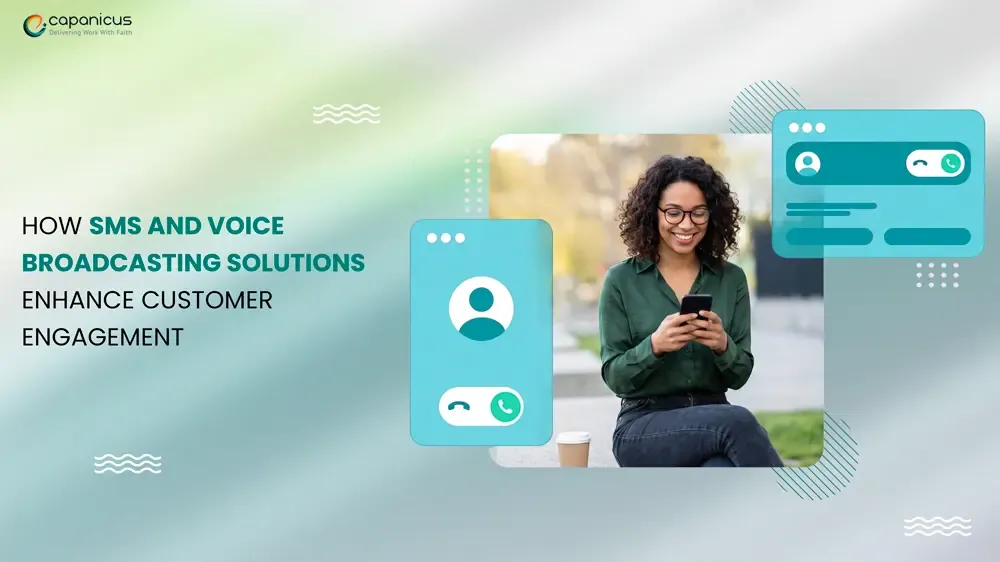
Just text me.
That’s what your customers are saying (not out loud) every time they ignore your notification, skip your email, and scroll past your post.
Honestly, they’re not ignoring you on purpose. They are just overwhelmed, like all of us. But a text? Or a voice message that speaks to them directly? That still cuts through every single time.
Most businesses already know this. They just haven’t built their communication around it yet and are still pouring budget into channels that made sense five years ago. And that’s exactly where Capanicus comes in with SMS broadcasting software. We help you debunk the uncomfortable truth that separates businesses that grow on the back of loyal customers from those that are constantly chasing new ones.
This piece of content covers everything from “how do we send more” to “how do we actually reach them”. Let’s start with the root.
The Attention Problem Is a Channel Problem
Don’t take our words for it; the numbers tell a completely different story.
- SMS open rates hover around 98%.
- Email? Closer to 20% on your lucky day.
- Voice messages – when delivered at the right moment – drive response rates that digital-native marketers spend years trying to replicate with complex automation stacks.
This clearly tells the channel that the channel you choose is a statement about how much you respect the person on the other end.
SMS says: I understand you’re busy. But here’s what you need in 5 seconds.
Voice says: This matters enough that I want you to hear it.
When put together, they form the backbone of what modern customer engagement should look like. Actually, this type of customer engagement is built around your customer’s time, not yours.
What SMS Broadcasting Solution Actually Does for a Business
A well-defined SMS broadcasting software is a complete kind of communication infrastructure.
Let’s understand this with an example. You can reach 10,000 customers in the time it takes to write one email. You can categorize the list by location, purchase behavior, or customer tier and send messages so relevant that they feel like they were written by someone who actually understands the recipient and their challenge. Also, you can schedule campaigns, track delivery, monitor opt-outs, and optimize everything from one dashboard.
This is a relationship management system that fits inside a text message. Like for a retail brand, an SMS broadcasting solution might mean sending a flash sale notification that drives 400 in-store visits in two hours. Whereas for a healthcare provider, it’s appointment reminders that cut no-show rates by 40%. The usage varies, but the principle stays the same: when you meet people where they already are – on their phones, on SMS, in a channel they actually look.
Voice Broadcasting: The Human Touch at Scale
It’s a well-known fact that there’s something SMS can’t replicate. When a customer hears a voice, it triggers the same processing pathways as real conversation, conveying urgency, warmth, and authority. Honestly, voice broadcasting services exist precisely because this gap matters. Businesses that have integrated voice broadcasting into their outreach consistently report higher recall rates, stronger emotional responses, and improved conversion on time-sensitive communications compared to text.
Furthermore, a voice SMS broadcasting service closes the loop between the two worlds. It allows businesses to deploy both formats in a coordinated campaign, or the reverse: an SMS that piques curiosity, with a voice follow-up that seals the deal.
It’s not at all complex. It just recognizes that different customers respond to different stimuli, and that a channel strategy built on that reality outperforms one built on what’s easiest to deploy.
The Case for a Call Broadcasting Solution – You Must Know
It’s no longer a hidden secret that SMS alone won’t cut it through, and that’s where a call broadcasting solution earns its place.
Political campaigns, emergency alerts, and financial institutions notifying customers of suspicious account activity. Besides, educational institutions reaching thousands of parents simultaneously are another example. In all these examples, the message is action-critical as it demands a medium that needs attention the moment it arrives.
Here, once again, a voice call broadcasting system delivers pre-recorded or live-transfer calls to massive contact lists within minutes. In reality, modern platforms go a step ahead. They support interactive voice response (IVR), enabling recipients to press a key to speak to an agent, confirm an appointment, opt into a service, or even register a vote.
The efficiency gain is beyond measure. But the more crucial transition is in how customers experience. A call that says “press 1 to confirm your appointment at 3 PM tomorrow” is a convenience, not a hurdle. And when implemented well, voice broadcasting services feel like a healthy business investment.
Integration Is The Subtle Difference That Matters
The real power of blending SMS and voice broadcasting is in the orchestration.
Capanicus builds call broadcasting solutions and SMS platforms, particularly to work in tandem, feeding data back and forth so every touchpoint informs the next. For example, a customer who doesn’t respond to the SMS gets a voice follow-up, or a customer who engages with the voice message gets an SMS with the link to complete the action. The system learns which customers prefer which channel, and over time, your outreach becomes genuinely smarter.
This is the difference between broadcasting and engaging. Broadcasting is merely sending, while engaging is a conversation that happens to be at scale.
What Businesses Get Wrong About Broadcasting And How To Solve It
The technology isn’t the complex part. The mindset is.
Numerous businesses treat SMS and voice broadcasting as a volume play, like more sends, more calls, better results. But, in the real world, that’s not how it works. A customer who receives irrelevant messages from your brand five times a week will opt out by week two. And once someone opts out, they’re carrying a negative impression of your brand.
But the businesses that win with SMS broadcasting software and voice call broadcasting are the ones that treat these channels as premium real estate. Every message has to earn its send, and every call has to justify the interruption. That requires clean segmentation, thoughtful timing, and copy that respects the reader’s intelligence.
It also requires the right platform, one that makes compliance easy, lists hygiene, and analytics clearly enough that you can see what’s working and what’s not before burning your complete contact database.
Finally, The Shift Is Already Happening
And your competitors are not sitting still on this. The brands are already ahead of square one, deploying coordinated SMS and call broadcasting solutions, shortening their sales cycles, reducing churn, and building the kind of consistent top-of-mind presence that earns repeated business.
Now, the question for every stakeholder like you reading this isn’t whether SMS and voice broadcasting work. The evidence on that is settled. The pressing question is whether your present communication infrastructure is built to capitalize on its advantage. Or whether you’re still relying on a channel mix designed for a customer behavior that stopped being true five years ago.
Capanicus exists to answer that question. And to make the transition from “we send emails and hope” to “we reach people and get responses” feel less like a technology project and more like a business turning point.
Want to know how Capanicus SMS and voice broadcasting platform can transform your customer engagement? Let’s start the conversation.
Because we understand, nobody ever said: “Just email me more.”