Your sales team finally reaches a hard-to-reach decision-maker. The conversation is going well. Then the agent goes, “Uh… just a second, I need to pull up your details,” and there’s an awkward silence while they click through screens, dial numbers, and wait for calls to connect all day long.
By the end of the shift, your agents are exhausted, but not because they spoke to too many customers. They are tired of fighting inefficient tools.
In most outbound call centers, the single biggest productivity killer isn’t bad agents or weak scripts. It is time lost to manual dialing, unanswered calls, and low contact rates. That is exactly the problem predictive dialers are built to solve.
Over the last decade, the way outbound teams operate has shifted from static lists and manual dialing to cloud-based dialer platforms that automate almost everything between “I have a lead list” and “my agent is in a live conversation.” Predictive dialing sits at the heart of this shift.
This guide will walk through what a predictive dialer is, how it works, how it boosts call center efficiency, and why it matters for businesses building or adopting mobile, web, or custom outbound dialer solutions.
What Is a Predictive Dialer?
A predictive dialer is an outbound dialing system that automatically calls multiple numbers from a contact list and connects only answered, live calls to available agents. Instead of agents dialing numbers one by one, the software dials ahead of time, predicts when each agent will be free, and keeps their time filled with real conversations rather than rings and busy tones.
In simpler terms, a predictive dialer uses algorithms and live data to “stay one step ahead” of agents, so as soon as one call ends, the next customer is ready on the line. Predictive dialers become even more effective when integrated with an omnichannel communication platform, allowing agents to manage calls alongside email, chat, SMS, and social conversations.
How a Predictive Dialer Works Behind the Scenes

A predictive dialer doesn’t just dial faster; it dials smarter. Under the hood, it typically does four key things.
1.Extracts Campaign Data and Lead Lists
A dialer system fetches the phone numbers either from saved lists or directly from a CRM, then it classifies the numbers into different purposes, such as sales, collection, renewal, survey, or customer support follow-ups.
- Agent Availability is Forecast
Based on past data like average handle time, answer rates, and agent occupancy, the software predicts when each staff member will hang up the current call. According to those predictions, it starts dialing new numbers a little time ahead of agents becoming free so that there is hardly any downtime between conversations.
- Simultaneously Calls Several Numbers
To increase the efficiency of the call center operation, a predictive dialer places multiple calls per available agent, expecting that several of them will be unanswered, will go to voicemail, or will be invalid. It is this parallel dialing that is responsible for massive productivity increases.
- Identifies Unproductive Calls
The tool recognizes busy tone, no answer, disconnected number, and even answering machines at times, and then it drops or tags them in accordance with campaign rules. Call center agents receive only those calls that humans answer; no time is wasted on calls that ring and need to be tried again. All of this happens continuously. As connect rates, agent availability, and campaign behavior shift throughout the day, the predictive dialer adjusts its pacing in real time.
Predictive Dialer vs. Manual Dialing and Other Dialer Modes
To understand the real value of a predictive dialer, it helps to see how it compares with other outbound dialing methods.
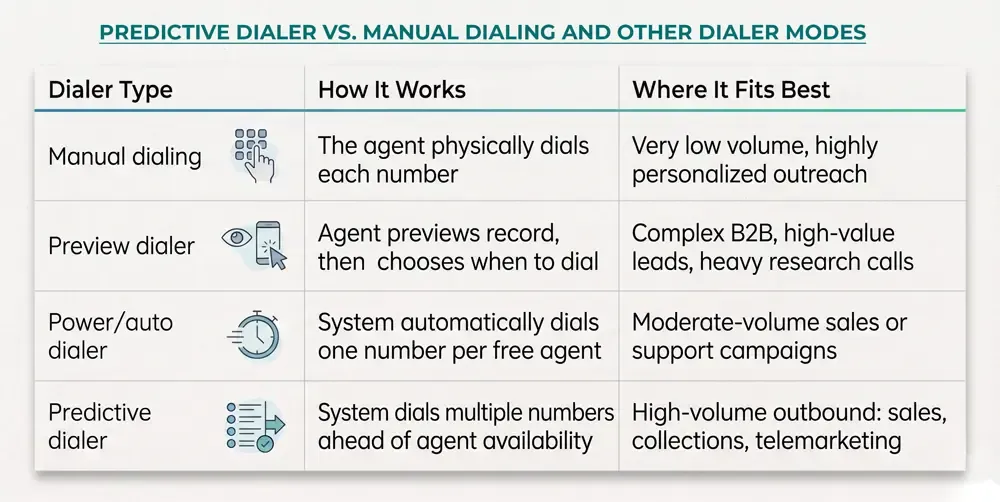
Manual and preview modes give more control but sacrifice volume. Predictive dialing reverses that: maximum volume and agent talk time, with intelligent pacing to keep experience and compliance under control.
How Predictive Dialers Increase Call Center Efficiency

1. Much Greater Agent Talk Time
Agents who rely entirely on manual dialing in their work often spend a great deal of their time, when the phone rings, listening to voicemail greetings or calling numbers that don’t work. Studies show that manual dialing can result in only 10-15 minutes of talk time per hour. By automating dialing and removing calls that are unproductive, predictive dialers help agents talk for about 40-50 minutes per hour. This not only boosts efficiency but also nearly triples the number of real conversations without recruiting more staff.
- More Live Connections from the Same List
As the system is capable of dialing several numbers simultaneously and it is constantly “learning” from the calling patterns, it is able to get more out of the same lead list. These are some of the main advantages:
- Higher contact rates due to parallel dialing.
- Automatic redialing rules for no-answer or busy lines.
- Optimal timing when linked with time-zone-based or schedule-based dialing.
In contrast to agents who might abandon the list after only a few manual attempts, the predictive dialer methodically follows campaign logic and manages the list.
- Reduced Agent Fatigue and Better Focus
When agents are freed from the burdens of dialing, waiting, and listening, they can devote the rest of their workday to the most critical parts of the job: soft skills such as listening, problem-solving, persuading, and closing.
Less manual work means:
- Lower cognitive exhaustion when working on repetitive tasks.
- Those who work late shifts are likely to maintain their level of performance better.
- Coaching becomes easier as managers can concentrate on improving call quality rather than monitoring dial discipline.
4. More effective campaign oversight for supervisors
Nowadays, the best predictive dialer solutions have attractive interfaces and control panels offering live visual information on polling scenes. Supervisors are capable of monitoring.
- Connecting ratios, abandonment rates, and agent occupancy.
- List utilization and campaign advancement.
- The agent performs individually and calls the results.
This type of information not only allows us to modify the speed of activities, to change the agent mainly supporting us, or to reformulate the scripts and the strategy quickly, but also leads us out of the dependence on waiting for the daily report.
Essential Features in Predictive Dialer Software

While every provider or custom solution looks a little different, the most effective predictive dialers share a core set of features.
- Advanced dialing and pacing engine: Calculates the right number of simultaneous calls per agent based on live metrics.
- Answering machine and voicemail detection: Identifies non-human answers and handles them according to campaign rules (drop, voicemail drop, reschedule).
- Flexible outbound modes: Ability to switch between preview, power, and predictive modes for different campaigns.
- Call recording, monitoring, and whispering enable QA teams and supervisors to coach and improve agent performance.
- Callback scheduling and rescheduling: Let agents set precise follow-up times when customers ask to be contacted later.
- Compliance and policy controls: Supports regulatory rules on calling times, opt-outs, abandonment limits, and Do Not Call management.
- Integrations with CRM and ticketing tools: Automatically log calls, update records, and pull context for more meaningful conversations.
When these features are delivered through mobile, web, or custom dialer interfaces, outbound workflows become smooth end-to-end from lead import to reporting.
Mobile, Web, and Custom Dialer Development with Predictive Capabilities
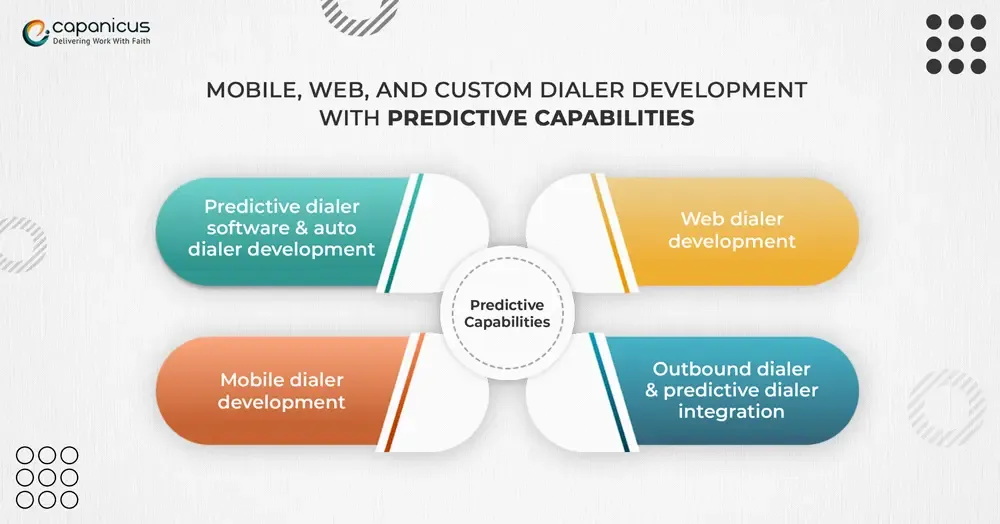
For businesses building or upgrading their own dialer systems, predictive dialing is no longer optional. It is a core expectation in competitive call center environments.
This is where dialer developers, mobile dialer developers, and web dialer development services come in:
- Predictive dialer software and auto dialer development
Custom development teams can design dialing engines tailored to your specific use cases, sales, support, and collections, and integrate them tightly with existing CRMs, billing systems, or analytics tools. - Mobile dialer development:
Mobile SIP dialers allow agents to work from smartphones while still connecting through a centralized predictive dialing engine in the cloud. This is critical for remote teams, distributed call centers, or field sales operations. - Web dialer development
Browser-based dialers give agents a simple interface they can access from anywhere, while the predictive logic runs in the backend. This reduces hardware requirements and speeds up deployment across large teams. - Outbound dialer and predictive dialer integration:
Combining predictive dialing with other outbound modes and VoIP infrastructure ensures that call centers can switch strategies without changing platforms: one stack, multiple dialing options.
When done right, these solutions turn outbound calling from a manual, inconsistent process into a data-driven engine that scales with your business.
When a Predictive Dialer Is the Right Choice
Predictive dialers are especially powerful in scenarios like:
- High-volume B2C sales and telemarketing campaigns.
- Collections and payment reminders.
- Customer win-back and churn prevention programs.
- Large-scale survey or outreach projects.
They are less effective when every call requires heavy research and long preparation, such as niche, complex B2B deals, where agents need several minutes of context before dialing. In those cases, preview or power dialing may be a better fit, and many platforms mix modes across campaigns.
Why Businesses Are Moving to Cloud-Based Predictive Dialer Solutions
Just as companies switched from on-premise PBX to cloud-based VoIP for more flexibility and the ability to scale, outbound teams are upgrading from simple dialers to cloud-hosted predictive dialer platforms.
Main advantages are:
- It is very easy to scale up and down with changing campaign demands.
- Rollout becomes very quick even for remote or hybrid teams who are using mobile and web dialers.
- By means of continuous improvement of algorithms and features, one can avoid heavy internal IT work.
For companies that need more than an off-the-shelf product, custom VoIP and dialer development offers an additional advantage. Capanicus can align dialing logic, reporting, and integrations exactly with how the client’s business operates.
Final Thoughts: Turning Outbound Calls into an Engine for Growth
Most outbound teams don’t fail because their agents can’t sell or support. They fail because agents spend too little time talking and too much time waiting. Predictive dialers fix that by using data and automation to make every hour of agent time count. When combined with robust VoIP infrastructure, mobile and web dialer interfaces, and the right development partner, they transform outbound calling into a scalable, measurable growth channel. Capanicus is a leading provider of mobile dialers or SIP dialers for their VoIP domain clients, making it a one-stop shop for all our clients around the globe.