Whether you are rolling out a cloud phone system, a conferencing platform, or investing in custom softphone development, the underlying switching engine plays a bigger role than it seems. It directly impacts scalability, performance, flexibility, and long-term sustainability.
At Capanicus, we understand making a choice between Asterisk and FreeSWITCH development is one of those critical decisions that’ll shape the direction of your entire communication infrastructure. And yes, it can feel a bit overwhelming at first. That’s exactly why it’s critical to understand what each platform brings to the table.
After 17+ years and 300+ projects delivered on both platforms, here’s our definitive 2026 comparison, including how each integrates with the new generation of AI voice agents.
The Fundamental Difference: Architecture
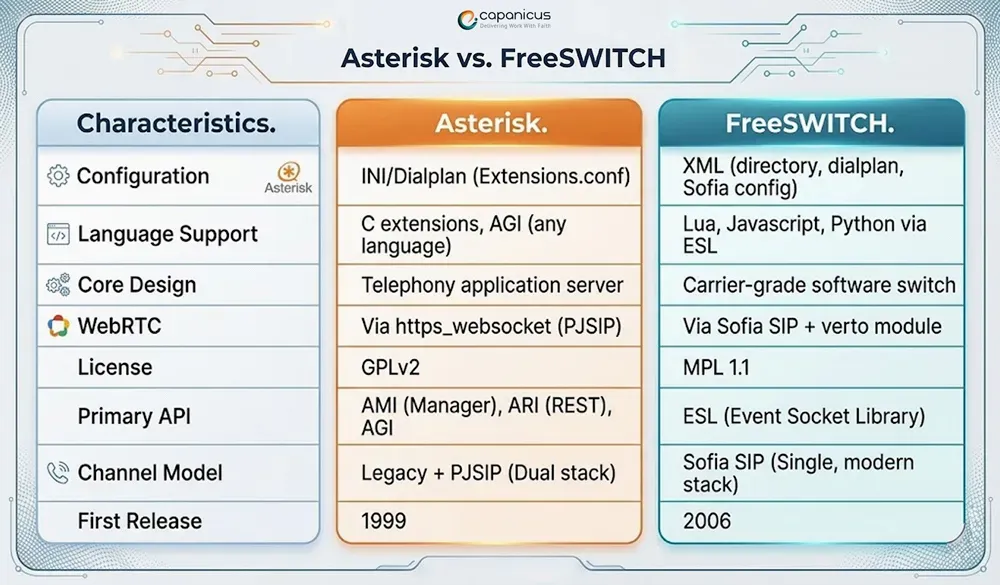
At its core, Asterisk is a telephony application server that turns an ordinary computer into a communication server. It processes calls through a flexible dialplan (extensions.conf or AEL) and executes applications. Whereas FreeSWITCH is an event-enabled software switch with a more modular, XML-based configuration. Asterisk development is more like programming, while FreeSwitch is more like configuring a system.
A Direct Outcome: Call Capacity & Scalability
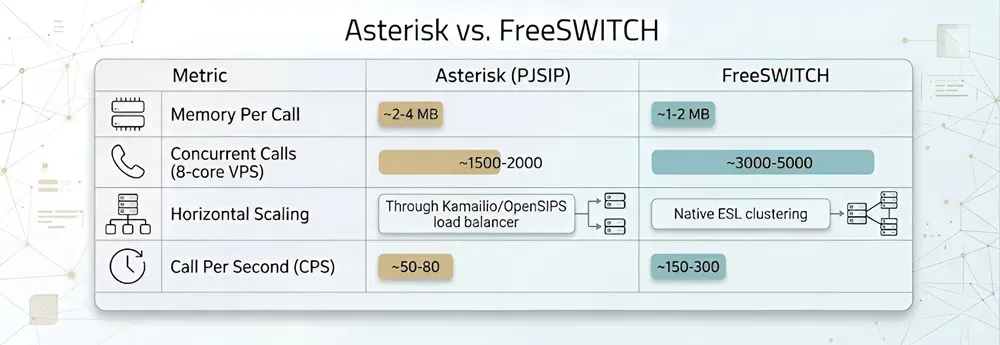
As an experienced FreeSWITCH development company, we’ve seen on equivalent hardware of 8-core and 32 GB RAM, FreeSWITCH consistently outperforms Asterisk in raw concurrent call capacity.
FreeSWITCH’s event-driven and multi-threaded architecture scales more linearly with cores. While Asterisk has significantly improved with PJSIP, FreeSWITCH still holds an edge on the higher side.
Browser-based Calling: WebRTC Support
In 2026, Asterisk and FreeSWITCH both support WebRTC, but FreeSWITCH’s Verto module provides a more polished WebRTC experience with a clean JSON-RPC API. When choosing Asterisk Development Services to ensure WebRTC via PJSIP works well, it’s equally important to make sure DTLS/SRTP configuration works well, too.
For production browser-based softphones, we recommend FreeSWITCH Verto.
AI Readiness: AI Voice Agent Integration
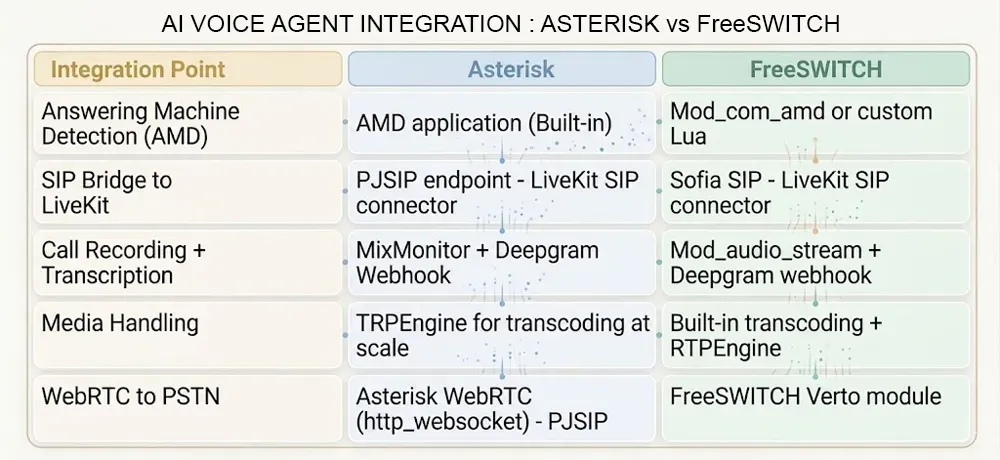
Honestly, this is where the comparison gets interesting. AI voice agents like Pipecat, VAPI, and LiveKit are all well-versed with WebRTC or SIP. Both Asterisk development solutions and FreeSWITCH can bridge AI agents to PSTN via SIP, but the approach is different.
Optimisation and Efficiency: Predictive Diallers and Contact Centres
For outbound contact center applications like progressive dialers, predictive dialers, Asterisk with Vicidial, or GoAutoDial is the ideal choice. The ecosystem around Asterisk-based dialler solutions is mature, well-documented, and supported by numerous experienced and trusted Asterisk solution providers. On the other hand, FreeSWITC-based diallers exist but are less available and have a smaller support ecosystem.
Which to Choose in 2026 – FreeSWITCH Development or Asterisk Development
By now, it must be clear that asterisk FreeSWITCH development brings unique strengths to the table. The real decision comes down to what your business actually needs, and the best way to figure that out is by looking at specific use-case scenarios.
When to Choose Asterisk
You need a conventional PBX system (IVR, ring group, voicemail, queues)
Your call volume is average
You want quick deployment
Your internal IT team can manage the system
Your core objective is enterprise telephony
When To Choose FreeSWITCH
You want better native WebRTC support via Verto
You need carrier-grade scalability
You plan significant future expansion
You need high concurrency handling
You are developing a cloud communication product
Finally
From managing call volumes to supporting advanced features, the platform you choose becomes the foundation of your complete communication strategy.
Though both FreeSWITCH and Asterisk are dynamic and widely trusted platforms, the real differentiation lies in how well each aligns with your specific business requirements. Honestly, it’s not about which platform is better, but which one is better for you. And this is where working with industry experts becomes inevitable. A trusted Asterisk development company can help you build a flexible and cost-effective system tailored to traditional and moderately complex use cases. If your focus is scalability, high-driven architecture, or high-volume communication environments, FreeSWITCH development company will offer you the edge you need to scale.
Still unsure about the right fit? Talk to experts at Capanicus and build a foundation that supports your business with what it actually needs.
Frequently Asked Questions
1. What is the difference between FreeSWITCH and Asterisk?
FreeSWITCH is built for high-performance, scalable communication systems with a modular architecture. While Asterisk is simple, more flexible, and ideal for small to mid-sized VoIP setups.
2. Which platform is better for large-scale VoIP systems?
FreeSWITCH is usually better for large-scale and high-concurrency environments because of its event-driven architecture and potential to handle heavy call loads efficiently.
3. When should you choose Asterisk for your VoIP solution?
Asterisk is a good choice for small to medium-sized businesses. When you need a cost-effective and easy-to-deploy solution for standard telephony features, this fits in well.
4. Do you need a development company for FreeSWITCH or Asterisk setup?
Working with an experienced Asterisk development company or FreeSWITCH development company makes sure the right setup, customization, scalability, and long-term performance of your VoIP system.