Your call center is silently bleeding revenue, and you don’t even know it yet.
Don’t believe it? The data might change your mind.
A single second of call latency can drop customer satisfaction scores by 20%. And surprisingly, while you’re reading this, thousands of calls are being mishandled, misread, and lost because of bad milliseconds.
And, are you sure your call center software isn’t one of them? Most vendors won’t tell you when they’re pitching their contact center solutions that latency isn’t always loud. For operations heads, CX leaders, and executives overseeing call center development, this should be your wake-up call. Literally.
Because the hidden causes of high latency are buried inside your network routing, your third-party integrations, and your outdated contact center development architecture. And sometimes, your call center solutions vendor’s infrastructure isn’t optimized either.
So before you blame your agents or the internet, ask yourself: Do you actually know where your latency is coming from?
If the answer is anything less than a confident yes, keep reading. But to truly get ahead of it, it’s important to revisit the fundamentals.
What Is Call Latency, and Why Does It Matter?
Call latency is the delay between when a speaker says something and when the listener hears it. This delay is measured in milliseconds, but even the slightest lag (<150 ms) can create noticeable disruptions in the natural flow of conversations.
Though some degree of latency is expected in any form of communication, excessive latency becomes a real problem, especially in real-time customer service scenarios where clarity, speed, and responsiveness are crucial. This kind of poor communication experience impacts your brand as a whole.
Unfortunately, you don’t get many second chances in customer service, which is why resolving call latency should be an utmost priority.
Beyond Call Lag – The True Business Cost of High Latency in Call Center Software
Most stakeholders look at call latency and see a technical problem. It is often considered something for the backend team to sort out.
But here’s what is actually happening while that ticket sits in the queue.
-
It’s Quietly Draining Revenue
Every fraction of a second your call center software lags is a window for miscommunication to slip through. It can be a missed cue, a repeated question, or an upsell moment that passes before your agent can even pivot.
In sales-driven environments, where reputation is built in real-time and trust is measured in tone, latency kills the momentum completely.
-
It’s Eroding the Customer Trust You Worked Hard to Build
Today’s customers aren’t patient, and honestly, they don’t have to be. The moment your contact center solution introduces awkward silences, cropped sentences, or confusing interruptions, the experience swaps from efficient to exhausting.
Most customers don’t even complain. They simply leave. One bad interaction quietly becomes a one-star review, a churned account, or a screenshot shared in a community your brand can’t afford. No business, no matter how advanced its call center platform is, can afford to let latency be the reason a loyal customer walks out.
-
It’s Burning Out the Resources You Depend On
The human cost of latency is the one that shows up last on dashboards but hits hardest on the floor. When your call center development infrastructure forces agents to regularly repeat themselves, apologize for delays, and manually compensate for what the system should be managing, exhaustion steps in faster.
Your agents aren’t underperforming; it’s your contact center software infrastructure causing the hiccup.
-
It’s Amplified Across Global Operations
For enterprises transcending geographies, latency doesn’t just add a delay. Particularly, in cross-border contact center development, where agents and customers are managing different accents, time zones, and second-language nuances, it multiplies every existing challenge.
A communication that should be completed in ten seconds now takes twenty. And in those ten extra seconds, patience, context gets lost, and it turns into an escalated complaint. Your call center solution might be globally deployed, but if latency is left unchecked, the experience it delivers is anything but global-ready.
The Hidden Causes of High Latency in Your Call Center – And Why They’re So Hard to Spot
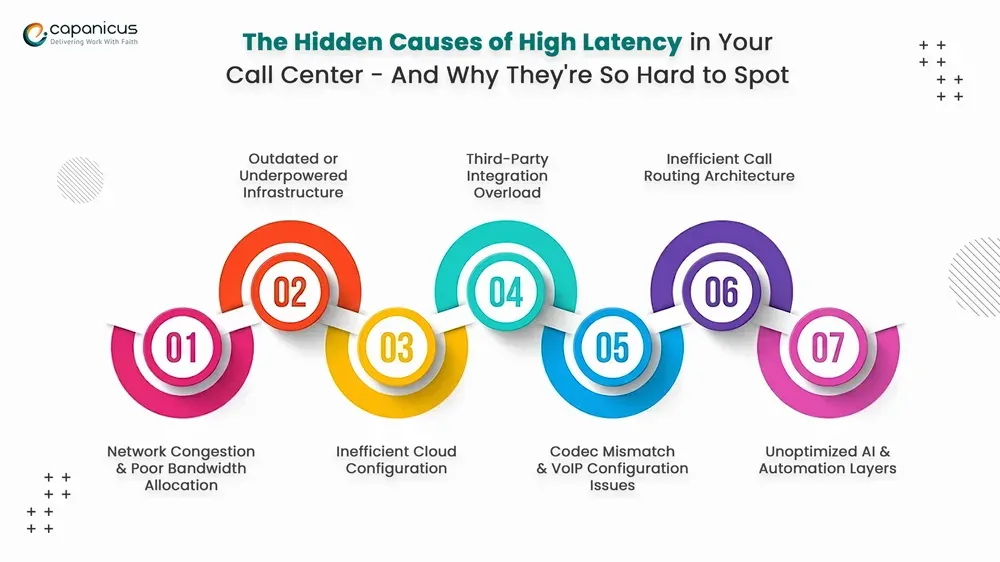
If latency were so obvious, you’d have fixed it already. But the reason it persists across industries, infrastructure, and teams is that its root causes don’t announce themselves. They hide inside the layers of your systems, quietly compounding, until the damage is too visible to ignore.
Here’s where they’re actually hiding.
1. Network Congestion & Poor Bandwidth Allocation
It’s always about how intelligently your call center software is using the bandwidth. When voice traffic competes with unmanaged data traffic, packets get delayed or dropped. Without proper Quality of Service (QoS) configuration, even a high-speed network can challenge your entire contact center solution during peak hours.
2. Outdated or Underpowered Infrastructure
Traditional legacy hardware wasn’t built to accommodate the demands of modern contact center software. And, when these servers are pushed to run on current workloads, they slow down quietly. And that slowdown translates directly into the legacy your agents feel on every call, and your customers feel in every pause.
3. Inefficient Cloud Configuration
Wrong server regions, shared cloud instances, or underprovisioned resources are the reasons that cause latency. Poor cloud configuration is one of the most underdiagnosed causes in contact center development.
4. Third-Party Integration Overload
Your call center platform is connected to CRMs, ticketing tools, AI agents, and an analytics dashboard, all communicating in real time. Stacking integrations together without proper API optimization results in increased waiting time. This wait time is silent; your customer doesn’t like.
5. Codec Mismatch & VoIP Configuration Issues
The codec your contact center software uses doesn’t align with your network capacity or if your endpoints use different codecs, the system spends precious milliseconds negotiating and reprocessing audio.
The subtle delay is enough to trigger an alert, but consistent enough to make every conversation feel slightly off.
6. Inefficient Call Routing Architecture
Poorly designed routing logic means calls take longer paths than required. In global operations where calls hop across regions and data centers, even a single inefficient routing rule in your call center development architecture adds noticeable latency at scale.
7. Unoptimized AI & Automation Layers
AI-enabled features like real-time transcription, sentiment analysis, and virtual assistants are now standard across call center platforms. But when these are layered onto a system without performance tuning, they consume processing power that was never accounted for. So, the more your contact center solution leans into automation without optimizing the underlying architecture, the more latency gets quietly baked into every call.
How to Reduce or Eliminate High Latency in Your Contact Center
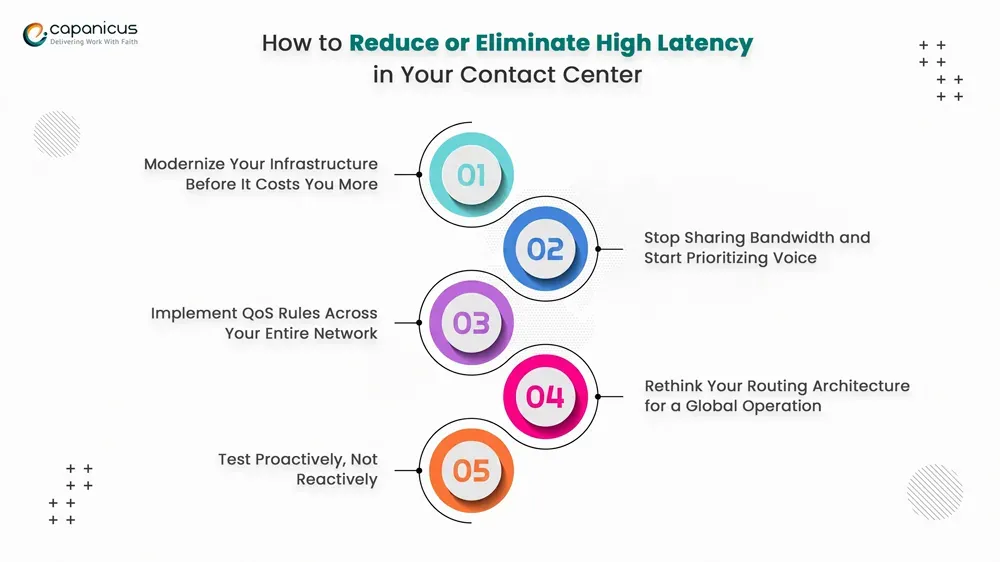
Understanding the causes is half the battle. The other half is developing a call center development strategy that systematically closes every gap. Here’s where to start.
1. Modernize Your Infrastructure Before It Costs You More
Outdated technology doesn’t just underperform; it silently multiplies your latency problem with every passing quarter. Upgrading to high-speed routers, enterprise-grade VoIP platforms, and performance-optimized workstations is an operational investment your contact center solution depends on to function at the level your customers expect.
If your hardware hasn’t been audited in the last 18 months, that’s where this conversation begins.
2. Stop Sharing Bandwidth and Start Prioritizing Voice
More bandwidth alone won’t solve latency if voice traffic is still competing with everything else on your network. The smarter move is segmentation, like isolating your VoIP traffic, so your call center software isn’t struggling with file downloads, video streams, or background system updates for the same pipeline.
Dedicated bandwidth for any serious contact center development is a baseline requirement.
3. Implement QoS Rules Across Your Entire Network
Quality of Service configuration tells your network what matters most, and voice packets should always be at the top of that list. And, when properly established across your call center platform, QoS ensures that even during peak traffic hours, your voice data moves without interruption, without delay, and without competing against lower-priority processes.
This one change alone has resolved latency issues for teams who spent months looking in the wrong direction.
4. Rethink Your Routing Architecture for a Global Operation
If your contact center solutions are addressing customers across regions, every extra hop your voice packet takes adds latency. Partnering with a trusted provider that operates multiple global data centers and uses intelligent routing algorithms to keep calls local is no longer a choice for enterprise operations.
The primary objective is “the shorter and smarter the path, the faster and cleaner the call”.
5. Test Proactively, Not Reactively
Mostly, teams only investigate latency after customers complain. By then, the damage is already done. So, building a proactive monitoring framework into your call center software stack is important. It tracks latency, jitter, and packet loss in real time, meaning you catch degradation before it becomes a pattern.
Metrics like MOS (Mean Opinion Score) and a VoIP-specific analytics dashboard give your team the visibility to act early, adjust fast, and protect the experience your customers expect every single time they call.
The Bottom Line
If you’re serious about removing call latency and delivering exceptional customer service, you need the right tools and the right partner. That’s where Capanicus comes in.
Whether you’re battling latency in your current system, evaluating a new contact center software stack, or starting a contact center development project from scratch, we’ve solved these problems before.
Our software solutions are built at scale, across industries, and for operations that couldn’t afford to get it wrong. And we’d love to do the same for yours.