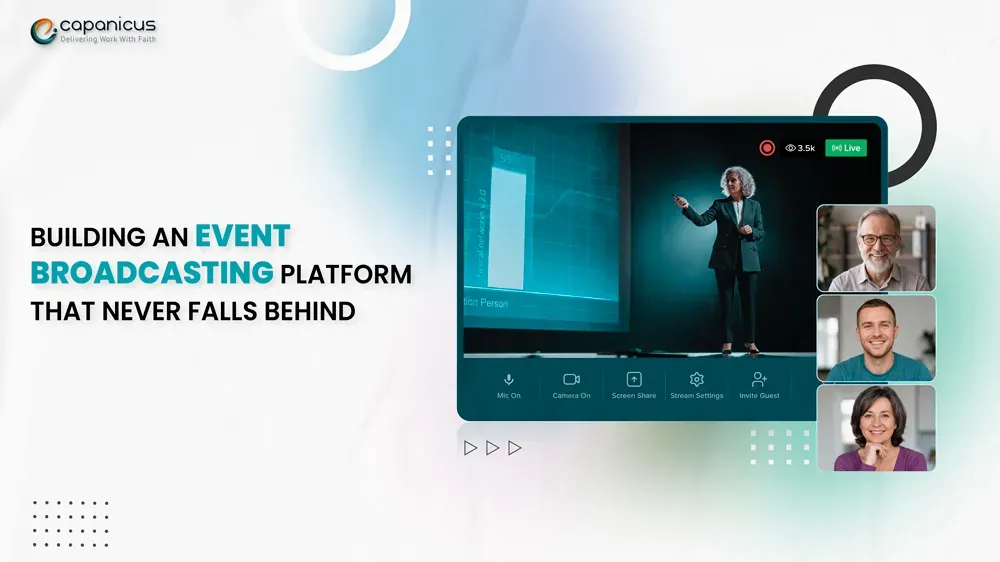
If you are planning to broadcast an event, there’s a lot to decide on. You’ll need to figure out which event broadcasting platform to use, how to structure your content, and how to make sure you have the right audio-visual (AV) equipment. You might want to find ways to get your audience involved with interactive content.
This is exactly why Capanicus focuses on helping businesses create a virtual event platform that can reliably, securely, and seamlessly deliver a flawless experience.
Whether you need a global product launch, a virtual investor meeting platform, or a hybrid corporate conference, brands today expect an event broadcasting platform that can manage endless participation without user drop-offs or broken streams. In this blog, we’re breaking down our top live event broadcasting tips to ensure you have a successful broadcast. But before we explore the nitty-gritty of development, let’s understand the subtle difference that outweighs traditional streaming solutions.
Why Traditional Streaming Solutions No Longer Work for Modern Events
Most organizations still depend on outdated streaming setups that were originally designed for small webinars or internal meetings. But those systems often fail when a large number of users attempt to join simultaneously across multiple devices and network environments. And, the biggest challenge with conventional streaming solutions is that they were never built to manage modern audience behavior. These include live chat engagement, real-time polls, AI-enabled personalization, and much more.
In today’s time, a scaling enterprise hosting a large-scale online conference cannot afford delays caused by overloaded servers or unstable bandwidth. These few seconds of interruptions can negatively impact user trust and audience retention. Research shows that in 2026, nearly 68% of viewers leave a live stream within two minutes if buffering issues occur repeatedly during the broadcast.
This is why businesses are inching towards cloud-native webinar broadcasting solutions that prioritize scalability and intelligent traffic distribution.
4 Core Elements Every Event Broadcasting Platform Needs in 2026
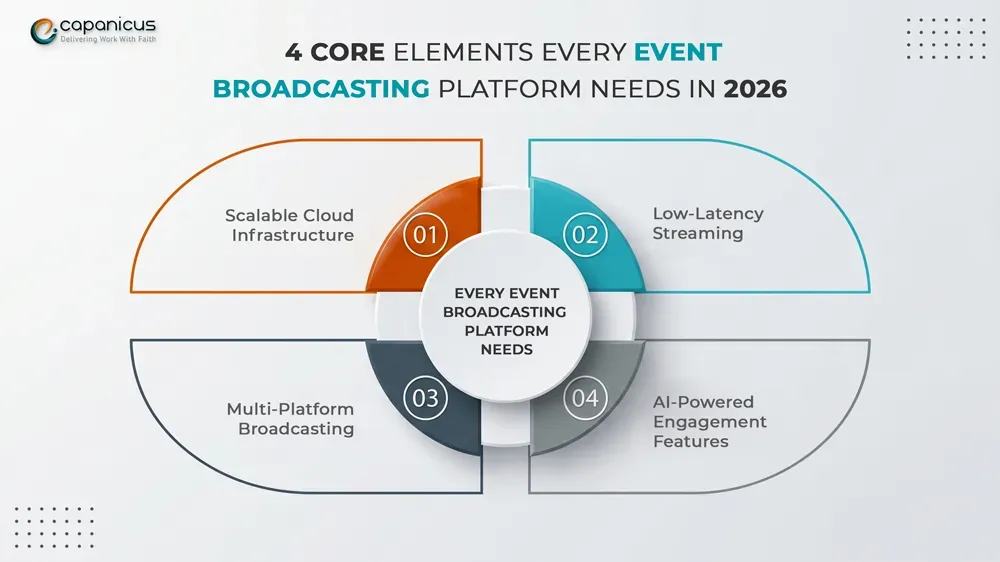
A future-proof event broadcasting system is not merely about video streaming because the expectations surrounding virtual experiences have outgrown. Businesses today need platforms that function as a complete engagement ecosystem that are able to manage everything from registrations to content distribution within one unified environment.
- Scalable Cloud Infrastructure
One of the most important features of a performance-driven virtual event platform is cloud scalability because audience sizes can fluctuate dramatically during live events. For example, a product launch initially attracts 4,000 attendees but suddenly crosses to 50,000 viewers after social media exposure begins generating traffic.
A modern event broadcasting architecture can scale resources in real time without affecting stream quality. Cloud-native infrastructure enables platforms to distribute traffic intelligently across multiple servers and regions. Besides, it also ensures stable experiences regardless of audience volume.
- Low-Latency Streaming
Today, viewers expect real-time interaction during live events. This is because delays can entirely damage engagement, especially during Q&A sessions, live auctions, sports broadcasts, gaming events, or interactive webinars.
Here, advanced event streaming platform technologies use adaptive bitrate streaming and edge delivery systems to reduce latency to just a few seconds. It helps businesses maintain smoother audience engagements without frustrating delays.
- Multi-Platform Broadcasting
Modern events no longer exist within a single digital destination. The primary reason behind this is that brands now stream simultaneously across websites, mobile apps, social media channels, and smart TV ecosystems.
An efficient event broadcasting platform supports omnichannel distribution, enabling businesses to manifold audience reach without managing multiple disconnected streaming workflows manually.
- AI-Powered Engagement Features
AI is revolutionizing how audiences interact with virtual events. After all, businesses want smarter engagement tools that improve participation and retention.
In 2026, top webinar broadcasting solutions will integrate AI-enabled features like:
- Real-time language translation
- AI-generated event summaries
- Smart attendee matchmaking
- Automated moderation
- Sentiment analysis for audience engagement
These handpicked features help organizations create more personalized experiences while minimizing the manual workload.
Why Reliability Has Become the Biggest Competitive Advantage
The success of any virtual event depends significantly on reliability because users immediately relate technical failures to brand inefficiency. Even the most visually impressive conference can fail if attendees experience login crashes or frozen crashes during key moments.
For instance, numerous high-profile global events faced backlash after server crashes interrupted keynote sessions. These incidents are examples of how even established businesses can lose audience trust when their event broadcasting software infrastructure falls short of managing real-time demand. Once again, modern enterprises prioritize redundancy and failover systems while selecting a broadcasting solution. In essence, uninterrupted delivery is synonymous with brand credibility.
A trusted event broadcasting system typically consists of:
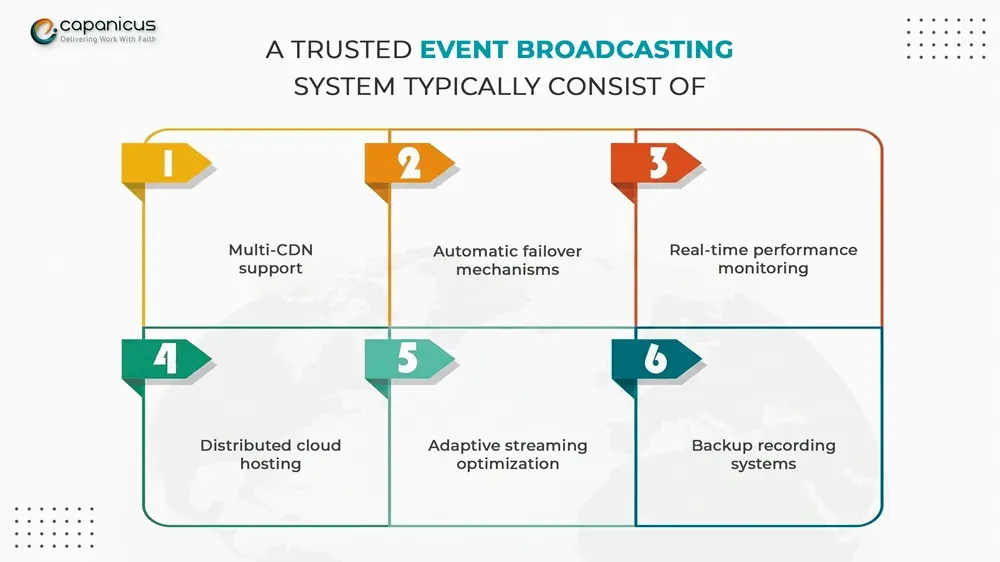
- Multi-CDN support
- Automatic failover mechanisms
- Real-time performance monitoring
- Distributed cloud hosting
- Adaptive streaming optimization
- Backup recording systems
The Dawn of Hybrid Events and What It Means for Businesses
2026 is all about finding the perfect equilibrium of technology and intelligence. This holds true for broadcasting and hybrid events underline it. Businesses have realized that blending physical experiences with digital participation significantly grows reach while minimizing logistical constraints.
A business hosting an event in Dubai can now attract on-site as well as remote participants across the globe. All this is possible through a dynamic virtual event platform that synchronizes live experiences across numerous touchpoints.
This transition has created huge demand for event broadcasting platform ecosystems with the potential to support:
- In-person and virtual attendee synchronization
- Live audience interaction
- Multi-camera broadcasting
- Virtual networking lounges
- Real-time analytics dashboards
Security and Compliance Are Inevitable in 2026
With organizations increasingly hosting confidential corporate meetings, healthcare webinars, educational events online or financial conferences, security is one of the significant priorities for broadcasting systems.
Businesses these days cannot risk data breaches, unauthorised access, or content piracy during high-value events because cyber threats targeting virtual platforms have become significantly more sophisticated in 2026. A secure event broadcasting software solution should include:
- End-to-end encryption
- Secure attendee authentication
- Role-based access control
- DRM-protected streaming
- GDPR and compliance support
Data Analytics Is Crucial to Shape the Future of the Event Broadcasting Platform
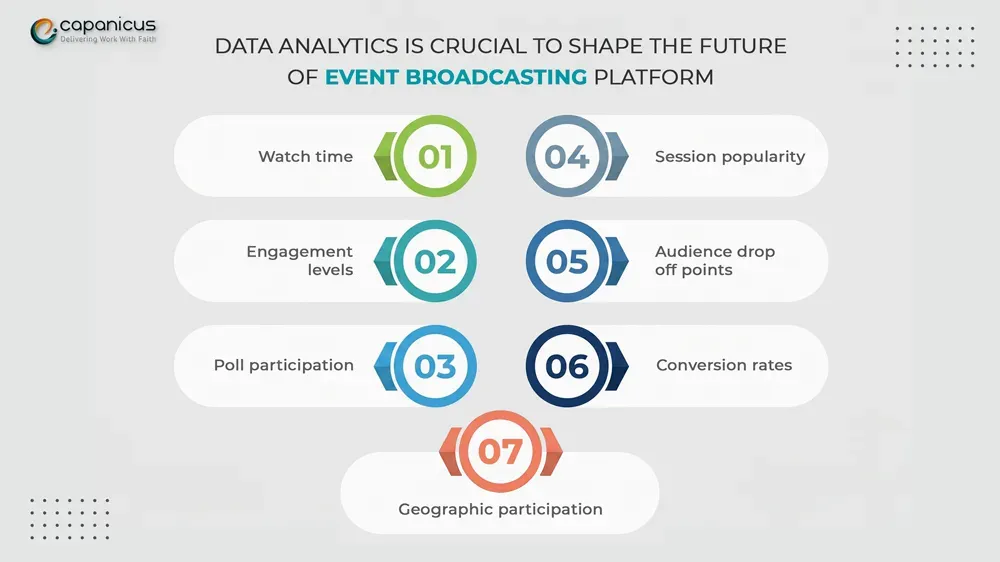
One of the most significant advantages of the digital event ecosystem is the capability to gather real-time audience insights that help businesses enhance future engagement strategies, unlike conventional physical conferences, where users’ behavior is difficult to measure. Herein, webinar broadcasting solutions offer analytical visibility into user participation patterns.
With this, businesses can now easily manage:
- Watch time
- Engagement levels
- Poll participation
- Session popularity
- Audience drop-off points
- Conversion rates
- Geographic participation
Finally
Developing an advanced event broadcasting platform that never falls behind needs a lot more than basic streaming functionality. Above all, today’s audiences expect scalability, reliability, personalization, and real-time engagement within every virtual interaction. To address this unmet gap, businesses need intelligent event broadcasting software that can handle massive traffic loads and transcend geographical challenges.
If you are planning to build a scalable, secure, and engagement-driven Virtual Event Platform for your business, connect with the experts at Capanicus right away. Ultimately, what matters the most is that the audience stays connected with your business.