Business communication has changed fast, and most companies have felt that shift in real time. Email alone is no longer enough when customers expect instant replies, smoother handoffs, and more personal support across voice, chat, video, and messaging channels. That’s exactly why Business Communication Software has become such an important part of how modern teams work.
For businesses today, communication software is not just a phone system with a few extra features. It’s the layer that keeps sales, support, operations, and customer experience connected in one place. Whether a company needs a Business Communication Platform for internal collaboration or an Enterprise Communication Software setup for customer-facing teams, the goal is the same: make communication easier, faster, and more reliable.
What is Business Communication Software?
Business Communication Software refers to a digitized platform that assists in the communication of businesses with their customers, employees, partners, and vendors through various communication channels. Instead of using separate tools for calling, messaging, meetings, and support, businesses can combine all communication
Most of the time, a solid platform provides voice calling, video conferencing, team chat, SMS, and integration with email, live chat, and CRM. Nowadays, many advanced systems are also equipped with AI assistants, analytics, and workflow automation. The bottom line is that it allows individuals to engage in the appropriate conversation at the proper time without having to switch among too many tools.
It is especially beneficial for those teams that are working remotely or are spread across different locations. A solitary Unified Communication Software system can enable workers to connect from any device and, at the same time, offer customers a more consistent experience.
Why Businesses Need Modern Communication Platforms
Separate tools cause small problems that get bigger and bigger. A customer repeats the same issue to different agents. A sales lead is left hanging for a long time without a follow-up. An employee loses time switching between applications just to complete one task.
Today, customers have become the main driving force behind the business. With the help of cloud-based access, file sharing, call controls, messaging, and video support in one place, collaboration becomes simpler. For many companies, the real value of Digital Communication Solutions is not just convenience; it’s speed, clarity, and better customer outcomes.
Types of Business Communication Software

It’s not possible to come up with a one-size-fits-all communication configuration that will be suitable for each company. While some businesses require high-volume calling, others focus on omnichannel support or AI-driven automation. You’re correct, Business Communication Solutions are determined not just by the nature of your work, but also by how your customers contact you.
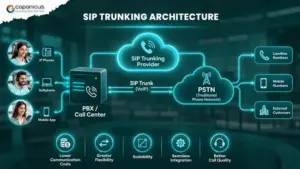
VoIP Software
VoIP software enables people to make calls using the Internet rather than telephone lines. It has gained tremendous popularity in the world of communication due to its unparalleled flexibility, low cost, and ease of scaling.
VoIP is used by companies for making high-definition voice calls, call forwarding, Interactive Voice Response (IVR), automatic attendant, call recording, and Customer Relationship Management (CRM) integration. For teams working in different locations, it definitely is the easiest means of maintaining professional communication without reliance on bulky on-premises infrastructure.
WebRTC Solutions
WebRTC provides voice, video, and text communication features straight from the browser. This implies that people do not have to download a separate application only to initiate a conversation. This makes it a lot easier and quicker for customers when they interact with businesses.
In addition to that, it is an exceptional tool for browser-based support, online consulting, video interviewing, and even live product demonstration. Hence, if a company aims at a less cumbersome customer experience, WebRTC could be a wise choice in the set of tools.
Call Center Software
Call Center Software is mainly meant to handle a high number of incoming and outgoing calls. It not only makes it easier for agents to pick up the phone but also ensures proper routing of calls and seamless performance monitoring without agents being buried in manual tasks.
Some of the usual features are IVR, automatic call distribution, call recording, queue management, whisper coaching, and dashboards. Hence, it is really the right solution if you want to equip your support, sales, and debt collection teams with the necessary tools for effective call management.
Contact Center Software
Contact Center Software is not just limited to voice. It integrates email, chat, SMS, WhatsApp, and social media channels into a single workflow, allowing agents to handle all types of conversations from one place.
This is where the customer service level rises. Instead of addressing each communication channel as a separate entity, the entire team has a connected customer history as a single reference point. It is a sure way to make replies more prompt, personalized, and well-tracked.
Omnichannel Communication Platform
Integrating various customer interaction points through an omnichannel approach gives a person a smooth journey. Say, a customer begins on social media, proceeds to chat, and then ends up talking on the phone – all without having to repeat their story at each stage.
That seamlessness is why an Omnichannel Communication Platform is so powerful. It helps companies to upgrade customer delight, shorten the time for feedback, and enable staff with exposure to all the details without having to ask first.
Predictive Dialer
A predictive dialer strategizes outbound sales calls. It concurrently dials several numbers, and only answered lines are connected to the available agent, thus saving time and boosting performance.
Lead generation, surveys, debt collection, and appointment reminders are some of the instances when it is taken advantage of. For those who work mostly through making contact with outsiders, it can noticeably help agents’ output.
AI Voice Agents
AI Business Communication Software enables companies to automate the handling of basic conversations. AI voice agents can pick up the phone, answer FAQs, book slots, generate leads, and refer the more difficult problems to humans.
Availability is the main advantage. Such tools are able to operate 24/7, allowing customers to get assistance even when businesses are closed. It results in quicker responses and a lesser workload in support for companies.
AI Virtual Agents
AI virtual agents are available on websites, WhatsApp, SMS, as well as email, and perform customer service. They can get the semantic meaning, recall previous conversations, and generate responses that are quite natural and unlike chatbot-type responses.
They are frequently deployed for handling repetitive queries, and human agents are freed for performing other tasks. During the period when the human agents have had enough of answering human questions, the automated agents and chatbots provide a good support balance. That balance and quick turnaround times are the biggest advantages for cloud platforms.
UCaaS
UCaaS, short for Unified Communications as a Service, integrates voice communication, video, messaging, file sharing, and screen sharing into one cloud-based platform. It’s a great communication tool for hybrid or remote teams needing to communicate effectively from anywhere.
When it comes to the delivery of services, UCaaS is delivered from the cloud, so companies can expand without getting additional equipment. This adaptability is the reason why it’s considered one of the top Business Communication Tools for teams that are developing.
CCaaS
CCaaS, or Contact Center as a Service, enables businesses to use contact center functionalities through the cloud instead of managing a physical infrastructure by themselves. They simply pay a subscription fee to a service that supplies various features like routing, automation, analytics, quality monitoring, and CRM integration.
For organizations looking for rapid setup and minimal infrastructure expenses, CCaaS represents a viable solution. It enables teams to enjoy the capabilities of a state-of-the-art contact center without the complexity of a conventional one.
Cloud PBX
Cloud PBX replaces old-fashioned office telephone systems with internet telephone communication. It not only eliminates the use of physical equipment at the site but also makes it much easier for businesses to grow as they get bigger.
Most companies see this as a simple method of updating their communications. A Communication Service Provider based on cloud architecture through PBX technology can provide features like remote working, automatic updates, less maintenance, and greater flexibility.
How to Choose the Right Communication Platform
The most suitable platform for you will depend on your company’s size, your schedule of customers, and how your teams work practically. A small business just starting could be fine with a simple VoIP system, whereas a bigger business might require the whole Enterprise Communication Software system with omnichannel support, automation, and analytics.
Identify your primary core needs first. Do you require internal collaboration improvements only, or customer service enhancements only, or both? Would you prefer a platform that can develop alongside your team? Does your platform require deep integrations with your CRM and a help desk? A solid Business Communication Platform should handle these issues in a way that doesn’t add to the complexities in your organization.
In addition, consider the issues that affect overall acceptance and adoption. The most effective communication system is undoubtedly the one that your team members end up using. When the user interface is too complex, work efficiency decreases instead of increasing. For this reason, the top Business Communication Solutions usually feature a good mix of features and user-friendliness.
Technology Stack
Every powerful communication system backbone is a stack of trustworthy technologies. VoIP is responsible for the delivery of voice, WebRTC handles browser-based communication, and APIs act as a medium to connect the platform with CRM, support, analytics, and automation tools.
An important element of the story is cloud infrastructure as well. It helps companies to grow their scale more quickly, enable remote team support, and release new features without a major hardware investment. Moreover, AI is gradually being incorporated into various aspects, such as routing, call transcription, agent assistance, and virtual support. When these components intertwine well, the output is a versatile and forward-looking
Modern Communication Platform
Businesses should aim for: not just a tool, but rather a whole system that can facilitate growth.
Future Trends
The future of communication software is incredibly bright, as it is going to be packed with a lot of great innovations, i.e., automation that recognizes each customer’s unique situation and experiences that are more deeply connected to each other. AI will continue to be deeply involved in voice interaction, ticketing, call management, and customer self-service.
Cloud-first platforms will remain the most preferred ones since they are simpler to manage and scale.
More importantly, customers not only care about speed but also want the quality of a natural and personal conversation. The best Digital Communication Solutions of the future will probably be the ones that can combine high-level automation with a true understanding of the customer context.
FAQs
What is the difference between VoIP and PBX?
VoIP is an internet-based phone service, while PBX is a type of phone system that handles both internal and external communications.
Is unified communication software only for large businesses?
Definitely not. Small and medium-sized companies also benefit from Unified Communication Software as it helps them reduce tool overload and increase collaboration.
Why are AI features becoming popular in communication software?
By employing AI, the system can effortlessly perform routine tasks, shorten response time, and improve routing. As a result, the support team can work more effectively, and the customer experiences shorter waiting times for their service.
What should businesses prioritize when choosing a platform?
Features such as scalability, security, integrations, ease of use, and support play a very important role. An ideal platform should cater to your immediate requirements while also allowing future growth.
Conclusion
Business Communication Software is an essential part of a modern company’s operations now. It links different departments, helps customers, makes the work easier, and allows various communication channels without any hurdles.
As communication becomes more digital and AI-driven, companies need to have platforms that are capable of evolving with them. No matter what the aim is: a Business Communication System, a Cloud Communication Platform, or a complete AI Business Communication Software, the best decision is the one that maintains simplicity, scalability, and reliability in communication.
Capanicus, with its solid experience in VoIP, telephony, WebRTC, call center software, and custom communication development, is well-positioned for this space. This makes the brand a natural choice for businesses that seek tailored Business Communication Solutions that are above and beyond the generic tools.