Someone gets into your SIP-based PBX. They place calls you never approved. Then you pay for them. That’s SIP toll fraud in one sentence, and it’s usually built around premium-rate numbers somewhere the attacker has a revenue-share deal, so every minute your system burns, they’re getting paid on the other end.
CFCA’s 2019 survey put global telecom fraud losses at $28.3 billion. Two years later that number was $39.89 billion. PBX and VoIP attacks specifically have shown up in this report for more than ten years running.
What follows is built on work we’ve done at Capanicus alongside VoIP developers handling real PBX deployments. It covers how these attacks actually run, what they leave behind, and what actually stops them.
What SIP Toll Fraud Looks Like From the Inside
The Billing View
Nothing looks wrong while it’s happening. Calls connect. Audio’s fine. Nobody at your company notices a thing, because there’s nothing to notice from the inside. Instead, the only trace lives in your call detail records, and you usually meet it for the first time on an invoice. Hundreds of calls to a handful of country prefixes. Many of them lasting just long enough to bill. Most of it crammed into a single weekend when nobody’s checking logs.
Four Common Patterns
Recognizing these billing patterns is an important first step in identifying SIP toll fraud before unauthorized calling activity leads to significant financial losses.
- International Revenue Share Fraud (IRSF): This is the one behind most five and six-figure invoices. Specifically, the attacker controls, or has arranged access to, a premium number range, and gets paid every time you call it. A couple dollars a minute doesn’t sound like much until a few hundred concurrent calls run for a few hours straight.
- PBX hijacking: On the other hand, this one is far more straightforward. A person obtains a working credential or discovers a hole in the dialplan, which allows an unauthorized caller to make calls on your trunk.
- Traffic pumping: Similarly, this is the practice of targeting certain number ranges with high termination costs. The incoming call can find its way through something that wasn’t secured, such as voicemail-to-phone or an open IVR menu.
- Wangiri and callback tactics: These go in reverse. Here, the phone rings for only a moment, luring unsuspecting folks into calling back. Most companies, however, expect it to be incoming, rather than outgoing, which is why they tend to overlook it until after they see the bill.
How an Attack Unfolds on a Real PBX
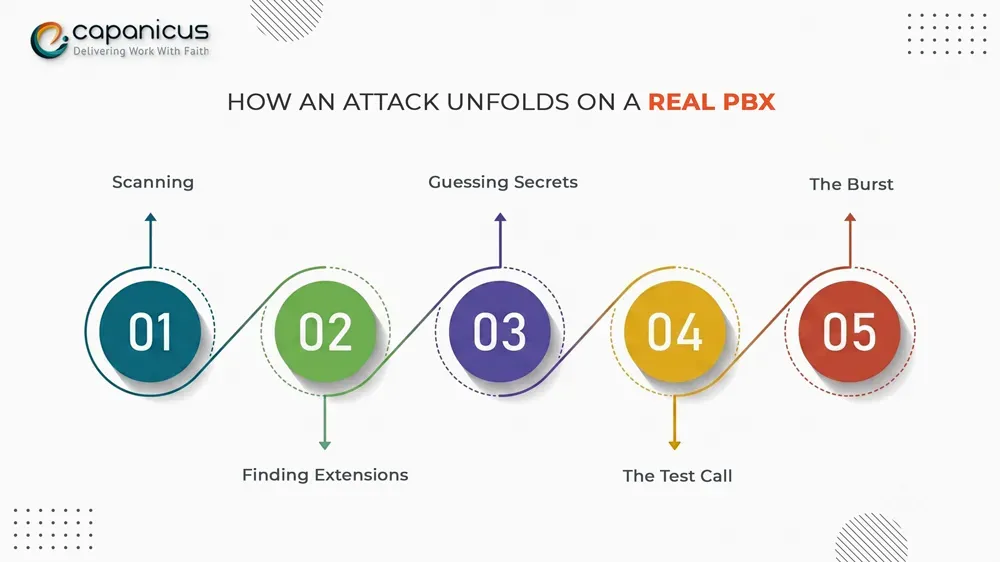
Pull enough SIP honeypot logs and incident reports and the same sequence shows up over and over. It barely varies.
Scanning
Bots sweep the internet constantly, looking for anything answering on port 5060 or TLS port 5061. They send OPTIONS or INVITE probes, read what comes back in the User-Agent header, and now they know your PBX brand and roughly which version you’re running. svmap, part of the SIPVicious toolkit, does exactly this. As a result, a freshly exposed server usually gets hit within minutes. This isn’t personal. You just showed up in a scan.
Finding Extensions
Here’s a small detail that matters a lot. Some servers respond differently, a 401 versus a 404, depending on whether an extension actually exists. That one difference is enough. Then a script fires off a REGISTER for every plausible extension number, watches the response codes, and builds a map of your entire numbering plan without ever touching a password. svwar handles this automatically.
Guessing Secrets
Once the attacker has real extension numbers, they start guessing. Common passwords first, then extension-as-password combos, then whatever leaked credentials happen to be floating around from some unrelated breach. For instance, if extension 2041’s secret is 2041, that’s gone in the first try. It should be.
The Test Call
This part gets missed constantly, and it shouldn’t. Before running up real charges, attackers test. One short call, maybe two, just to confirm outbound routing actually works through the compromised account. It’s cheap, it’s quiet, and almost nobody’s watching for it even though it’s the single clearest early warning you’ll get.
The Burst
Then it’s volume. Dozens of concurrent calls hammering premium prefixes, usually overnight, usually on a weekend. Sophisticated operators spread this traffic across several compromised PBXs at once specifically so no individual victim’s usage spikes enough to trip an alarm.
Building Toll Fraud VOIP Prevention in Four Layers
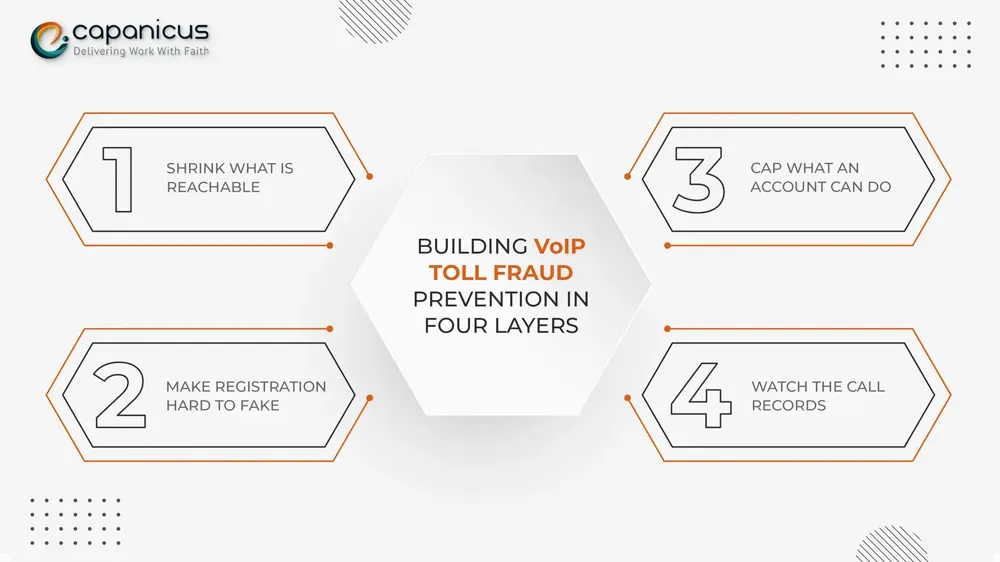
An effective VoIP toll fraud prevention strategy requires multiple layers of protection. Network security, strong authentication, outbound calling restrictions, and continuous monitoring work together to reduce the risk of unauthorized calls.
Layer 1: Shrink What Is Reachable
The fraud attempt that never reaches your PBX is the cheapest one you’ll ever deal with.
Put an Enforcement Point in Front
Terminate external SIP on a session border controller, or a hardened proxy if a commercial SBC isn’t in the cards, and keep your actual call servers on private addressing behind it. That edge device validates SIP syntax, rate-limits incoming sources, hides your internal structure, and gives you exactly one place to enforce policy instead of ten. For example, Kamailio or OpenSIPS in front of Asterisk or FreeSWITCH works fine for this if budget’s tight.
Allowlist Trunk Sources
Your carrier trunk has a known peer. So there’s no reason to accept SIP toll fraud signaling from anywhere outside the ranges that carrier publishes. A minimal nftables setup for this:
table inet voice {
  set carrier_sip {
    type ipv4_addr; flags interval;
    elements = { 203.0.113.0/24 }
  }
  chain input {
    type filter hook input priority 0; policy drop;
    ct state established,related accept
    iif lo accept
    ip saddr @carrier_sip udp dport 5060 accept
    ip saddr @carrier_sip tcp dport 5061 accept
  }
}
However, that range’s just a placeholder. Use your real carrier ranges, add your management sources, and only then turn on the default-drop policy, or you’ll lock yourself out.
A Port Change Isn’t Security
Moving SIP off port 5060 will quiet down your logs. That’s because scanners that only check the default port stop finding you. But anyone running an actual targeted scan across the full port range finds you just as fast as before. Don’t mistake less noise for less risk.
Encrypt
TLS with valid certs, old TLS versions turned off, SRTP for media. This keeps credentials and metadata from being readable in transit. However, what it doesn’t do is stop a stolen password from working. Therefore, encryption is one layer among several, not a solution by itself.
Ban What Misbehaves
A firewall has no idea what an authentication failure looks like. Instead, you need something SIP-aware watching that layer. On Asterisk, for instance, a Fail2ban jail reading the PBX log does it:
[asterisk]
enabled  = true
filter   = asterisk
logpath  = /var/log/asterisk/messages
maxretry = 5
findtime = 600
bantime  = 86400
Similarly, at a Kamailio edge, the pike module flags request floods per source address:
# sampling window, in seconds
modparam("pike", "sampling_time_unit", 2)
# requests allowed per window before a source is flagged
modparam("pike", "reqs_density_per_unit", 16)
# how long a source stays tracked after its last request
modparam("pike", "remove_latency", 4)

request_route {
    if (!pike_check_req()) {
        xlog("L_ALERT", "SIP flood from $si dropped\n");
        exit;
    }
}
Make sure ban lists survive a restart. After all, there’s no point banning an attacker only to hand them a clean slate the next time the service reloads.
Layer 2: Make Registration Hard to Fake
Eventually one perimeter rule fails in toll fraud VOIP. Assume that going in. When it does, authentication is what stands between a failed firewall rule and an actual breach.
Use Real Secrets
Sixteen random characters, minimum, per endpoint. Never the extension number or the company name. Also, never reuse it as a voicemail PIN somewhere else in the system. Secrets live in a provisioning system or a secrets manager, full stop, not a shared spreadsheet someone screenshots and emails around the office.
Remove the Enumeration Signal
A request for a user that doesn’t exist and a request with a wrong password for a user that does exist should look identical coming back, same response code, similar timing. Legacy Asterisk handles this through alwaysauthreject. Worth testing yourself, honestly, send both requests and compare what you get.
Tie Endpoints to Networks
A desk phone physically sitting in your HQ office has zero legitimate reason to register from another country. So lock that down with an ACL. For people actually roaming, use a VPN or client-authenticated TLS, not a looser rule just because it’s more convenient for IT.
Audit Call-Relaying Features
Voicemail callback. External transfer from an IVR. Dial-by-name directories. Conference dial-out. Every one of these has been used by an attacker to reach an outside line at some point. Turn off external transfer unless there’s a written, documented reason it needs to stay on.
Lock the Control Plane
Web GUI, AMI/ARI, SSH, provisioning, none of it belongs sitting open on the internet. Management network or VPN only, MFA wherever it’s supported, default accounts deleted. Also, set alerts for new extensions, new trunks, new forwarding rules. And patch on a schedule you can actually point to if someone asks.
Layer 3: Cap What an Account Can Do
Here’s the layer that decides what a stolen credential is actually worth to whoever stole it for SIP toll fraud. Everything upstream can fail. So this is the backstop.
Assign Calling Classes by Job
| Class | What It Can Dial | Typical Endpoints |
| 0 | Internal extensions only | Lobby phones, conference rooms |
| 1 | Internal plus local and national | Most staff |
| 2 | Class 1 plus an allowlist of countries | Sales, support, purchasing |
| 3 | Unrestricted international | Named individuals, reviewed quarterly |
Default every new endpoint to class 0 or 1. Nothing higher. Moving up should need an actual ticket and a name attached to it, rather than a quick verbal favor granted on a busy Tuesday.
Prefer an Allowlist
A country list built from what you actually call can’t be beaten by a prefix someone forgot to block, because nothing’s forgotten, nothing’s missing. Stuck with a denylist instead? Then build it off carrier fraud advisories and put a review date on the calendar. Don’t wait for an incident to remind you it’s stale.
Limit Simultaneous Calls
Most employees never operate more than 2 or 3 outbound channels at one time. With fraud, dozens need to be run simultaneously in order to earn money. Therefore, using technical limits of the platform is not a good approach; the approach needs to be based on the actual traffic limitations.
Apply Time Rules
How does business run from 7am until 7pm? Receiving several international calls at three in the morning on a Sunday is considered abnormal, thus your system should take this into consideration, by default, too. However, the only thing required to do is create an exception for extraordinary late calls to avoid blocking those who might need to reach clients abroad.
Separate Inbound From Outbound
Go through every include, every Goto, every transfer target in the dialplan, one at a time if you have to. Calls coming in from a trunk should only ever land in contexts that reach internal destinations or specific DIDs. Also, unauthenticated INVITEs get rejected. No exceptions, no “just this once.”
Layer 4: Watch the Call Records
No matter how tight the first three layers are, something slips through eventually. So detection is what decides whether that costs you a few hundred dollars or a genuinely bad quarter.
Collect Four Things
CDRs, source, destination, start time, duration, trunk, endpoint. SIP signaling logs with REGISTER outcomes and 401/403 counts. Live per-endpoint and per-trunk channel counts. And carrier usage data, which matters more than people think, because that’s the one record an attacker sitting inside your PBX can’t touch or delete.
Alert on Patterns, Not Totals
| Signal | What It Suggests | Starting Threshold |
| Failed registrations across sequential extensions | Enumeration or spraying | 20+ failures from one source in 5 minutes |
| First registration from a new country or ASN | Credential theft | Any, for endpoints with stable history |
| First call ever to a destination country | Validation call | Any new country for the tenant |
| Many calls under 10 seconds | Testing or pumping | A sustained burst |
| Premium-prefix traffic | IRSF | A very small count |
| Channels above the per-endpoint cap | Burst fraud | Any breach |
Treat these as starting points. Run them against two to four weeks of your own traffic before paging anyone. For example, a PostgreSQL query that surfaces endpoints placing many short international calls:
SELECT src,
       COUNT(*) AS calls,
       COUNT(*) FILTER (WHERE billsec < 10) AS short_calls,
       SUM(billsec) AS total_secs
FROM   cdr
WHERE  calldate > NOW() - INTERVAL '15 minutes'
  AND  dst ~ '^(00|011)'
GROUP  BY src
HAVING COUNT(*) FILTER (WHERE billsec < 10) >= 8
ORDER  BY short_calls DESC;
Carrier-Side Limits Worth Negotiating
Everything above assumes your own PBX still behaves. Controls at the carrier keep working when it doesn’t. So ask your provider, and write down the answers:
- A maximum concurrent-channel count per trunk.
- A daily or hourly spend ceiling that suspends or alerts automatically.
- Destination allowlists or blocklists enforced on their side.
- Near-real-time usage alerts to a mailbox that someone reads.
- A named fraud contact and an emergency block procedure.
- Contract language on who pays for traffic that originates from your credentials.
This is the cheapest item in the whole program. In fact, one phone call can put a ceiling on your worst weekend.
Remote Workers, Softphones and Cloud PBX: Where the Perimeter Disappears
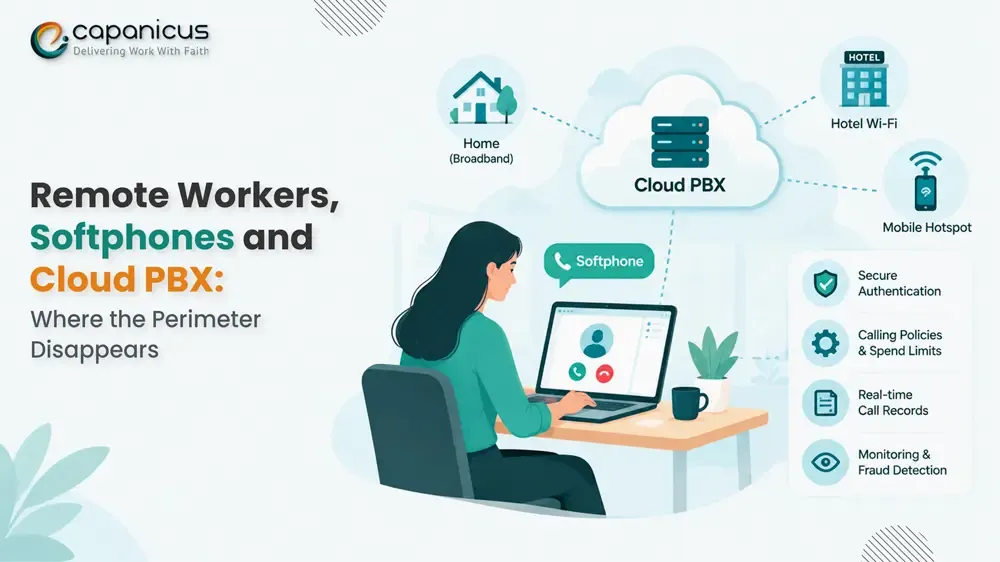
Most of the advice earlier in this guide assumes one thing: there’s an office, a firewall, and a PBX that sits behind it. However, that picture is out of date for a lot of companies. People register softphones from home broadband, hotel Wi-Fi and phone hotspots, and the PBX may live in a provider’s data center instead of your rack. SIP toll fraud doesn’t care about any of that. It just follows the weakest registration.
Moving to a cloud provider moves the hardware and the patching. But it doesn’t move your users’ passwords, your calling policy or your monitoring of what your own tenant dials. Before you sign or renew, get plain answers to a few questions:
- Is international calling off by default for new users, or on?
- Can you set per-user and per-tenant spend or channel limits yourself, or only through a support ticket?
- Can you export CDRs or receive usage alerts in near real time?
- What does the provider do if it sees a burst of traffic to premium destinations on your tenant?
If the answers are vague, assume the controls aren’t there. In short, effective VoIP toll fraud prevention in a hosted or cloud PBX environment depends on clear calling policies, enforceable spending limits, secure user authentication, and access to near-real-time call records.
A Hybrid Warning
The riskiest setups tend to sit right in the middle. On-prem PBX, cloud SIP trunk layered on top, a separate cloud tool for the call center, plus two or three gateways nobody’s touched since a migration that happened years ago. Every single trunk in that mess has its own credentials and its own rules. So document every one of them to prevent toll fraud VOIP. A trunk nobody’s inventoried is a trunk nobody’s watching, period.
Testing Your Own Defenses Before Someone Else Does
You can read every security guide ever published and still be wrong about your own system. So the only real way to know is to try breaking it yourself, with permission, on systems you actually own, and with your carrier given a heads-up first.
What to Check
Scan your own public IPs for SIP toll fraud and management ports. Anything answering that you didn’t expect is a finding, full stop. Register with a user that doesn’t exist, then with a wrong password for one that does, and compare the two responses, any difference means your numbering plan is enumerable. Audit stored credential strength directly rather than trying to brute-force your own system in production.
Test the Alerts, Not Just the Blocks
A lot of teams confirm a rule blocks a call and never go the extra step of checking whether a human actually gets told about it. That’s the real gap. Fire off a deliberate burst of test calls against a sandbox destination and time how long it takes before someone responds. “By tomorrow morning” is not an acceptable answer, and if that’s what you get, you’ve just found your real weak point.
Make It Routine
Test after every major change, a new trunk, a new office opening, a platform upgrade, a dialplan rewrite. Quarterly as a baseline if nothing else forces an earlier look. Also, write down what you tested and what broke. That record earns its keep later with auditors and with insurers.
Who Owns Toll Fraud VOIP? Budget, Accountability and Metrics
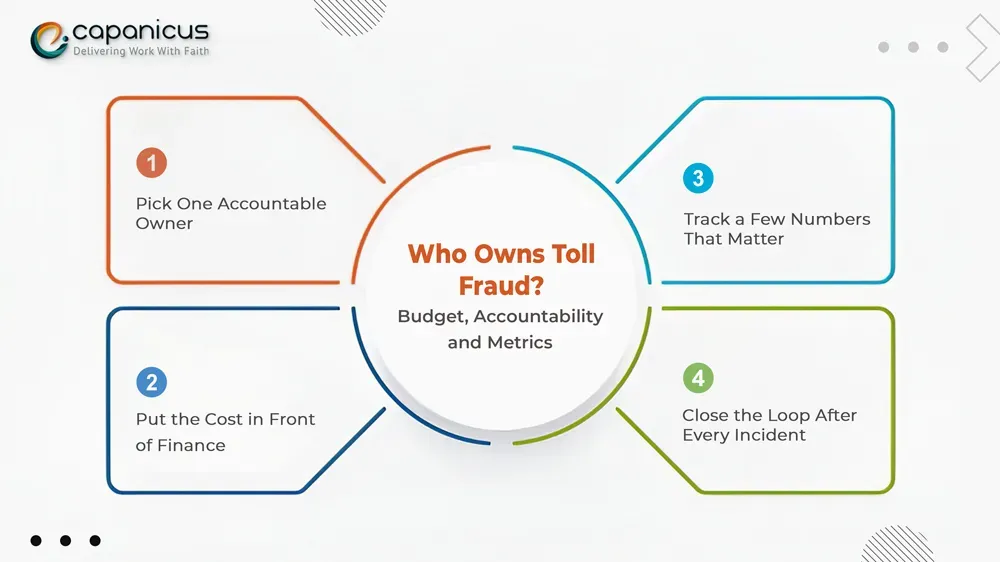
Controls fail silently when there’s no clear owner. That’s because telephony tends to sit in the gap between network, security, and procurement, and each team quietly assumes someone else already has it handled. That gap is exactly where toll fraud VOIP thrives.
Pick One Accountable Owner
One name, not a committee. They don’t have to build every control personally, but they need real authority, to restrict calling classes, suspend a trunk, escalate to a carrier, without having to track down a sign-off at 3am.
Put the Cost in Front of Finance
One bad weekend of premium traffic can cost more than years of these controls combined. So put that number in a budget meeting and watch the conversation move fast. Bring finance in early on spend ceilings, on what insurance actually covers, on who eats the cost while a dispute’s still being argued with the carrier.
Capanicus Engineering Insight: Most PBX environments we’ve reviewed treat these controls as a one-time setup. However, the ones that actually stay protected are the ones where someone revisits calling classes and destination lists every quarter, not just after a fraud event forces the issue.
Track a Few Numbers That Matter
You don’t need fifty dashboard widgets for this. Time from first anomalous call to a human actually responding. Share of endpoints sitting in the lowest calling class that still fits their job. Endpoints with international dialing turned on. Percentage of trunks with carrier-side spend limits set. That’s enough to tell you whether the program’s actually working.
Close the Loop After Every Incident
Even a blocked scan that got further than it should have is a free lesson sitting right there. Write it up, short, adjust one threshold because of it, date the change. As a result, a year of these small edits turns a reactive phone system into a genuinely hard target to crack.
| Metric | Why it matters | A sensible target |
| Time from first anomalous call to a person acting on it | Measures real detection speed | Minutes, not hours |
| Share of endpoints in the lowest calling class that fits their job | Shows how much blast radius you’ve removed | Rising every quarter |
| Endpoints with international dialing enabled | The smaller this is, the smaller the worst case | Only those with a stated need |
| SIP secrets that meet your standard | Shows credential hygiene | 100% |
| Trunks with carrier-side spend and channel limits | Your ceiling if everything else fails | 100% |
| Days since the last controlled test | Shows whether defenses are still verified | Under 90 |
Review these quarterly with the owner, security and finance in the same room. If a number moves the wrong way, you’ve found a problem on your own schedule, which is far cheaper than finding it on the carrier’s.
How Capanicus Designs VoIP Platforms to Minimize Toll Fraud Risks
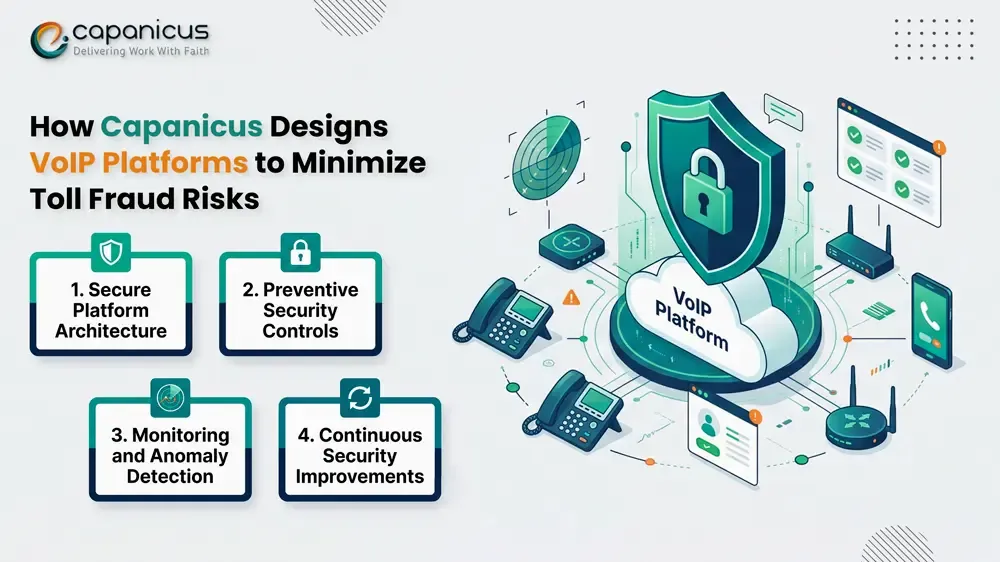
Preventing toll fraud VOIP starts with how a VoIP platform is designed, configured, and secured. While individual security controls can be added later, building them into the platform from the beginning helps reduce vulnerabilities before attackers can exploit them.
At Capanicus, we approach the development of VoIP platform solutions with an emphasis on the prevention of toll fraud. This means that regardless of whether we are working with Asterisk, FreeSWITCH, or a custom VoIP solution, we place a primary emphasis on limiting the options available for attackers. The implementation of our approach consists of the following four steps.
1. Secure Platform Architecture
We assess SIP toll fraud vulnerabilities, administrative access, authentication policies, dial plan switching, and carrier limitations during the architectural design. Identifying vulnerabilities early also allows us to lay a solid foundation to minimize unauthorized access.
2. Preventive Security Controls
Access controls, secure signaling and media protocols such as TLS and SRTP when workable, endpoint constraints, destination permit lists, limitations for call initiation, etc. also play a significant role in keeping the calls free from being conducted through the use of unauthorized devices or stolen credentials.
3. Monitoring and Anomaly Detection
Specifically, using Call Detail Records, SIP signaling and alerts allows the identification of suspicious calling behavior, unexpected directory numbers, and increase in call volume.
4. Continuous Security Improvements
VoIP systems are dynamic, especially as organizations bring new employees, locations, destinations, and service providers into their fold. Consistent review of access policies, upgrades of destination policy as well as updates of fraud detection mechanisms ensures the effectiveness of preventative measures as systems change.
The overall aim is to make toll fraud almost impossible by alleviating security deficiencies at the design, settings and monitoring stages. By embedding these factors into the VoIP architecture design, Capanicus allows organizations to keep their telephone systems as secure as possible.
When It Happens Anyway: A Response Plan
First 15 minutes
- Disable international and premium routing at the SBC or in the dialplan.
- If you cannot tell which accounts are compromised, cut outbound trunks to essential traffic and restore selectively.
- Then call the carrier’s fraud desk, report suspected fraud, and request blocks on the affected destinations.
First 24 hours
- Export CDRs, SIP logs, and carrier usage records before you change anything.
- Find the way in: successful logins from unfamiliar sources, new extensions or trunks, changes to the dialplan or forwarding, admin access logs.
- Rotate SIP secrets, voicemail PINs, admin credentials, provisioning credentials, and API tokens. Also, delete anything the attacker created.
- Fix the root cause before restoring normal routing.
Within two weeks
- Review your carrier contract and any insurance policy. Toll fraud VOIP is often capped or excluded.
- Finally, write a short post-incident review and feed the findings into thresholds, policy, and training.
A 90-Day Rollout
Days 1 to 30: lower your exposure. Inventory every SIP-facing address and management interface you have. Allowlist trunk sources. Move admin access behind a VPN. Then get spend limits set with your carrier.
Days 31 to 60: tighten identity and policy. Rotate every SIP secret under a real standard. Make authentication failures uniform. Bind fixed endpoints to known networks. Then roll out destination allowlists with concurrency caps per endpoint.
Days 61 to 90: build real detection. Centralize your CDRs and signaling logs. Deploy and tune alert rules against actual traffic. Write a runbook. Finally, put a quarterly review permanently on the calendar.
Final Thoughts
SIP toll fraud keeps working because it’s automated, it’s profitable, and it’s aimed at systems nobody’s really watching. The pipeline barely changes, find something reachable, map the extensions, guess a credential, test it quietly, then burn through charges as fast as the system allows before anyone notices.
Two changes if that’s all you have time for this week. Pull international dialing from every extension that doesn’t actually need it. Set spend and concurrency limits with your carrier so even your absolute worst weekend has a hard ceiling. Everything else here builds on those two moves.
If you’d rather hand this to a team that deals with it constantly, Capanicus runs VoIP development and PBX security audits built specifically around this kind of fraud prevention. Reach out and we’ll go through exactly where your current setup stands.
Frequently Asked Questions
What is toll fraud in VoIP?
It’s the unauthorized use of a company’s phone system to place chargeable calls, usually to premium-rate or high-cost international numbers, while the business that owns the system pays for calls it never approved.
How does SIP toll fraud usually begin?
It usually starts with automated tools searching for exposed SIP services, after which the hacker conducts some reconnaissance to gain access to valid SIP credentials, runs some test calls, and enters the so-called fraud stage after that.
How much can a toll fraud incident cost?
That depends on the call charges used, the concurrency and also the duration of the calls! The most expensive destinations charge quite a lot per minute, and the hacker may open many channels at the same time, so losing tens of thousands of dollars over one bad weekend is very much possible, provided that carriers do not have spending limits on their side.
How do I secure FreePBX or Asterisk against toll fraud?
Keep it off direct public exposure. Use strong random secrets. Turn on automatic banning for failed logins. Also, disable guest calling. Apply per-extension calling restrictions and concurrent call limits. Patch on a schedule, and keep the admin interface off the open internet entirely.
Is toll fraud covered by insurance?
There is a potential for insurance coverage to apply to toll as some telecommunication or cyber policies offer coverage while others don’t. To understand how toll situations apply to your policy, be sure to check the fine print of your insurance purchase contract.
Can SIP trunks be hacked?
The trunk is an access point but can still have IP authentication and credentials exposed. A trunk can generate bad calls if it is linked to a vulnerable PBX telephone system. Therefore, to secure trunks, use strong authentication from the carrier company and limit calls made through the trunk.
Should I block port 5060 to prevent toll fraud?
Blocking port 5060 is a good step if SIP access is not needed and using the trunk only from limited channels. However, just changing the 5060 port won’t provide much protection in itself.