What Is a Voicebot?
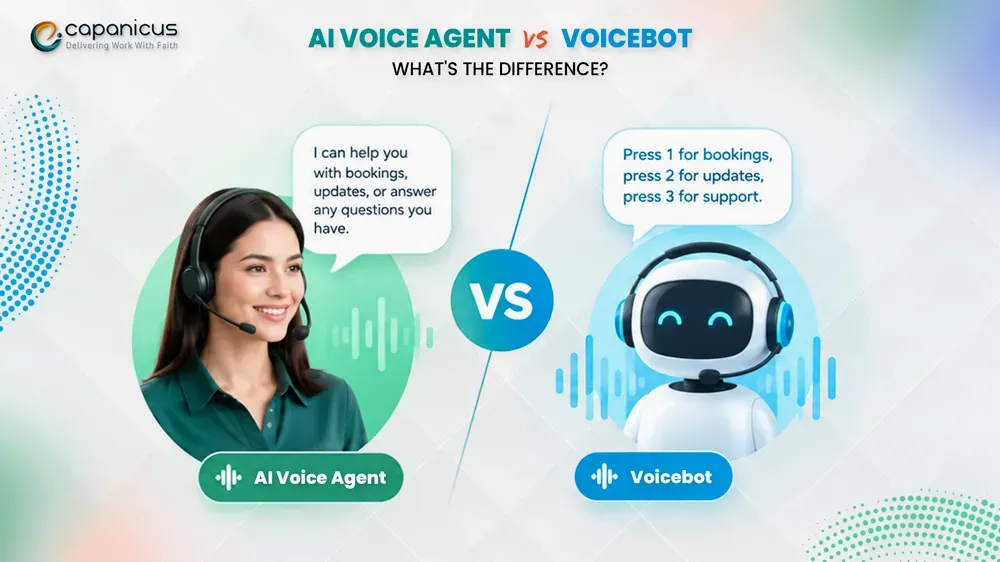
Simply put, a voicebot is an AI-driven software solution that interacts with humans via human speech only. Voicebots use various technologies to carry out conversation tasks, e.g., voice recognition and pre-written conversation rules to know what is being said by the caller and to deliver a suitable reply. Most voicebots are integrated in one or more ways into a telephone system, contact center platform, website, mobile app, or other communication methods. A customer making a phone call to a customer service department hears. “Welcоme to ABC Services. Pleаse say either ‘billіng, sаleѕ, or support’ to proceed.” Upon the customer’s reply, the voice Bot recognizes and categorizes the request, and the voicebot responds in a way relevant to what the person has asked.
How Does a Voicebot Work?
A voicebot of a usual type has a number of technological tools that altogether enable the conversation. Speech recognition turns the caller’s voice into text or in some other format that can be interpreted by software. Natural language Processing (NLP) helps the computer to get a grasp of the customer’s underlying intentions in their words. Conversation logic is about how the system will proceed given predefined rules, intents, or workflows. Text-to-speech (TTS) converts the computer-generated response into spoken language.
With this kind of voice interface, even for the simplest kind of interactions, it can be very effective. Presumably, a voicebot can be used for a customer query about the status of an order, a company’s operating hours, a basic customer information check, call routing, etc., or even to provide a simple confirmation of a previously made appointment, or to answer some of the most common questions (FAQ).
Where Are Voicebots Commonly Used?
In a variety of ways and for a great variety of purposes, businesses are using voicebots. Mainly for routine and predictable interactions that can be fully handled by voicebots.
- Answers to customer service FAQs
- Confirmations of appointments
- Updates on orders and delivery
- Basic account information
- Call routing
- Collection of Leads
- Reminders of payment
- Survey calls
- Booking requests
- Details about business-hour
- Simple troubleshooting
The benefit here is simple and the main one. For instance, the company will not need to employ staff to answer every call, and this way the company can save time in case of high-demand conversations with customers.
What Is an AI Voice Agent?
AI Voice Agent is a conversational AI system that understands and answers conversations spoken to machine using artificial intelligence.
Compared to the fixed path conversation-based voicebot, an AI voice agent can interpret meaning and context of a person’s verbal input and give a suitable reply.
How Does an AI Voice Agent Work?
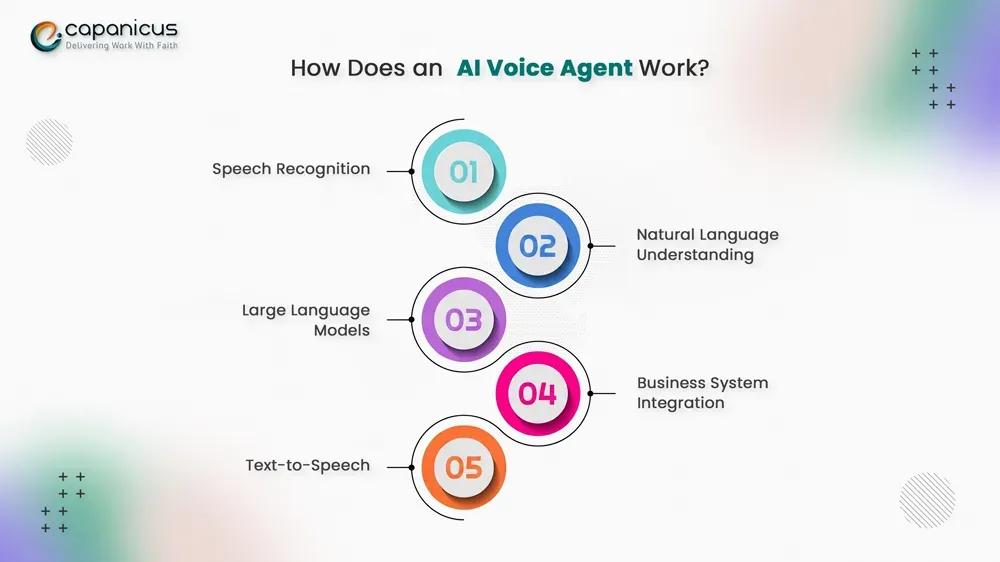
An AI voice agent typically combines several technologies into one conversational system.
Speech Recognition
The system first converts the user’s spoken words into text or structured information. Modern speech recognition systems can handle different accents, speaking styles, and conversational language more effectively than older speech-based systems.
Natural Language Understanding
The system then determines what the customer means.
This is important because customers rarely speak in perfectly structured sentences. Someone might say:
“My internet has been acting weird since yesterday.”
Instead of expecting the customer to use a predefined phrase such as “report internet connectivity problem,” an AI system can interpret the intent from natural language.
Large Language Models
Many modern AI voice agents use large language models to generate more natural and context-aware responses.
The model can consider previous parts of the conversation instead of treating every sentence as a completely separate request.
Business System Integration
This is where one of the primary distinctions between an introductory voicebot and a more capable AI voice agent comes in An AI voice agent can be integrated with such systems as:
- CRM platforms
- Helpdesk software
- ERP systems
- Appointments management systems
- Billing platforms
- E-commerce systems
- Contact centre software
- Databases
- APIs
- Communication platforms
These types of integrations mean the agent is not just talking; it could also get data. It could even get info, save info and records, kick off processes or workflows, and do a particular activity according to what the customer wants.
Text-to-Speech
Once the reply has been produced, it is spoken language that the text-to-speech is able to convert from text. With contemporary TTS technology, the voice will sound human, and it will be hard for anyone to tell this one is AI and not a human being; in fact, more natural-sounding than old IVR systems, which can only recite robotic lines.
AI Voice Agent vs Voicebot: Key Differences
Although both technologies can automate voice conversations, there are important differences between an AI voice agent vs voicebot.
| Feature | Voicebot | AI Voice Agent |
| Conversation style | Usually structured | More natural and flexible |
| Conversation flow | Predefined or rule-based | Dynamic and context-aware |
| Understanding | Handles known intents | Understands broader user intent |
| Context | Limited | Can maintain conversational context |
| Decision-making | Rule-based | AI-assisted within defined boundaries |
| Integrations | Basic to moderate | Extensive system integrations |
| Task execution | Usually simple | Can perform multi-step tasks |
| Personalization | Limited | More personalized |
| Complex conversations | Limited | Better suited |
| Scalability | High | High |
| Human handoff | Usually available | Can intelligently escalate |
| Best suited for | Repetitive requests | Complex customer interactions |
The difference becomes clearer when we look at how the two systems respond to unexpected requests.
A traditional voicebot might be programmed as follows:
“Press or say 1 for sales.”
An AI voice agent can be trained to manage:
“I’m looking for the enterprise plan, and I also want to know if you integrate with our current CRM, and whether someone can organise a demo next week.”
That request is actually several related inquiries and possibly a whole sequence of actions.
Understanding the conversation: Voicebot vs AI Agent
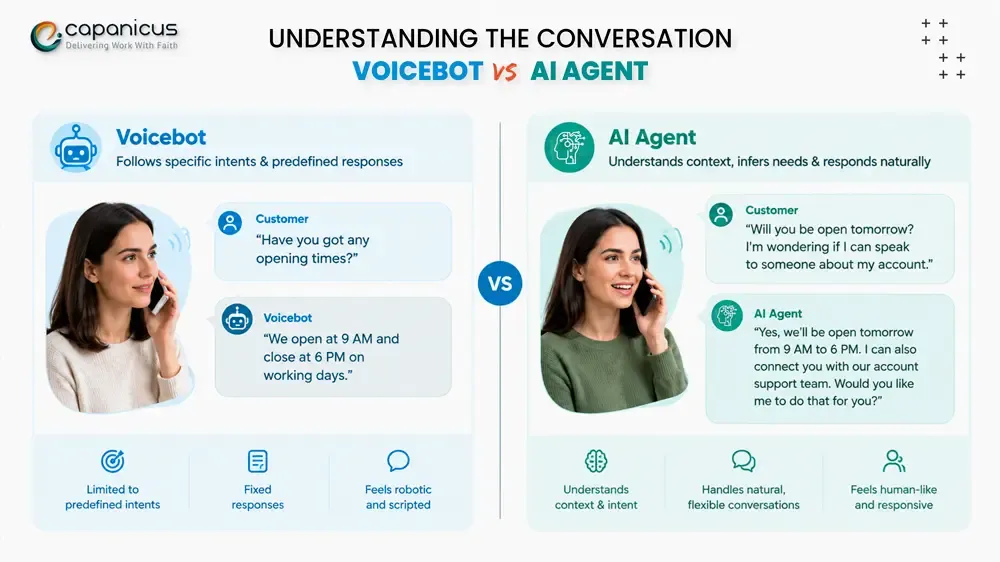
In the comparison of voicebot vs AI agent, one of the most significant aspects is their ability to understand the conversation.
In most cases, a voicebot operates on specific intents and predefined responses.
Here is an example:
Customer: “Have you got any opening times?”
Voicebot: “We open at 9 AM and close at 6 PM on working days.”
This is a very basic and expected interaction.
In contrast, an AI voice agent can handle much more natural and flexible interactions.
Customer: “Will you be open tomorrow? I’m wondering if I can speak to someone about my account.”
In that case, through the user utterance the agent will deduce that the customer needs information about their open hours and possibly also wants to get redirected to the right department.
The agent’s openness and flexibility make it possible to interact in a more natural, spoken way that resembles a real chat as opposed to an old-school automated phone system.
Voicebot vs AI Agent: Context understanding
Context is yet another key aspect to differentiation.
Sometimes the regular voicebot interprets each message of the user separately without taking into account the previous interactions.
On the other hand, the AI-powered voice agent has a capability to carry the context through out the whole talk.
Look here:
Customer: “Schedule a appointment for me, please.”
AI Agent: “Fine. Which date are you thinking of?”
Customer: “Friday after work.”
AI Agent: “We have 2:30 PM and 4:00 PM slots. Which of these would you prefer?”
“Friday afternoon” to the system is the reference of the appointment request made earlier by the customer.
This ability for understanding by reference will bring great utility in conversations that entail series of queries or actions.
AI Voice Agent vs Voicebot: Task Execution
A voicebot can provide information, but an AI voice agent can go further when it has access to the right systems.
For example, a healthcare business could use a conversational AI voice agent to:
- Identify the reason for a call
- Check available appointment slots
- Ask for the patient’s preferred time
- Schedule an appointment
- Send confirmation
- Update the relevant system
Similarly, an e-commerce company could use an AI voice agent to check an order, answer delivery questions, initiate a return request, or escalate a problem.
The key point is that the agent is not simply answering questions. It can become part of the business workflow.
AI Voicebot vs AI Voice Agent: Are They the Same?
The terms are sometimes used interchangeably, but they don’t always describe the same level of technology. An AI voicebot may use artificial intelligence to improve speech recognition, intent detection, or response generation. An AI voice agent generally represents a more capable system designed to manage conversations and perform actions toward a specific goal. The distinction is not always universal because different technology providers use these terms differently.
However, as a general rule:
Voicebot = automated voice conversation
AI voicebot = voicebot enhanced with AI
AI voice agent = AI-powered conversational system capable of understanding context, making decisions within its scope, and performing tasks
This makes the AI voice agent vs voicebot distinction less about the name and more about the capabilities behind the technology.
Key Features of an AI Voice Agent
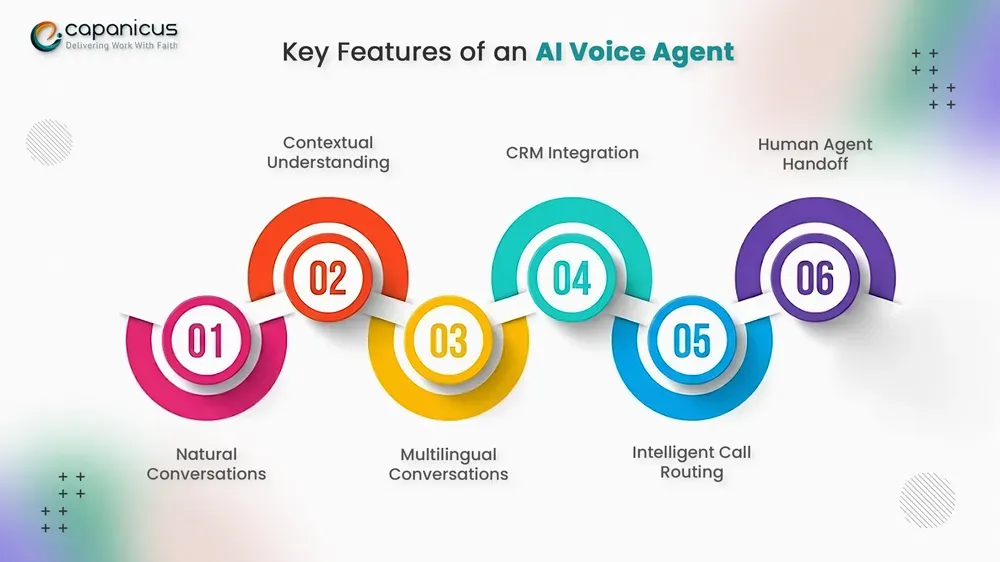
A modern AI voice agent can include several capabilities that go beyond traditional voice automation.
Natural Conversations
Instead of forcing customers to follow rigid prompts, the system can allow them to speak naturally.
Customers can ask questions, change topics, clarify their requests, and provide information in their own words.
Contextual Understanding
The agent can remember relevant information from the ongoing conversation.
For example, if a customer has already provided their order number, they should not necessarily have to repeat it every time they ask another question about the same order.
Multilingual Conversations
Multinational companies that interact with customers in various regions can utilize AI voice technology to handle different languages and even allow switching languages mid-conversation if needed.
Such a feature may be very helpful in various fields such as global companies, tourism, health, banking, and customer service sectors.
CRM Integration
If a CRM system is made available to an AI voice agent, businesses are more likely to deliver customized communications. The bot might pull customer notes, modify contact details, generate follow-up reminders, etc., or it can handover the customer and conversation summary to a human.
Intelligent Call Routing
Rather than merely requesting clients to scroll through the options an interactive AI voice agent can be used to grasp why you’re calling, which service department you are likely going to need, and it might help you to be connected. Take a look at an instance: “My intention is to change the subscription and in addition also I wish to get in touch with someone concerning the bill.” Such requests might not just be split up, i.e., subscription & customer service. Instead, the machine recognizes that there is not a singular, but two problems that are related at least, so the customer shall be provided the assistance they need right away.
Human Agent Handoff
To put it simply, artificial intelligence voice agents do not take over human workers entirely, but there will certainly be times when customers prefer human interaction mainly for very delicate, rare events, or challenging problems. An AI voice agent that’s properly designed is not only equipped to identify but also able to pass on information to a human agent in the form of an escalated case when the customer’s query cannot be addressed by an automated system without the loss of the human touch element.
That way, the customer will be spared from having to retell their story, a time-consuming and frustrating experience that should be avoided.
AI Voice Agent vs. Voicebot: Which One Is Better?
There isn’t one answer that fits all the businesses. When the purpose is to automate the simplest and repetitive voice interaction, a voicebot may be a great solution. A more natural conversation, system integration, contextual understanding, and task automation will call for an AI voice agent. The most important thing is to pick neither based solely on the technology being more recent! On the contrary, the businesses should find out what kinds of problems the customers they are targeting face and then only go for the level of automation that would suit.
Let’s see some examples:
Simple FAQ → Voicebot
Basic call routing → Voicebot
Lead qualification → Voicebot or AI voice agent
Customer support involving several issues that interconnect → AI voice agent
Making customers perform different tasks in a certain order is a case for automation → AI voice agent
In the contact centers, people and AI cooperation → AI voice agent
Final Thoughts
When it comes to AI voice agent vs voicebot, it’s basically about finding the right fit for AI in a company’s voice automation. Voicebots can help companies whose interactions are pretty much set from one conversation to the next. They can automate repetitive call requests, route calls, provide information, and cut down the workload of the customer service agents.
On the other hand, AI voice agents bring more features and possibilities. They can understand natural language, remember the conversation history, integrate with business systems, carry out certain tasks, and even hand the customer interaction to a customer service employee if required.
Certainly, for businesses developing the new generation of communication platforms, the main target shouldn’t be to make a machine talk. The ultimate goal is to generate a voice interaction for the customers that is not only helpful but also reliable, safe, and comfortable.
A company’s AI voice agent, AI voicebot, and conversational AI voice agent can provide a better way to communicate with customers if there is proper architecture, integration, conversation design, and a well-developed set of AI skills. This way, machines can be a big support to humans, who are free to focus only on the conversations that they are the most skilled at.
Build Smarter Voice Communication with Capanicus
Capanicus supports businesses in building and integrating today’s modern communication solutions such as AI-powered voice, VoIP, contact centre, and conversational communication technologies. If you have only a simple requirement to use a voice bot during routine transactions or would like to get a more powerful AI voice agent that will be able to deal with difficult conversations and complex business workflows, there will surely be a solution suitable for you based on the exact features you require.
Would you be interested in trying AI-powered voice automation at your workplace?
Get in touch with Capanicus to go through your needs and develop a voice solution tailored both for your customers and business processes.
Frequently Asked Questions (FAQs)
Q: What’s the key difference between a voicebot and an AI voice assistant?
A: A voicebot operates by following fixed paths in the form of scripts, dealing with simple repetitive jobs such as FAQs or call routing. On the other hand, an AI voice assistant is one who has the understanding of what context they’re talking through, manages conversations that change dynamically, and is capable, through integration with your business systems, of performing multi-step tasks.
Q: Is a voicebot able to catch your drift in natural language?
A: Voicebots with limited capacity detect predefined keywords only, which limits their conversation scope greatly. Whereas AI voice assistants, using techniques of natural language processing and large language models, decode the meaning of natural, everyday language even if words are not clear, such as with accents, interruptions during speech, etc.
Q: Will AI speech assistants remember previous parts of the conversation?
A: Of course. The voicebot, however, processes every utterance without remembering the conversation history, whereas conversational continuity is the AI voice agent’s hallmark feature. So if a client mentions “Friday afternoon”, the AI agent knows it is the time to be reminded of the earlier discussed appointment.
Q: Which one is best suited for customer care service: a voicebot versus an AI voice agent?
A: A voicebot is a good fit for customers’ routine needs such as FAQs, appointment confirmations, or even just routing of calls. If you have customer service issues where human agents have to be able to talk about things like support issues, check systems, or perform some task – an AI voice agent will be better at solving such multi-dimensional support requests. E.g., scheduling + billing + escalation, etc.
Q: Can an AI voice assistant connect to other programs such as a CRM?
A: That’s right! Besides CRMs, an AI voice assistant can link to ticketing system software, helpdesk, ERPs, billing platforms, and other such tools. With all that, the agent can extract data, modify records, activate processes, and provide individualized answers in a flash.
Q: Are AI voice assistants multilingual?
A: Modern-day AI voice assistants can speak various natural languages, including switching from one language to another in the middle of a single conversation. This feature is particularly beneficial for global enterprise companies that have customers across several countries.
Q: If an AI voice agent doesn’t cope, what comes next?
A: Designed carefully, AI voice agents smoothly transfer complex conversation to human agents with full conversation history included so that customers do not need to tell their stories over and over again. Voicebots can also make handovers; however, the context they pass is very limited.
Q: Are AI voicebot and AI voice agent the same thing?
A: Rather not. An AI voicebot is a voicebot augmented with AI features (improved speech recognition, better detection of purposes/requests). Meanwhile, an AI voice(agent can understand context, take decisions independently and carry out the tasks autonomously).
Q: Which type requires fewer costs: voicebots or AI voice agents?
A: Voicebots are economical solutions if all you need is quick, easy access to information that’s already been written or just repeating things. However, when it comes to handling complex customer service situations AI voice agents may well pay off as they allow for a great reduction in human staff hours while enhancing the quality of customer service.
Q: Can an AI voice assistant take care of several things within a single conversation?
A: Yes. If a customer is saying “I want to cancel my subscription and also discuss my bill,” an intelligent AI voice assistant will not fail and will understand the customer’s needs from two sides and then accordingly act on one side (e.g., cancelling the subscription) and send the bill information to the other side. If a voicebot is involved, there is a strong chance that either it will give an error message or just end up creating another call for bill discussion.
Q: What services can Capanicus provide in terms of the voice bot automation?
A: Capanicus offers voice automation solutions starting with simple voicebots for repetitive task jobs of answering customer questions or routing calls, all the way up to the complex level that AI voice agents are capable of handling, from conversations to different systems being integrated with voice automation. These are tailor-made communications solutions based upon your company’s particular needs and customer pain points.