
An omnichannel communication platform enables businesses to manage customer interactions across multiple communication channels—including voice calls, email, SMS, live chat, WhatsApp, and social media—from a single unified interface. It helps improve customer experience, boost agent productivity, reduce response times, and create consistent conversations across every touchpoint.
Introduction
Customer expectations have changed dramatically over the past few years. People no longer interact with businesses through a single communication channel. They might discover your business through social media, ask questions via WhatsApp, receive updates by email, and later contact your support team over a phone call.
Regardless of the channel they choose, customers expect one continuous conversation. They don’t want to repeat their problem every time they contact your business.
Unfortunately, many companies still rely on disconnected communication tools. Customer conversations are scattered across multiple platforms, forcing support teams to switch between applications and manually piece together interaction histories. This results in slower response times, inconsistent support, frustrated customers, and reduced team productivity.
An omnichannel communication platform solves this challenge by bringing every customer interaction into one centralized workspace. Whether a customer contacts your business through voice, SMS, live chat, WhatsApp, Facebook Messenger, Instagram, email, or any other supported channel, your team has complete visibility into the entire customer journey.
Instead of juggling multiple systems, agents can focus on what matters most—delivering fast, personalized, and consistent customer experiences.
In this guide, we’ll explore the essential features every modern omnichannel communication platform should have, along with how these capabilities improve customer engagement, operational efficiency, and long-term business growth.
Why Businesses Need an Omnichannel Communication Platform
Businesses today communicate with customers through more channels than ever before. While this creates more opportunities to engage customers, it also introduces new operational challenges.
Imagine this scenario.
A customer first sends a product inquiry through Facebook Messenger. The following day, they email your support team asking about pricing. Later, they call your sales department to confirm availability.
If your communication channels operate independently, each employee only sees a portion of the conversation. The customer must explain the same issue multiple times, creating frustration and delaying resolution.
Now imagine the same interaction using an omnichannel communication platform.
Every conversation—regardless of whether it happened through Facebook, WhatsApp, email, live chat, SMS, or voice—is automatically connected to the customer’s profile. When the customer contacts your business again, your team immediately sees previous conversations, purchase history, support requests, and important notes from earlier interactions.
This creates several business benefits:
- Faster response times
- Higher first-contact resolution rates
- Better customer satisfaction
- Increased agent productivity
- Improved collaboration across departments
- Consistent customer experiences
- Reduced operational costs
Rather than managing multiple communication tools, your team spends more time solving customer problems and building stronger relationships.

1. Unified Inbox
A unified inbox is the foundation of every successful omnichannel communication platform.
Instead of checking separate dashboards for email, SMS, WhatsApp, live chat, Facebook Messenger, Instagram, LinkedIn, and voice calls, agents manage every customer conversation from one centralized interface.
A unified inbox becomes even more effective when integrated with VoIP software development for seamless voice communication.
This eliminates unnecessary context switching and significantly improves productivity.
A well-designed unified inbox should support:
- SMS
- Voice Calls
- WhatsApp Business
- Facebook Messenger
- Instagram Direct Messages
- Live Chat
- LinkedIn Messaging
- Telegram
- Custom Business Channels
Beyond simply collecting conversations, the inbox should also allow agents to:
- Assign conversations to teammates
- Transfer chats between departments
- Add internal notes
- Tag conversations
- Track conversation status
- Set priorities
- View complete customer history
- Search previous interactions instantly
With every customer interaction available in one place, teams collaborate more effectively while delivering faster and more personalized support.
2. Real-Time Synchronization Across Every Channel
Customers expect businesses to remember every previous interaction regardless of which communication channel they use.
Real-time synchronization ensures that customer information is updated instantly across the entire platform.
For example, if a customer places an order through WhatsApp and later contacts support via email, the support agent should immediately see:
- Order history
- Previous conversations
- Support tickets
- Customer profile
- Payment status
- Notes from other departments
Without real-time synchronization, different teams often work with outdated or incomplete information, resulting in inconsistent communication and unnecessary delays.
A modern omnichannel communication platform keeps every interaction synchronized automatically, ensuring every department has access to the latest customer information.
3. Intelligent Conversation Routing
Every customer inquiry requires different expertise.
A billing issue should reach the finance department.
A technical issue should be reported to technical support.
Sales inquiries should go directly to the sales team.
This is where intelligent routing becomes essential.
Instead of manually assigning conversations, the platform automatically routes requests using predefined rules such as:
- Customer type
- Department
- Language
- Business hours
- Product category
- Priority level
- Customer location
- Agent availability
For example:
- Billing questions are automatically assigned to the finance team.
- Technical support requests are routed to certified engineers.
- High-value customers receive priority support.
- Frequently asked questions are handled by AI before reaching a live agent.
Intelligent routing minimizes wait times, improves response quality, and ensures customers always connect with the right expert. Organizations using contact center software development can automate intelligent routing across multiple communication channels.
4. AI-Powered Automation
Artificial Intelligence has become one of the most valuable components of modern customer communication.
Rather than replacing human agents, AI helps them work faster by automating repetitive tasks.
Today’s omnichannel communication platforms commonly include:
- AI Chatbots
- AI Voice Agents
- Automated FAQs
- Smart Reply Suggestions
- Ticket Categorization
- Sentiment Analysis
- Conversation Summaries
- Workflow Automation
For instance, if a customer asks about store hours, order tracking, password resets, or appointment availability, an AI chatbot can provide instant responses without human intervention.
If the issue requires personalized assistance, the platform automatically transfers the conversation to a live agent along with the complete interaction history. This ensures customers never have to repeat themselves while allowing agents to resolve issues more efficiently.
5. Advanced Analytics and Reporting
You can’t improve what you don’t measure.
A robust omnichannel communication platform should provide real-time insights into customer interactions, team performance, and business operations.
Essential reporting metrics include:
- First Response Time (FRT)
- Average Resolution Time (ART)
- Customer Satisfaction Score (CSAT)
- First Contact Resolution (FCR)
- Agent Productivity
- Channel-wise Performance
- Peak Communication Hours
- Customer Engagement Trends
These insights help managers identify bottlenecks, optimize staffing, improve customer service strategies, and make data-driven business decisions.
Instead of relying on assumptions, businesses gain complete visibility into how every communication channel contributes to customer experience and operational performance.
6. Enterprise-Grade Security and Compliance
Customer communication often contains sensitive information, including personal details, payment records, business conversations, and confidential documents. Protecting this data isn’t just a best practice—it’s a business necessity.
A reliable omnichannel communication platform should include enterprise-level security features such as:
- End-to-end encryption
- Multi-factor authentication (MFA)
- Role-based access control
- Audit logs
- Automatic data backups
- Disaster recovery
- Secure cloud infrastructure
- Compliance with GDPR, HIPAA, PCI DSS (where applicable)
Security also means giving administrators complete control over who can access customer information. Different departments should only see the data relevant to their responsibilities.
A secure platform builds customer trust, reduces business risk, and helps organizations meet regulatory requirements without adding unnecessary complexity.
7. Seamless Integration with Business Applications
An omnichannel communication platform should never operate in isolation.
Your customer conversations become far more valuable when they connect with the rest of your business systems.
The platform should integrate with:
- CRM Software
- Helpdesk Solutions
- ERP Systems
- E-commerce Platforms
- Marketing Automation Tools
- Payment Gateways
- Calendar Applications
- Business Intelligence Tools
For example, when a customer contacts support, the agent should instantly see:
- Customer profile
- Previous purchases
- Active subscriptions
- Open support tickets
- Payment status
- Sales history
This eliminates manual data entry, reduces response time, and helps agents provide more personalized support.
If your business requires custom workflows, the platform should also provide REST APIs, SDKs, and Webhooks for seamless third-party integrations.
8. Mobile Accessibility
Customer conversations don’t stop after office hours.
Modern businesses require communication tools that work from anywhere.
Whether your support agents work remotely, travel frequently, or manage field operations, they should have secure access to customer conversations through mobile devices.
A powerful mobile application should allow agents to:
- Receive real-time notifications
- Respond to conversations instantly
- View complete customer history
- Transfer conversations
- Access internal notes
- Share files
- Monitor team activity
- Join voice or video calls
The mobile experience should offer the same functionality as the desktop platform without sacrificing performance or security.
With mobile accessibility, businesses can deliver uninterrupted customer support regardless of location.
9. Performance Monitoring and Agent Productivity
Delivering exceptional customer service requires continuous improvement.
That’s why every omnichannel communication platform should include performance monitoring tools that help managers evaluate agent productivity and service quality. Teams handling large outbound campaigns often integrate predictive dialer development solutions to improve agent productivity.
Key performance indicators (KPIs) include:
- Average Response Time
- First Contact Resolution
- Average Handling Time
- Customer Satisfaction Score (CSAT)
- Service Level Agreement (SLA) Compliance
- Missed Conversations
- Agent Availability
- Queue Performance
- Customer Wait Time
By analyzing these metrics, businesses can identify performance gaps, optimize workflows, and improve customer service strategies.
For example, if one support channel consistently experiences longer wait times than others, managers can adjust staffing or automate repetitive tasks to improve efficiency.
Data-driven decisions lead to better customer experiences and more productive support teams.
10. Scalability for Future Business Growth
The communication needs of your business today may look very different a year from now.
As your customer base grows, your communication platform should grow with it.
A scalable omnichannel communication platform should support:
- Unlimited users
- Multiple business locations
- Global teams
- High conversation volumes
- New communication channels
- AI-powered automation
- Multi-language support
- Cloud deployment
Whether you’re handling hundreds or millions of customer interactions each month, the platform should continue delivering reliable performance without requiring major infrastructure upgrades.
Cloud-native architectures make scaling easier while reducing maintenance costs, allowing businesses to focus on growth instead of managing servers.
Omnichannel vs Multichannel Communication
Many businesses confuse multichannel and omnichannel communication. Although they sound similar, they provide very different customer experiences.
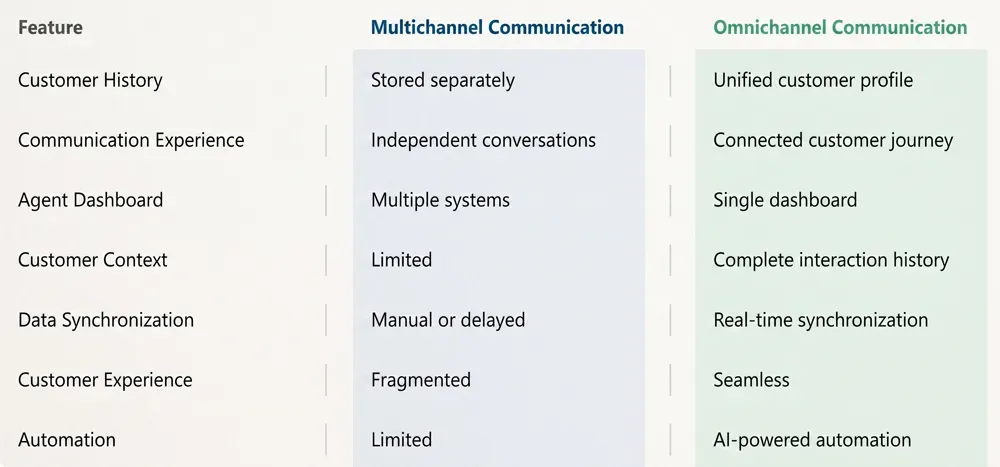
Multichannel allows customers to contact your business through different channels.
Omnichannel connects every interaction into one continuous conversation, giving customers a seamless experience while improving agent productivity.
Benefits of an Omnichannel Communication Platform
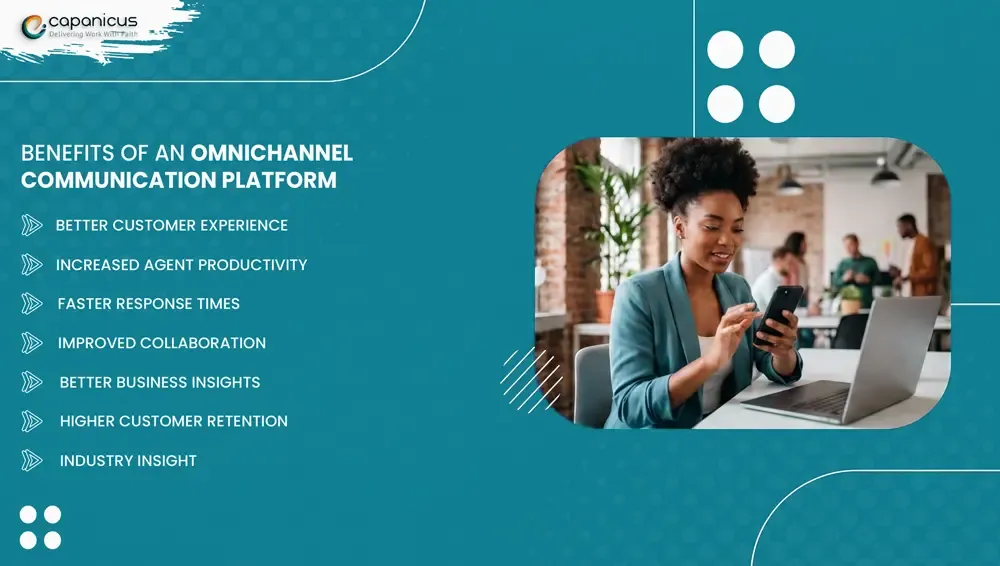
Implementing an omnichannel communication platform delivers measurable benefits for both customers and businesses.
Better Customer Experience
Customers receive faster responses, personalized interactions, and consistent support across every communication channel.
Increased Agent Productivity
Agents spend less time switching between applications and more time solving customer issues.
Faster Response Times
AI automation, intelligent routing, and a unified inbox significantly reduce response and resolution times.
Improved Collaboration
Sales, support, and marketing teams share the same customer information, reducing miscommunication and duplicated work.
Better Business Insights
Real-time analytics help businesses understand customer behavior, monitor team performance, and make data-driven decisions.
Higher Customer Retention
A seamless communication experience builds trust, improves customer satisfaction, and encourages long-term loyalty.
Industry Insight
Businesses that unify customer communications often experience improvements in response times, operational efficiency, and customer satisfaction because agents no longer need to switch between disconnected systems or ask customers to repeat information. Instead, every interaction is available in one place, making support faster and more consistent.
Technology Stack for Omnichannel Communication Platform Development
Building a modern omnichannel communication platform requires a robust technology stack that ensures scalability, security, and real-time communication. The right technologies help businesses deliver seamless customer experiences while supporting future growth.
A typical omnichannel platform includes the following components:

Choosing the right technology stack depends on your business goals, expected customer volume, security requirements, and integration needs. A scalable architecture ensures your platform remains reliable as communication volumes grow.
How an Omnichannel Communication Platform is Developed
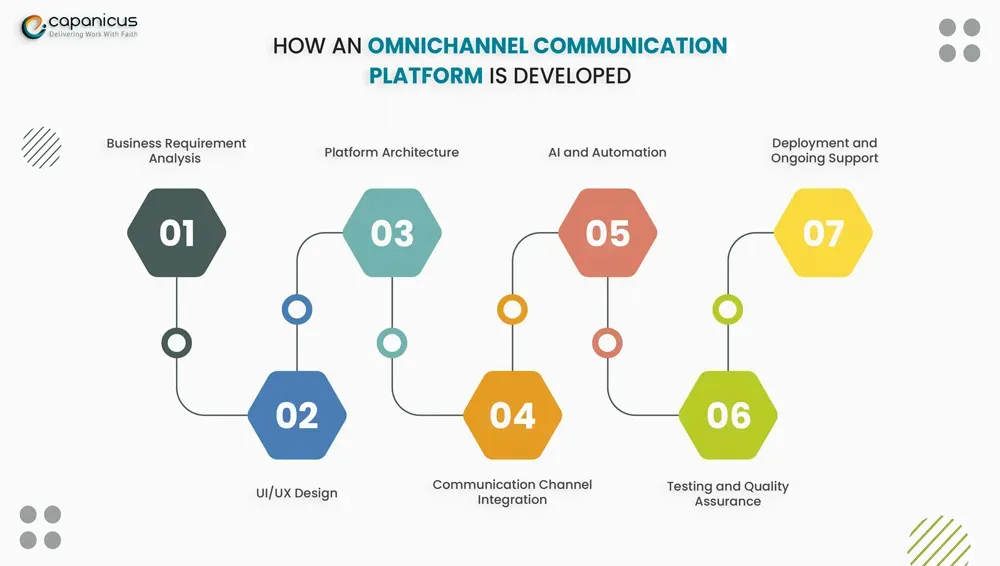
Developing an omnichannel communication platform involves much more than integrating multiple communication channels. It requires careful planning, scalable architecture, and a user-centric approach.
1. Business Requirement Analysis
The first step is understanding your communication workflows, customer journey, business objectives, and existing software ecosystem. This helps define the platform’s scope and required features.
2. UI/UX Design
An intuitive interface improves agent productivity. During this stage, designers create dashboards, conversation views, customer profiles, and reporting screens that are easy to navigate.
3. Platform Architecture
Developers design a secure and scalable architecture that supports voice, video, chat, email, SMS, and social media channels while ensuring real-time synchronization.
4. Communication Channel Integration
Popular communication channels such as WhatsApp, email, voice calls, live chat, Facebook Messenger, Instagram, SMS, and third-party CRMs are integrated into a unified platform.
5. AI and Automation
AI-powered features like chatbots, voice agents, intelligent routing, sentiment analysis, and automated workflows are implemented to improve efficiency and customer experience. Businesses are increasingly combining AI automation with AI virtual agents to provide intelligent 24/7 customer support.
6. Testing and Quality Assurance
Every feature undergoes functional, security, performance, and usability testing to ensure reliable operation across devices and communication channels.
7. Deployment and Ongoing Support
After deployment, the platform is continuously monitored, updated, and optimized to support new features, security enhancements, and business growth.
Industries That Benefit from Omnichannel Communication Platforms
Almost every customer-focused business can benefit from an omnichannel communication platform. However, the impact is particularly significant in industries that handle high volumes of customer interactions.
Healthcare
Manage patient appointments, telehealth consultations, reminders, and support requests from a single platform while maintaining secure communication.
Banking and Financial Services
Provide secure customer support across voice, chat, email, and messaging channels while ensuring compliance with industry regulations.
E-commerce and Retail
Support customers throughout their buying journey with order updates, product inquiries, returns, and personalized recommendations across multiple channels.
Telecommunications
Handle technical support, billing inquiries, and service requests efficiently while improving first-contact resolution rates.
BPO and Contact Centers
Enable agents to manage conversations across voice, email, chat, and social media through one unified interface, improving productivity and reducing response times.
Real Estate
Manage property inquiries, appointment scheduling, follow-ups, and customer engagement through integrated communication channels.
Education
Improve communication between institutions, students, and parents with centralized messaging, notifications, and support services.
Travel and Hospitality
Deliver seamless booking support, itinerary updates, customer assistance, and post-trip engagement through a consistent omnichannel experience.
Future Trends in Omnichannel Communication Platforms
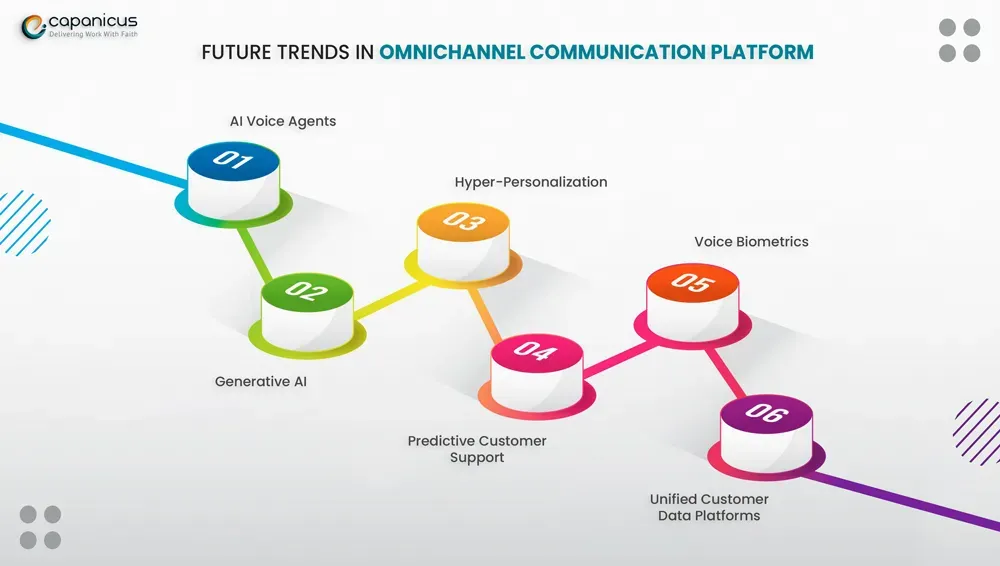
Customer communication continues to evolve rapidly. Businesses investing in omnichannel solutions should prepare for technologies that will shape the future of customer engagement.
AI Voice Agents
AI-powered voice assistants will handle routine customer interactions, reducing wait times and improving service availability.
Generative AI
AI will assist agents by generating responses, summarizing conversations, and recommending next-best actions in real time.
Hyper-Personalization
Platforms will use customer behavior, purchase history, and AI-driven insights to deliver highly personalized communication experiences.
Predictive Customer Support
Advanced analytics will identify customer issues before they occur, enabling proactive engagement and reducing support requests. AI-powered voice agents are becoming an essential part of modern omnichannel communication platforms.
Voice Biometrics
Voice authentication will improve security while eliminating the need for lengthy identity verification processes.
Unified Customer Data Platforms
Customer information from CRM systems, communication channels, and business applications will become even more interconnected, providing a complete 360-degree customer view.
Businesses adopting these technologies early will gain a competitive advantage by delivering faster, smarter, and more personalized customer experiences.
Why Choose Capanicus for Omnichannel Communication Platform Development?
At Capanicus, we build custom omnichannel communication platforms that simplify customer engagement and improve business communication. Our solutions are designed to unify voice calls, video, email, SMS, WhatsApp, live chat, and social media interactions into one centralized platform.
Our expertise includes:
- Custom Omnichannel Platform Development
- Contact Center Software Development
- VoIP Software Development
- WebRTC Development
- AI Voice Agent Development
- AI Virtual Agent Solutions
- Predictive Dialer Development
- CRM & Third-Party Integrations
We focus on building secure, scalable, and future-ready communication platforms that help businesses improve customer experience, streamline operations, and accelerate digital transformation.
Whether you’re launching a new communication platform or modernizing an existing system, our team delivers solutions tailored to your unique business requirements.
Frequently Asked Questions (FAQs)
1. What is an omnichannel communication platform?
An omnichannel communication platform is a centralized solution that enables businesses to manage customer interactions across multiple communication channels—including voice calls, email, SMS, WhatsApp, live chat, and social media—from a single dashboard. It provides agents with complete customer context, resulting in faster responses and a more consistent customer experience.
2. What is the difference between omnichannel and multichannel communication?
Multichannel communication allows customers to contact a business through multiple channels, but each channel operates independently. Omnichannel communication connects every interaction into one continuous conversation, ensuring customer history and context remain available across all channels.
3. Which communication channels should an omnichannel platform support?
A modern omnichannel communication platform should support:
- Voice Calls
- SMS
- WhatsApp Business
- Live Chat
- Facebook Messenger
- Telegram
- Video Calling
- Custom APIs
The exact channels depend on your business requirements and customer preferences.
4. Can an omnichannel communication platform integrate with CRM software?
Yes. Most modern platforms integrate with popular CRM systems, helpdesk software, ERP solutions, payment gateways, and marketing automation tools. These integrations provide agents with a complete customer profile and reduce manual work.
5. Is AI important in an omnichannel communication platform?
Absolutely. AI helps automate repetitive tasks such as answering FAQs, routing conversations, summarizing chats, analyzing customer sentiment, and providing response suggestions. This improves response times while allowing agents to focus on complex customer issues.
6. How secure are omnichannel communication platforms?
Enterprise-grade platforms include advanced security features such as end-to-end encryption, role-based access control, multi-factor authentication, audit logs, automatic backups, and compliance with standards like GDPR and HIPAA where required.
7. Which industries benefit most from omnichannel communication platforms?
Industries including healthcare, banking, insurance, retail, e-commerce, telecommunications, education, travel, logistics, and BPO/contact centers can significantly improve customer engagement and operational efficiency with omnichannel communication.
8. How long does it take to develop a custom omnichannel communication platform?
The timeline depends on the project’s complexity, required integrations, communication channels, and AI capabilities. A basic solution may take a few months, while an enterprise-grade platform with advanced features and custom integrations can take significantly longer.
9. Can an omnichannel communication platform scale as my business grows?
Yes. Cloud-based omnichannel platforms are designed to scale with your business. They can support additional users, communication channels, business locations, and customer interactions without compromising performance.
Conclusion
Customer expectations continue to evolve, and businesses that rely on disconnected communication systems risk slower response times, inconsistent customer experiences, and lower operational efficiency.
An omnichannel communication platform solves these challenges by bringing every customer interaction into a unified workspace. From a centralized inbox and AI-powered automation to real-time synchronization, advanced analytics, enterprise security, and seamless integrations, the right platform enables businesses to deliver faster, smarter, and more personalized customer support.
Whether you’re building a communication platform from scratch or modernizing your existing infrastructure, investing in the right omnichannel solution helps improve customer satisfaction, increase team productivity, and prepare your business for future growth.
As AI, automation, and customer expectations continue to evolve, organizations that adopt scalable omnichannel communication platforms today will be better positioned to compete in the years ahead.
Looking to build a scalable customer communication solution? Explore our Omnichannel Platform Development Services to develop a custom AI-powered omnichannel platform with VoIP, WebRTC, CRM integration, and automation.
Ready to Build a Custom Omnichannel Communication Platform?
Looking to develop a secure, scalable, and AI-powered omnichannel communication platform tailored to your business?
At Capanicus, we help businesses build modern communication solutions that integrate voice, video, email, SMS, WhatsApp, live chat, social media, and AI automation into one unified platform.
Whether you need a custom contact center solution, omnichannel platform, AI voice agent, or enterprise communication software, our team can help you design and develop a solution that meets your business goals.
Get in touch with Capanicus today to discuss your omnichannel communication platform development project.