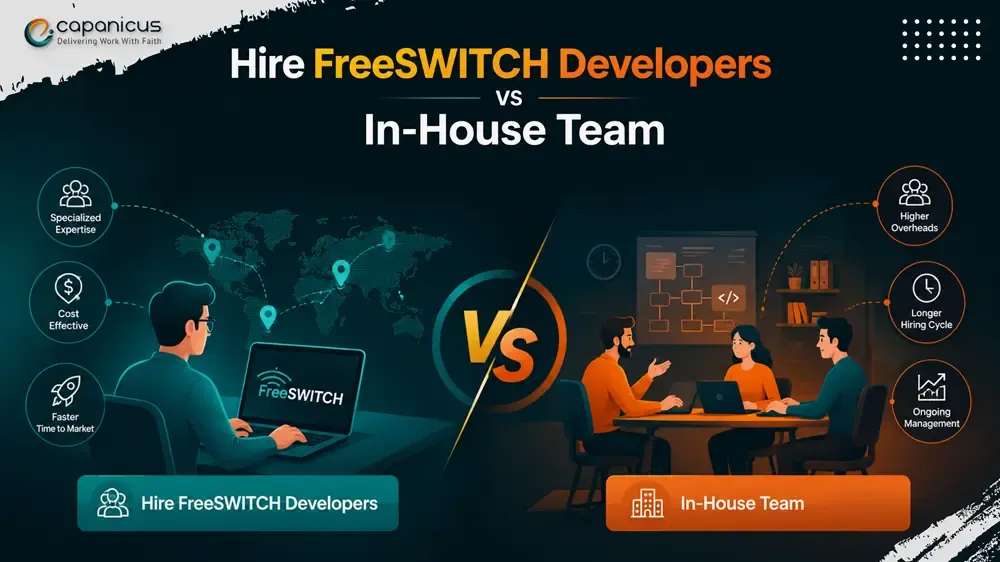
Still weighing whether to hire FreeSWITCH developers or build the team in-house? That decision usually comes down to one thing: you need engineers who can work with FreeSWITCH from day one, and right now, 78 percent of employers in IT cannot find them fast enough, according to ManpowerGroup’s latest Talent Shortage Survey. The good news is that the shortage is only a problem if you are hiring the way everyone else is.
FreeSWITCH sits at the center of that demand. It powers everything from cloud PBX systems and SIP trunking to WebRTC applications and AI-driven voice agents, and the platforms built on it need developers who understand its event-driven, XML-based architecture from day one. So when you are deciding between hiring FreeSWITCH developers through a specialized partner or building an in-house team from scratch, the choice comes down to more than personal preference. It comes down to cost, speed, and how central voice infrastructure is to your business, and getting that decision wrong can set a product timeline back by months.
The Real Cost of Building an In-house FreeSWITCH Team
A single mid-to-senior software developer in the US now costs between US$200,000 and US$240,000 a year once you account for salary, benefits, payroll taxes, and equipment, based on 2026 industry cost breakdowns from TPLEX. FreeSWITCH expertise is even harder to price predictably, since it is a niche skill set compared to general web or mobile development, and the talent pool is smaller. Most in-house hiring plans are built around a single salary figure, and that figure is rarely the number that actually lands on your books once the full picture comes into view.
Then there is the hiring timeline itself. Recruiting, interviewing, and onboarding a specialized engineer takes weeks or months, and every week without the right developer is a week your product sits in the backlog. During that stretch, you are also paying recruiters, pulling your existing engineers away from real work to conduct interviews, and absorbing the ramp-up period before a new hire becomes fully productive. None of that shows up in the headline salary figure, but it shows up in your runway.
There is also a retention risk that rarely gets discussed until it becomes a problem. FreeSWITCH developers with real production experience are in short supply, so once you find one, competitors are actively trying to hire them away too. If that person leaves eighteen months in, you are not just replacing a headcount. You are rebuilding institutional knowledge of a call routing system, a billing integration, or a WebRTC application that only lived in one person’s head. A specialized development partner spreads that knowledge across a team instead of concentrating it in a single hire, which removes a single point of failure from your roadmap.
What Changes When You Hire FreeSWITCH Developers
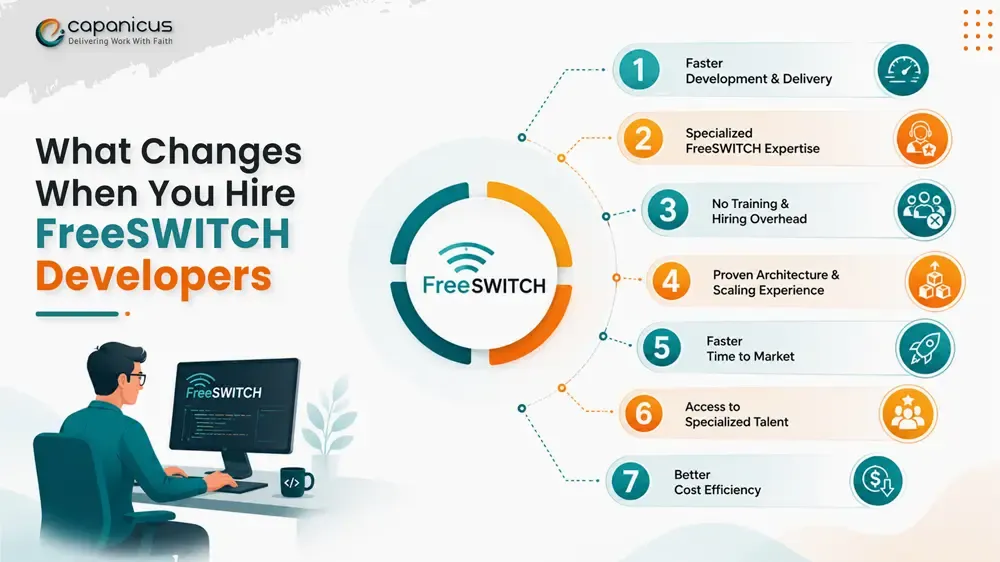
Working with a FreeSWITCH development company shifts that equation. You are paying for delivery, not for a seat that needs training, benefits administration, and long-term retention planning. A specialized team has already solved the configuration challenges, integration patterns, and scaling issues that a first-time in-house hire would need months to work through independently. Instead of one developer learning FreeSWITCH on your project’s timeline, you get a team that has already made those mistakes on someone else’s project and built the fixes into how they work.
That difference shows up most clearly in how quickly a project moves from requirements to a working build. An experienced FreeSWITCH development company can usually scope, architect, and start development within days, because the groundwork of understanding the platform’s dialplan logic, module ecosystem, and scaling patterns is already in place. An in-house hire, even a strong one, still needs time to get familiar with your specific infrastructure before they can move at full speed.
This is also why demand for FreeSWITCH development services keeps climbing alongside the broader VoIP market. The global VoIP services market is projected to grow from US$195.39 billion in 2026 to US$388.97 billion by 2034, a compound annual growth rate of 10.4 percent, according to Fortune Business Insights. As more businesses build cloud calling, conferencing, and AI voice products, the pressure to move quickly on communication infrastructure keeps rising, and speed is exactly what a dedicated FreeSWITCH development team offers. Businesses that wait months to staff an internal team are often watching that same window of opportunity close while competitors already have a working product in front of customers.
Cost efficiency is shifting too. Outsourcing motivations have moved beyond pure savings in recent years. According to Deloitte’s Global Outsourcing Survey, only 34 percent of organizations now cite cost reduction as their primary reason for outsourcing, down sharply from 70 percent a few years earlier, with access to specialized talent and faster delivery timelines taking priority. That shift matters for FreeSWITCH software development specifically, because the platforms built on it, from AI receptionists to omni-channel contact centers, depend on getting the architecture right the first time, not just getting it cheap.
When In-House is a Better Choice
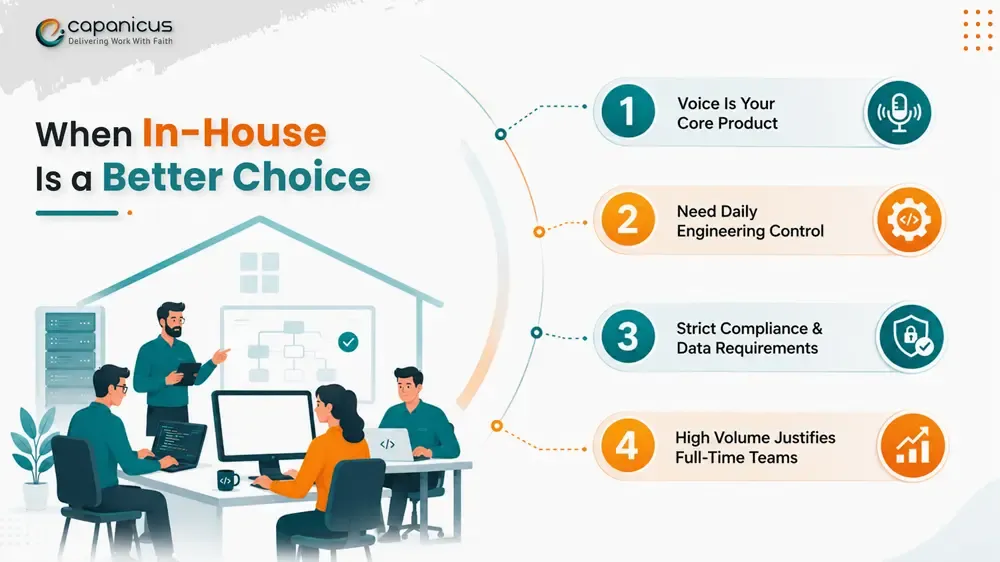
None of this means an internal team is the wrong call for every business. If voice infrastructure is your core product, not a supporting feature, and you need daily, hands-on iteration with your engineering team, hiring in-house FreeSWITCH developers can be worth the investment. Regulated industries with strict data residency or compliance requirements may also lean toward keeping development fully internal for tighter control, since some compliance frameworks require that specific systems never leave an organization’s direct oversight.
Company size and growth stage matter here too. A business processing millions of calls a month with a dedicated telecom product line has different needs than a startup adding click-to-call as one feature among many. The first case often justifies the fixed overhead of a full-time, in-house FreeSWITCH team because the platform is the business. The second case usually does not, since the ongoing engineering demand does not come close to filling a full-time role, and paying a full salary for part-time work rarely makes financial sense.
The honest answer is that the decision depends on your stage and your priorities. Early-stage products and companies validating a new communication feature usually benefit from working with an established FreeSWITCH development company first, then deciding whether to bring capabilities in-house once the product proves itself. That approach also lowers risk. You get to see how the system performs under real usage before committing to the long-term cost of a permanent team.
What to Look for in a FreeSWITCH Development Company
If you decide to hire FreeSWITCH developers externally, not every partner delivers the same value. A few things worth checking before you sign on:
- Track record with production systems, not just proof-of-concept builds. Ask for examples of PBX, SIP trunking, or WebRTC projects they have shipped and maintained.
- Depth across the wider stack, since most FreeSWITCH projects also touch Asterisk, Kamailio, or A2Billing at some point, and a team that only knows one piece of the puzzle will hit walls quickly.
- Clear communication and ownership of code, so you are not locked into a vendor relationship you cannot exit cleanly.
- Post-launch support, because voice infrastructure needs monitoring, scaling, and occasional troubleshooting long after the initial build.
- Experience with related tools, such as Kamailio for SIP routing or A2Billing for real-time billing, since most real-world FreeSWITCH projects eventually need one of these integrated rather than working in isolation.
- Transparent pricing and scope, so you know upfront what is included in a project engagement versus what would count as a change request, which avoids budget surprises later in the build.
At Capanicus, this is the kind of FreeSWITCH development services work we have built our practice around, spanning custom VoIP builds, mobile dialers, call and SMS broadcast systems, and WebRTC applications for businesses that need infrastructure that holds up under real call volume. With more than 17 years of experience in Asterisk, FreeSWITCH, Kamailio, and A2Billing, the goal has always been the same: give businesses a communication system that scales with them instead of becoming a bottleneck.
Frequently Asked Questions
- Is FreeSWITCH harder to hire for than general software development?
Yes. FreeSWITCH is a specialized skill that needs familiarity with its XML-based configuration model and event-driven architecture. This is why the qualified talent pool is smaller and more competitive to hire from directly.
- Can a FreeSWITCH development company work alongside my existing engineering team?
An experienced FreeSWITCH development company can seamlessly integrate into your existing architecture. Businesses use a hybrid approach, keeping product strategy and architecture decisions in-house while relying on a specialized team for the FreeSWITCH build itself.
3.How long does it typically take to build a custom FreeSWITCH-based system?
It solely depends on the project requirements. A proficient team with existing FreeSWITCH expertise can usually move from requirements faster than an in-house team building that expertise.
- Does outsourcing FreeSWITCH development mean giving up control of the codebase?
No, a transparent development company hands over full code ownership and documentation. This helps in retaining control even though the build itself was outsourced.
- What happens if we outgrow our current FreeSWITCH setup as call volume increases?
A well-built FreeSWITCH system is designed with scaling in mind from the start, using load balancing and distributed server architecture to manage scalability. If your current setup was not built keeping scalability in mind, a development partner with production experience can usually restructure it without a full rebuild in affordable manner.