Ask ten founders building a voice AI SaaS platform what they are optimizing for, and nine will say response accuracy or how natural the voice sounds. Almost none will mention billing, tenant isolation, or what happens when three customers hit the same API in the same second. That gap between what gets the engineering attention and what actually breaks first is where most of these platforms stall before they ever reach a real customer base.
Grand View Research values the global AI voice agents market at 3.5 billion dollars this year, on track for 35.2 billion dollars by 2033, and Statista projects that 157.1 million people in the United States alone will be using voice assistants by 2026. Neither number rewards the best sounding demo. Both reward the platform that keeps working once real usage hits it from multiple directions at once. If you are building a voice AI SaaS platform, the model is rarely what decides whether you survive that stage. This guide is built around that reality, starting with the infrastructure decisions most write-ups skip entirely.
What Makes Voice AI SaaS Development Different From a Chatbot Project
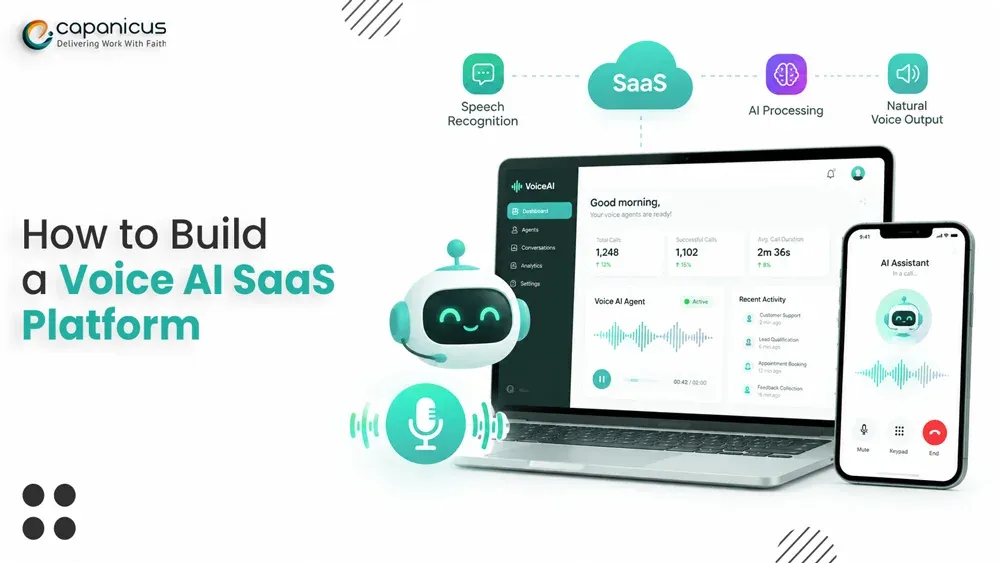
A text chatbot only has to understand words typed into a box. A voice platform has to listen, transcribe speech in real time, understand intent despite accents and background noise, generate a response, and speak that response back in a natural tone, all within a second or two. Every one of those steps introduces a place where latency, error, or awkward phrasing can break the experience. This is why voice AI platform development demands a different engineering mindset than building a website chatbot or a support ticketing tool. You are not just writing conversational logic; you are orchestrating a pipeline of speech recognition, language understanding, and speech synthesis that has to feel instant and human.
Core Components of an AI Voice Platform To Know in 2026
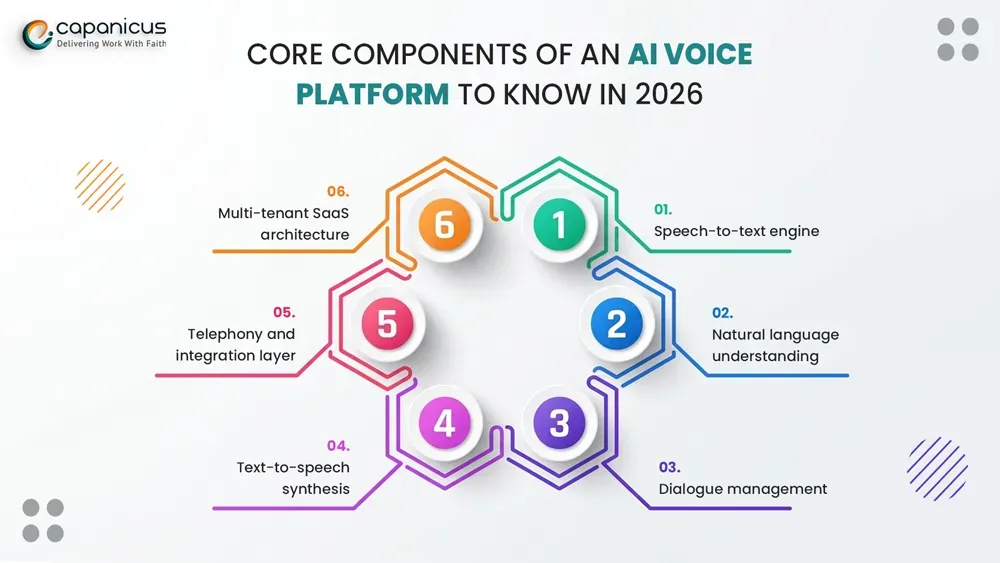
Before writing a single line of code, it helps to map out the building blocks that any AI voice platform needs.
Speech-to-text engine: This layer converts spoken audio into text your application can process. Accuracy here determines everything downstream, so most teams choose a proven provider rather than training a model from scratch.
Natural language understanding: Once you have text, the system needs to figure out what the caller actually wants. That means understanding the intent, pulling out the right entities, and keeping track of context as the conversation goes back and forth over multiple turns.
Dialogue management: This is where the real decision-making happens, whether that means pulling data from a CRM, escalating to a human, or asking a clarifying question.
Text-to-speech synthesis: The final response has to be converted back into audio that sounds like a person. And this matters more than people expect as voice quality directly affects how much users trust the platform.
Telephony and integration layer: For a platform handling real phone calls, you need infrastructure like SIP trunking or a service like Twilio to connect the AI to actual phone lines, along with APIs that plug into whatever business tools your customers already use..
Multi-tenant SaaS architecture: Since this is a platform meant to serve many customers, your data models, billing, and permissions all need to be built to handle multiple organizations securely right from the start.
Step-by-Step Process for Voice AI SaaS Platform Development
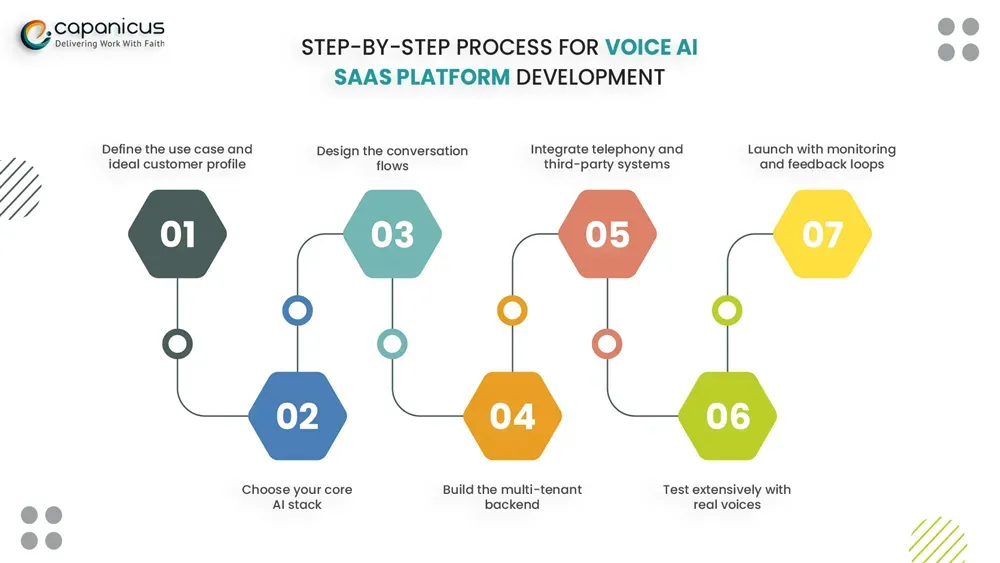
1. Define the use case and ideal customer profile
Voice AI software works best when it is scoped tightly. A platform built for appointment scheduling behaves very differently from one built for technical support triage. Decide who you are building for before you decide how.
2. Choose your core AI stack
You will need to select providers or models for speech recognition, language understanding, and voice synthesis. Most teams end up mixing and matching — using large language models for reasoning while bringing in specialized providers for transcription and voice output. There isn’t really a single vendor that does all of this well, so combining strengths tends to work better
3. Design the conversation flows
Define the paths callers usually adopt, along with what should happen when something unexpected comes up. Getting this right early on is what cuts down on those awkward silences and misunderstandings that make people give up on voice interfaces altogether
4. Build the multi-tenant backend
This is the piece that turns your product from a single bot into an actual SaaS platform. Account management, usage tracking, role-based access, billing are part of the foundation from the beginning. Trying to bolt on multi-tenancy after the fact tends to be a slow, costly mess.
5. Integrate telephony and third-party systems
This is where your platform actually connects with the phone networks themselves, along with CRMs, calendars, or support tools your customers are already using day to day. Honestly, this piece often ends up being the real deciding factor. It’s not the AI’s intelligence that determines whether someone sticks with your platform past the trial phase; it’s whether it fits smoothly into the tools they already depend on
6. Test extensively with real voices
Synthetic test data only tells you so much. It won’t show you how your system actually copes with different accents, mid-call interruptions, background noise, or a caller who suddenly changes their mind halfway through a sentence.
7. Launch with monitoring and feedback loops
Voice AI gets sharper the more real conversations it handles. That’s why analytics need to be part of the setup from day one, not an afterthought. They let you spot exactly where calls tend to break down, so you can keep tuning the models and flows even after the platform is live
As you follow the step-by-step development process, understanding how to build an AI voice agent: process, features, and trends will help you integrate modern features that users expect from a modern platform.
Choosing the Right Technology Stack
There is no single correct stack, but a few decisions matter more than others. For speech recognition and synthesis, you are choosing between managed APIs that get you to market quickly and open-source models that offer more control but require more engineering effort.
For the reasoning layer, most modern platforms lean on large language models, since they handle nuance and context far better than the rule-based systems used a few years ago. Cloud-native architecture with autoscaling is close to essential, since call volume for any AI voice agent SaaS can spike unpredictably and latency requirements leave little room for slow scaling.
Security and compliance also shape your stack early on. If your customers operate in healthcare, finance, or any regulated industry, your voice AI software needs to support call recording consent, data encryption, and regional data residency from the first release rather than as an afterthought.
Common Challenges Teams Run Into
Latency is the most persistent challenge. Every extra half second between a caller finishing a sentence and the AI responding feels unnatural, so engineering teams spend significant effort trimming milliseconds out of the pipeline. Handling interruptions gracefully is another hurdle, since real conversations are rarely as tidy as a scripted demo. Scaling multi-tenant infrastructure while keeping each customer’s data isolated adds further complexity, especially as usage grows. None of these challenges are unique to any one company, but they explain why so many teams choose to partner with an experienced voice AI development company rather than building every layer from zero.
Finally, Bringing It All Together
Voice AI SaaS platform development sits at the intersection of real-time engineering, conversational design, and scalable SaaS architecture. Getting all three right takes deep technical expertise and a fair amount of trial and error. Capanicus has spent years building complex telephony and communication platforms, and that background translates directly into helping businesses design, build, and scale AI Voice Agent without the usual missteps. Whether you are validating your first prototype or scaling an existing platform to handle enterprise call volumes, having a technical partner who has already solved these architecture problems can shorten your timeline considerably.
If you are exploring what a voice AI SaaS platform could look like for your business, Capanicus is ready to help you turn that idea into a working product.
Frequently Asked Questions
-
How long does it take to build a voice AI SaaS platform?
A basic working prototype can often be built in a few months, but a production-ready, multi-tenant platform with strong reliability usually takes six months to a year, depending on the complexity of the use case and integrations required.
-
Do I need to build my own speech recognition model?
Most teams don’t, and for good reason. Established speech-to-text and text-to-speech providers tend to be faster and more reliable than anything you’d build from scratch. That frees up your engineering effort for the parts that actually differentiate your platform — the conversation logic and integrations
-
What is the biggest technical risk in voice AI development?
Latency and natural conversation flow are usually the toughest problems to get right. A platform can be technically accurate and still fail with users if it’s slow or sounds robotic.
-
Can a voice AI SaaS platform integrate with existing business tools?
It can, and honestly, it should. The platforms that succeed are the ones that connect to CRMs, scheduling tools, and support systems, so the AI can actually take action during a call instead of just answering questions..