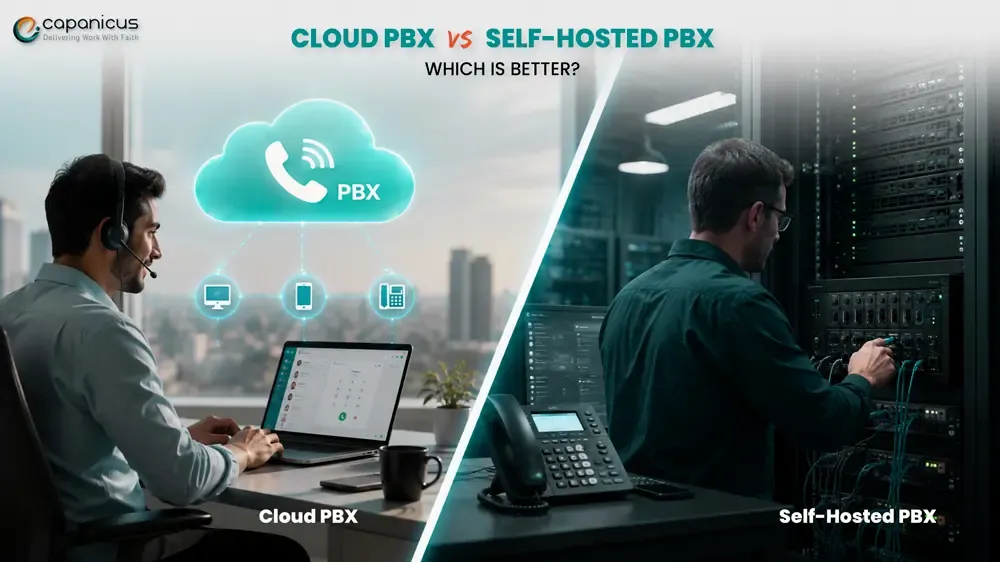
At some point, almost every growing business ends up staring at the same decision: stick with the phone system you’ve got, or move your whole call infrastructure to the cloud. It sounds like a simple upgrade question, but it’s really a question about control, cost, and how much risk you’re willing to carry yourself. It’s a tradeoff worth understanding properly before you touch anything, and this breakdown of IP PBX software development is a good starting point if you’re trying to figure out which side of this you actually belong on.
Here’s a stat worth sitting with before you decide anything: Cloud PBX adoption has reached 68% heading into 2026. That’s a big number, and it tells you where the market is heading. But it doesn’t tell you whether cloud is right for your business specifically, because the remaining businesses running on-premise or self-hosted systems aren’t behind the times. Many of them made that call on purpose.
So let’s break down what actually separates these two approaches, where each one wins, and how to think about the decision without just following the adoption curve.
What We Actually Mean by Cloud PBX and Self-Hosted PBX
Before comparing them, it helps to be precise about what each term covers, because “PBX” gets used loosely.
Cloud PBX
A cloud PBX (sometimes called hosted PBX) runs on infrastructure owned and maintained by a provider, not by you. Your calls route through their servers, your phones or softphones connect over the internet using SIP, and you manage everything, extensions, call routing, IVR menus, through a web dashboard. You’re renting the system as a service, usually on a per-seat monthly basis.
Self-Hosted PBX
A self-hosted PBX runs on hardware or virtual machines that you own and control, typically built on platforms like Asterisk or FreePBX. You, or a development partner, handle installation, configuration, patching, uptime, and scaling. In 2026, most self-hosted setups are virtualized on VMware or Hyper-V rather than sitting on a dedicated physical box in a closet, but the core idea hasn’t changed: the system lives inside your infrastructure, not someone else’s.
Cloud PBX Solutions: What You Actually Get
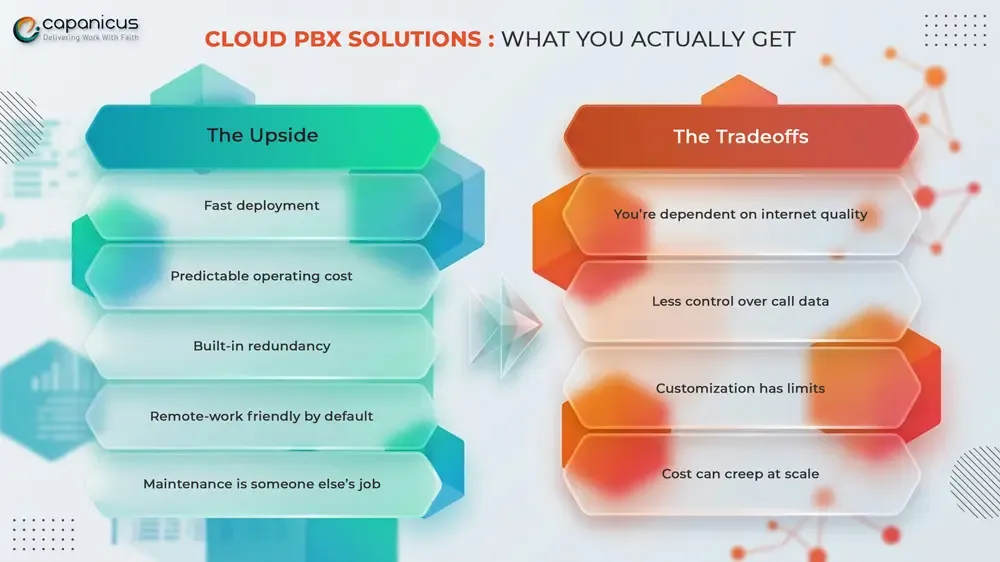
The Upside
- Fast deployment. You can have a working phone system in days, not months, since there’s no hardware procurement or server buildout involved.
- Predictable operating cost. A per-seat monthly fee, typically $15 to $35 per seat, replaces capital expenditure, which is easier to budget and easier to scale up or down as headcount changes.
- Built-in redundancy. Reputable providers run geographically distributed infrastructure, so a single data center issue doesn’t take your phones down.
- Remote-work friendly by default. Since everything routes over the internet, a distributed team can be on the same phone system whether they’re in the office, at home, or traveling.
- Maintenance is someone else’s job. Patching, uptime monitoring, and infrastructure scaling are handled by the provider, not your internal team.
The Tradeoffs
- You’re dependent on internet quality. Poor bandwidth or an ISP outage can directly translate into dropped calls or degraded voice quality, since there’s no local fallback.
- Less control over call data. Your call data lives on someone else’s servers, which can complicate compliance conversations in regulated industries.
- Customization has limits. You’re working within what the platform’s dashboard and API allow, which is usually plenty for standard use cases but can get restrictive for specialized workflows.
- Cost can creep at scale. Per-seat pricing that looks cheap at 20 users can add up meaningfully at 300+ seats over a multi-year horizon.
Self-Hosted PBX: What You Actually Get
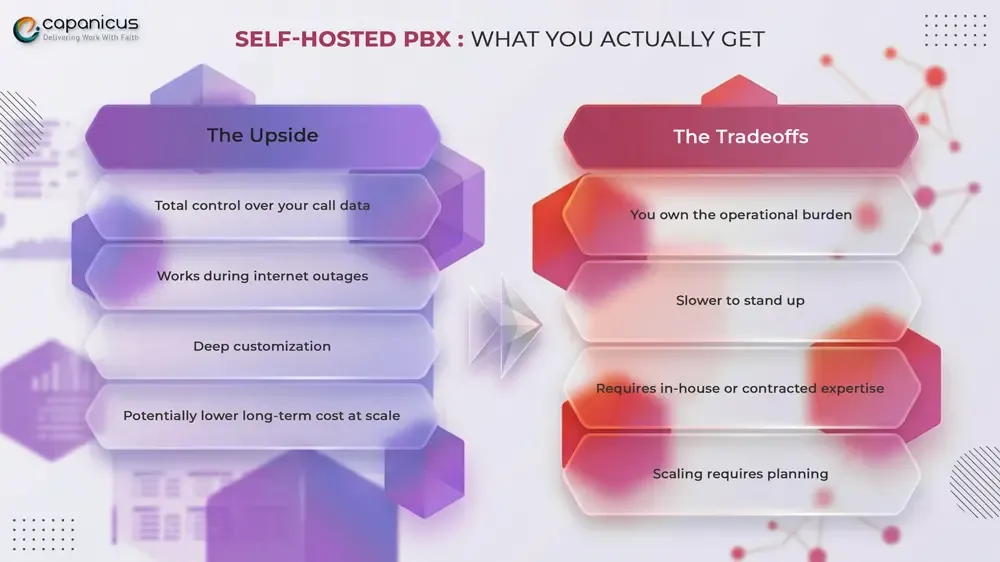
The Upside
- Total control over your call data. Nothing leaves your network unless you explicitly route it out, which matters a lot for healthcare, legal, government, and finance.
- Works during internet outages. Internal calling keeps functioning even if your internet connection drops, since the switching logic lives on your own infrastructure.
- Deep customization. You can build exactly the dialplan, integration, and routing logic your business needs, without waiting on a vendor’s roadmap.
- Potentially lower long-term cost at scale. For large, stable deployments, 150+ seats over a 7 to 10 year lifecycle, the one-time capital investment can work out cheaper than an ongoing per-seat subscription.
The Tradeoffs
- You own the operational burden. Uptime, security patching, and scaling are your team’s responsibility, or your development partner’s, not a vendor’s.
- Slower to stand up. Server provisioning, configuration, and testing take real time before the system is production-ready.
- Requires in-house or contracted expertise. Asterisk and FreePBX are powerful, but they’re not plug-and-play. Someone needs to actually know the platform.
- Scaling requires planning. Adding capacity means provisioning more infrastructure yourself, not just clicking “add seat” in a dashboard
Cloud PBX Software vs Self-Hosted: The Real Decision Factors
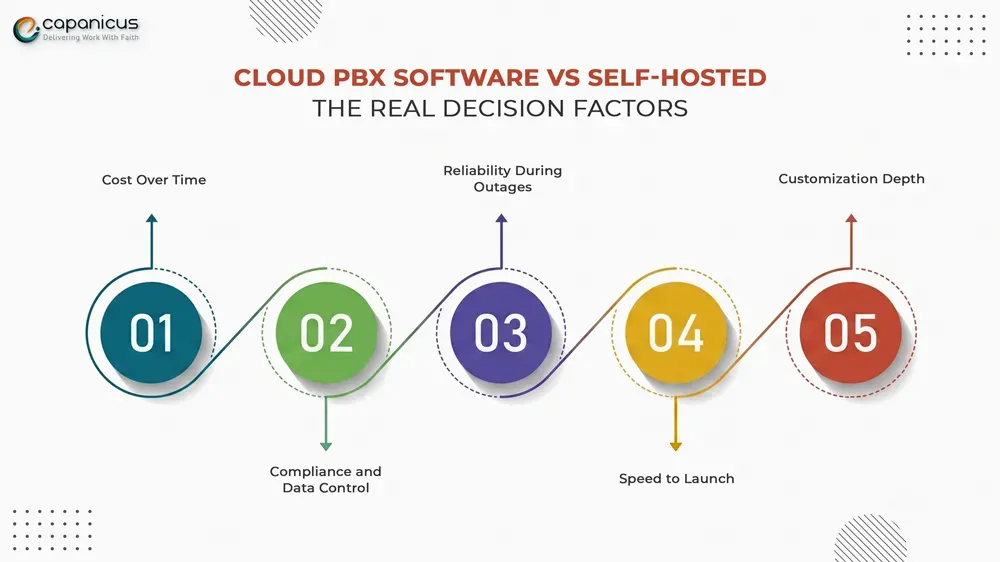
Cost Over Time
For most businesses under 50 seats, cloud PBX tends to be cheaper across a five-year horizon once you account for hardware, IT overhead, and maintenance. Past roughly 150 seats with stable headcount, self-hosted infrastructure can break even or come out ahead, because you stop paying a recurring per-seat premium on a system that isn’t changing size much.
Compliance and Data Control
If you’re in a regulated industry and someone might reasonably ask “where does our call data actually live,” self-hosted gives you a much simpler answer. That’s a major reason healthcare, government, and finance organizations lean toward self-hosted or on-premise setups even as the broader market shifts to cloud.
Reliability During Outages
Cloud PBX depends entirely on your internet connection. If that connection goes down, so does your phone system, unless you’ve built in failover. Self-hosted systems keep internal calling alive even during an outage, which matters if your business genuinely cannot afford dead phone lines for any stretch of time.
Speed to Launch
If you need a working system now, cloud wins clearly. Self-hosted deployments take longer to plan, provision, and test properly, even with an experienced team behind them.
Customization Depth
If your call flows are simple, cloud PBX software will almost certainly cover it. If you need highly specific routing logic, unusual integrations, or workflows that don’t map cleanly to a standard dashboard, self-hosted gives you room to build exactly what you need.
So Which One Should You Actually Pick?
A rough way to think about it:
- Choose cloud PBX if you’re a small to mid-sized business, your team is distributed or remote, you want predictable monthly costs, and you don’t have in-house telephony expertise to manage infrastructure.
- Choose self-hosted PBX if you’re a larger, stable organization, you operate in a regulated industry with strict data control requirements, you need deep customization, or you already have the technical team to manage it.
- Consider a hybrid approach if you want the reliability of local infrastructure with the flexibility of cloud features. This is increasingly common, and it’s usually built through custom PBX development rather than an off-the-shelf product.
Cloud PBX Development That Fits How We Actually Work
This is really where the decision stops being theoretical. Off-the-shelf cloud PBX platforms are built for the average business, and self-hosted platforms like Asterisk and FreePBX are powerful but require real engineering to configure properly. At Capanicus, we work across both sides of this, building custom Cloud PBX Development, Asterisk and FreeSwitch systems, and SIP Platform infrastructure depending on what actually fits a client’s operational needs, rather than pushing every business toward the same architecture.
That distinction matters because a lot of PBX vendors only offer one flavor of solution and then make the case for why it fits everyone. Because we’re comfortable building both cloud-hosted and self-hosted systems, we can actually evaluate your call volume, compliance requirements, and growth plans, and recommend the architecture that fits, instead of the one we happen to sell.
The Bottom Line
There’s no universal right answer between cloud PBX and self-hosted PBX. The market is trending toward cloud, and for good reason: it’s faster to deploy, easier to scale, and removes a maintenance burden most businesses don’t want to carry. But self-hosted still wins decisively in scenarios where data control, offline reliability, or deep customization matter more than convenience.
The right move isn’t picking whichever option is more popular this year. It’s matching the architecture to your actual call volume, compliance obligations, growth trajectory, and internal technical capacity, then building or buying accordingly.