Every founder or product team that decides to build a video calling application eventually asks the same question, and it’s rarely simple to answer with a single figure. Development cost depends on far more variables than most cost calculators or agency landing pages let on, and treating it as a fixed number is one of the fastest ways to end up with a budget that runs out halfway through a build. Anyone serious about this decision should look closely at what actually goes into video conferencing app development, because the real cost structure sits several layers beneath the surface-level pricing most quotes present upfront.
According to Fortune Business Insights, the global video conferencing market is projected to grow from USD 20.32 billion in 2026 to USD 37.45 billion by 2034, expanding at a compound annual growth rate of 7.9 percent, a projection detailed in the firm’s Video Conferencing Market research report. That growth is being driven by enterprise demand across healthcare, education, and remote collaboration, and it means more businesses than ever are weighing whether to build a proprietary video calling application rather than license an existing platform. Before making that decision, it’s worth understanding exactly where the money in a video calling app build actually goes.
This breakdown covers the real cost drivers behind video call app development, the technical decisions that move the number significantly in either direction, and what separates a realistic budget from an underestimated one.
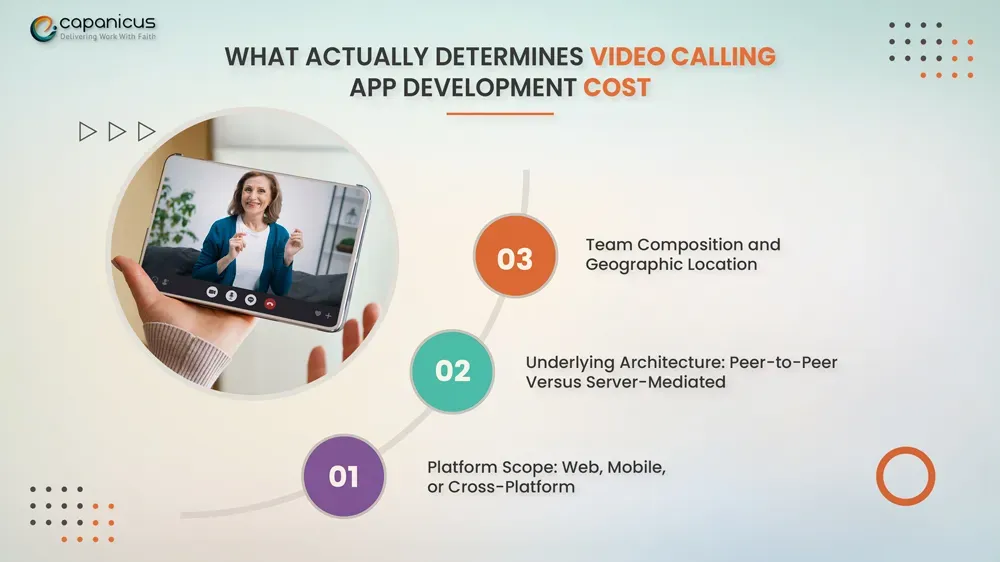
What Actually Determines Video Calling App Development Cost
Cost estimates for video calling applications vary wildly across the industry, often ranging anywhere from $15,000 for a barebones minimum viable product to well over $250,000 for an enterprise-grade platform with custom infrastructure. That range exists because video calling apps aren’t a single category of product. A two-person consumer video chat app and a 500-participant enterprise webinar platform share a name but almost nothing else in terms of engineering complexity.
A handful of structural decisions account for most of that variance before a single feature gets discussed.
Platform Scope: Web, Mobile, or Cross-Platform
Building for a single platform, say Android only, costs meaningfully less than building native applications for iOS and Android simultaneously, and cross-platform frameworks introduce their own tradeoffs between development speed and native performance. A web-based application built on WebRTC can reach users without any app store dependency at all, which is often the fastest and least expensive path to a working product, though it sacrifices some of the deeper device integration native apps allow.
Underlying Architecture: Peer-to-Peer Versus Server-Mediated
A basic one-to-one video calling feature built on direct peer-to-peer connections is comparatively inexpensive to develop. The moment a product needs group calls beyond a handful of participants, it requires server-mediated media routing through infrastructure like a Selective Forwarding Unit, and that infrastructure carries both upfront engineering cost and ongoing operational cost that a peer-to-peer app never touches.
Team Composition and Geographic Location
Development cost is also a function of who’s building it. Hourly rates for experienced WebRTC and real-time communication engineers vary substantially by region, and teams with genuine background in real-time media infrastructure typically charge more than general mobile or web development teams, for the straightforward reason that this is a specialized skill set with a smaller talent pool than general application development.
Video Calling App Development Cost by Feature Complexity
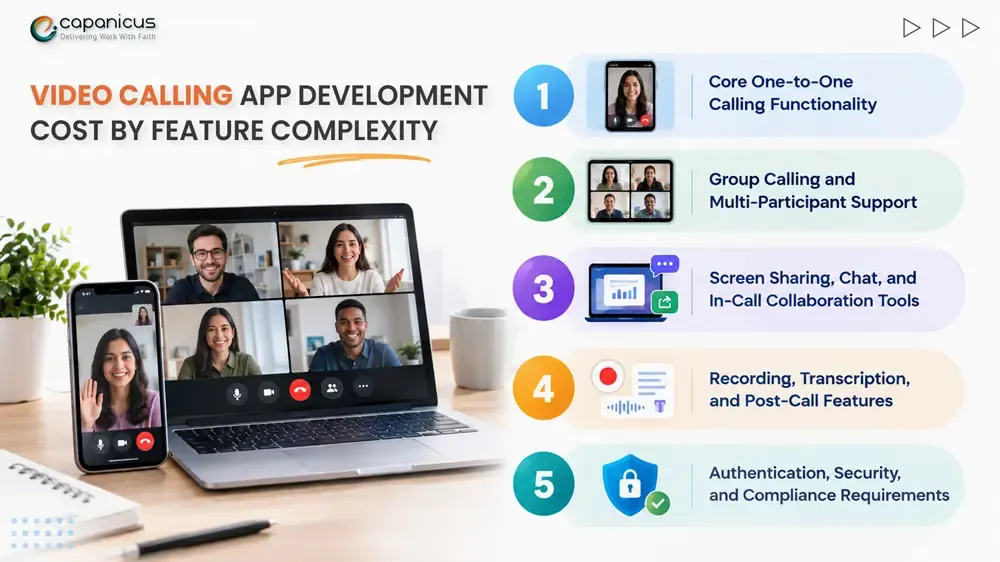
Rather than treating cost as one number, it’s more useful to break it down feature by feature, because that’s genuinely how a budget gets built in practice, one decision at a time, not as a single lump sum handed down from a spreadsheet.
Core One-to-One Calling Functionality
Basic one-to-one calling is the cheapest layer, and honestly the easiest to get right. Call initiation, connection handling, a working UI, nothing fancy. You’re looking at somewhere between $10,000 and $25,000 depending on how many platforms you’re targeting. Everything else in the app gets built on top of this, so it’s worth getting solid before adding complexity.
Group Calling and Multi-Participant Support
This is where the price jumps, and it’s not a small jump. The moment you need more than two or three people on a call, you’re no longer dealing with a simple connection between two devices. You need an SFU-based media server, or something more sophisticated if you’re expecting large groups, and that infrastructure isn’t cheap to build or run. Expect this to add anywhere from $20,000 to $60,000, depending on your target participant count and whether you’re building your own media server or leaning on a managed service instead.
Screen Sharing, Chat, and In-Call Collaboration Tools
Screen sharing, in-call chat, whiteboards, file sharing, these have basically become table stakes for any serious video conferencing application development project. Users expect them now. Each one typically runs $5,000 to $15,000 depending on how deep you want to go, and screen sharing specifically needs careful handling so it doesn’t choke the bandwidth your main video stream is using.
Recording, Transcription, and Post-Call Features
Recording sits on its own separate track technically, since it means capturing, encoding, and storing a stream rather than just forwarding it live. Layer AI transcription or meeting summaries on top of that and you’re pulling in a speech-to-text or LLM service, which adds its own cost. This whole feature set tends to land somewhere between $15,000 and $40,000.
Authentication, Security, and Compliance Requirements
This is the piece people most often try to skip early and regret later. If you’re building for healthcare, finance, or enterprise clients, you’re not optional on end-to-end encryption, HIPAA-aligned data handling, role-based access, secure meeting links. Doing this properly from day one is almost always cheaper than retrofitting it after launch, once you’ve already got real user data flowing through the system.
Infrastructure Costs That Continue Long After Launch
Here’s where a lot of teams get caught off guard. They budget for the build, celebrate the launch, and then get blindsided a few months in by infrastructure costs that keep climbing right alongside their user growth.
SFU media routing servers scale with concurrent call minutes, so the better your app does, the bigger that bill gets. It’s not a fixed monthly line item you can just forget about. TURN relay servers are another one people underestimate. Something like fifteen to twenty percent of real-world connections can’t establish a direct peer connection and need to be relayed through a TURN server instead, and every one of those relayed minutes costs bandwidth, which costs money. Then there’s storage. Recorded sessions pile up over time, especially if you’re in a compliance-heavy industry required to hang onto recordings for years.
Any credible video calling app development company should sit down with you and actually walk through what infrastructure will cost at realistic usage volumes, not just quote you the build price and leave the rest for you to discover later. That second number, the ongoing one, is often what decides whether the product is actually sustainable once real users show up.
Build Versus Buy: When Custom Development Actually Makes Sense
Not every business needs a fully custom video calling application, and it’s worth being straight about that instead of pushing custom development on everyone who walks in the door.
If video is a nice-to-have feature bolted onto a product that’s really about something else, licensing an existing video API is usually faster and cheaper, and that’s fine, there’s no shame in it. Where custom video calling application development actually starts to pay off is when video is the core of what you’re building, when you need control over your own infrastructure for compliance or data residency reasons, when you want features nobody’s SDK offers off the shelf, or when your call volume is going to get big enough that per-minute licensing fees start looking expensive compared to just owning the infrastructure yourself. That crossover point moves depending on the situation, but for products expecting heavy sustained usage, owning your own infrastructure often ends up cheaper within twelve to twenty-four months compared to paying per-minute fees indefinitely.
Choosing a Video Calling App Development Company Without Overpaying or Underbuilding
Selecting the right development partner has as much impact on final cost as any individual feature decision. A team without genuine WebRTC and real-time infrastructure experience will often underestimate the complexity of group calling, NAT traversal, and scaling, leading to costly rework mid-project once those gaps surface in production. Conversely, an agency that overengineers a simple use case with enterprise-grade infrastructure a client doesn’t yet need can inflate a budget unnecessarily for a product still validating demand.
The most reliable approach is working with a team that scopes infrastructure to actual expected usage, is transparent about the split between one-time development cost and ongoing infrastructure spend, and has direct, verifiable experience building the specific class of video calling application in question, whether that’s a lightweight consumer app or an enterprise conferencing platform with compliance requirements.
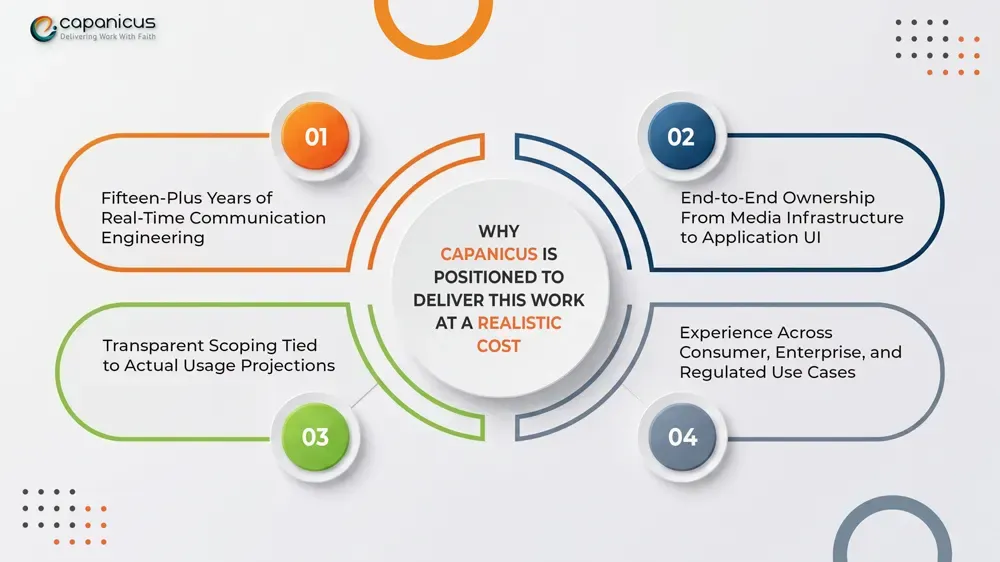
Why Capanicus Is Positioned to Deliver This Work at a Realistic Cost
Video calling application development sits squarely within the kind of infrastructure work we specialize in at Capanicus, and it’s worth explaining how our approach affects both the quality and the actual cost realism of a project.
Fifteen-Plus Years of Real-Time Communication Engineering
Our team has spent over fifteen years building VoIP, WebRTC, and real-time communication systems across telecom, healthcare, and enterprise clients, which means we’re not learning media server architecture on a client’s budget. That experience directly translates into more accurate upfront cost estimates, since we’ve already encountered the scaling and NAT traversal issues that catch inexperienced teams off guard mid-project.
End-to-End Ownership From Media Infrastructure to Application UI
We build the full stack ourselves, from SFU media server deployment and TURN infrastructure through the application layer end users actually interact with, rather than subcontracting the real-time communication layer to a third party. This reduces integration risk and gives clients a single accountable team across the entire cost structure of the project, rather than a fragmented budget split across multiple vendors.
Transparent Scoping Tied to Actual Usage Projections
Rather than quoting a flat number disconnected from how a product will actually be used, we scope both development cost and projected infrastructure spend around a client’s realistic user and call volume targets, so budgeting decisions are grounded in expected usage rather than guesswork that surfaces as a surprise months after launch.
Experience Across Consumer, Enterprise, and Regulated Use Cases
We’ve delivered video conferencing applications for telemedicine platforms requiring compliance-grade security, e-learning platforms supporting virtual classrooms, and general-purpose collaboration tools, giving us direct pricing context across very different complexity tiers rather than a single template applied to every client regardless of fit.
Conclusion: Budgeting for a Video Calling App Means Budgeting for the Whole Lifecycle
Video calling app development cost in 2026 isn’t a single number so much as a set of layered decisions: platform scope, architecture, feature depth, compliance requirements, and the ongoing infrastructure spend that continues well after launch. Teams that budget only for the initial build, without accounting for scaling infrastructure and long-term operational cost, consistently underestimate what a successful product actually requires to sustain.
Getting this right means working with a team that understands both the engineering and the economics of real-time video infrastructure well enough to give an honest number rather than an optimistic one. If you’re evaluating a build for your own product, our team’s work in video calling application development covers exactly this kind of project end to end, from initial architecture and cost planning through launch and the infrastructure that keeps it running reliably at scale.